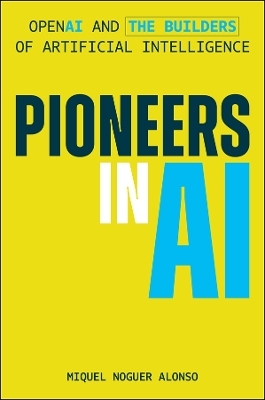
Pioneers in AI
John Wiley & Sons Inc (Verlag)
978-1-394-38169-2 (ISBN)
- Noch nicht erschienen (ca. Juni 2026)
- Versandkostenfrei
- Auch auf Rechnung
- Artikel merken
In Pioneers in AI: OpenAI and the Builders of Artifical Intlligence, Miquel Noguer, founder of the Artificial Intelligence Finance Institute, delivers an eye-opening discussion on OpenAI. A trailblazing company building the future of AI, Noguer details its journey and innovation via a compelling narratove, examining both its successes and failures, and providing readers with crucial insights into the future of transformatiive AI and its impact on society.
The book offers a collection of human stories and deep technical dives on the people and products that make up OpenAI. Readers will learn about the company’s origins, the challenges they faced and overcame, the products and services they created, and the dreams that drive OpenAI as its leaders chart a path into an exciting future. Pioneers in AI provides critical insights for future attempts to align powerful AI systems with human values.
Inside the book:
Detailed discussions of the technical milestones reached by OpenAI as revealed in academic papers, industry reports, and product announcements
Biographies of key figures in the company, with a focus on how their backgrounds, professional trajectories, and philosophical orientations shaped OpenAI
Explorations of the societal and cultural impact of AI technologies created by OpenAI and its leaders
Perfect for researchers, practitioners, policymakers, and more, Pioneers in AI is a must read that offers a comprehensive, factual, and analytically grounded account of OpenAI’s evolution and impact.
Preface
1 OpenAI: The Paradox of Purpose and Profit in the Race to Artificial General Intelligence
1.1 Introduction
1.2 Genesis and Early Vision (2015–2018)
1.2.1 The Founding Coalition
1.2.2 The Open Philosophy
1.2.3 Early Technical Achievements
1.2.4 The Financial Reality Check
1.3 The Pivot to “Capped-Profit” (2019)
1.3.1 Structural Innovation
1.3.2 The Microsoft Partnership
1.4 The ChatGPT Phenomenon and Hypergrowth (2020–2023)
1.4.1 Technical Breakthroughs
1.4.2 Business Model Evolution
1.4.3 Cultural Transformation
1.5 The November 2023 Crisis: When Structure Meets Reality
1.5.1 The Coup
1.5.2 The Revolt
1.5.3 The Capitulation
1.6 Technical Strategy and the Path to AGI
1.6.1 The Scaling Hypothesis
1.6.2 Safety and Alignment Challenges
1.7 Corporate Structure Evolution and Current Challenges
1.7.1 The Public Benefit Corporation Transition
1.7.2 Competitive Landscape and Strategic Pressures
1.7.3 Legal and Regulatory Challenges
1.8 Analysis: The Fundamental Tensions
1.8.1 Mission vs. Market
1.8.2 Governance Innovation and Failure
1.8.3 The AGI Paradox
1.9 Future Scenarios and Strategic Options
1.9.1 Scenario 1: The Microsoft Integration Path
1.9.2 Scenario 2: The AGI Breakthrough
1.9.3 Scenario 3: The Commoditization Challenge
1.10 Lessons for AI Governance
1.10.1 Structural Design Principles
1.10.2 Policy Implications
1.11 Conclusion
2 Samuel Altman: A Technological Visionary
2.1 Prologue: Between Acceleration and Caution
2.2 Early Influences: Privilege and Precocity
2.3 Stanford and the Mythology of the Dropout
2.4 Loopt: Ambition, Timing, and the Reality of Startup Failure
2.5 Y Combinator: Scaling Ambition and Institutional Power
2.5.1 Scaling the Core Program
2.5.2 The Continuity Fund and Conflicts
2.5.3 YC Research and Moonshot Ambitions
2.5.4 The Troubled Transition
2.6 OpenAI: Idealistic Origins and Pragmatic Compromises
2.6.1 The Pivot to "Capped-Profit"
2.6.2 The Microsoft Partnership
2.6.3 ChatGPT and the Acceleration of Everything
2.7 The November Crisis: Governance Unraveled
2.7.1 The Timeline of Crisis
2.7.2 Communication and Transparency Breakdowns
2.7.3 The OpenAI Startup Fund Controversy
2.7.4 Power Dynamics and Governance Reality
2.7.5 The Aftermath and New Governance Structure
2.8 The Broader Investment Ecosystem
2.9 Investment Activities and Persistent Conflict Questions
2.9.1 The Energy Bet: Helion and Fusion
2.9.2 The Identity Problem: Worldcoin
2.9.3 The Longevity Play: Retro Biosciences
2.9.4 The Hardware Ecosystem
2.10 Philosophical Contradictions and Critical Perspectives
2.10.1 The Regulation Paradox
2.10.2 The "Effective Accelerationism" Connection
2.10.3 The Utopian Vision vs. Practical Realities
2.10.4 The Democracy and Centralization Tension
2.11 Leadership Style and Organizational Culture
2.11.1 The Networker-in-Chief
2.11.2 Managing Through Ambiguity
2.11.3 The Reality Distortion Field
2.12 The Media Narrative and Public Perception
2.13 Global Impact and Geopolitical Dimensions
2.13.1 The US-China AI Competition
2.13.2 International Governance Initiatives
2.13.3 The Global South and AI Colonialism
2.14 Future Trajectories and Unresolved Questions
2.14.1 The AGI Timeline
2.14.2 Governance Evolution
2.14.3 Personal Wealth and Power
2.15 Conclusion: The Unresolved Legacy
3 The Architects of Intelligence: Biographies of Key Figures
3.1 Sam Altman: The Visionary and Statesman
3.1.1 Y Combinator Leadership and Philosophy
3.1.2 Early AI Involvement and Philosophical Development
3.1.3 The CEO’s Dilemma: Mission vs. Market
3.1.4 Regulatory Engagement and Global Influence
3.2 Greg Brockman: The Builder and Engineer
3.2.1 The Stripe Years: Scaling Payment Infrastructure
3.2.2 Technical Leadership at OpenAI
3.2.3 The Philosophy of Iterative Deployment
3.2.4 Leadership Crisis and Loyalty
3.3 Ilya Sutskever: The Scientist and Safety Proponent
3.3.1 The Deep Learning Revolution
3.3.2 The Sequence-to-Sequence Breakthrough
3.3.3 Founding OpenAI and Early Research Leadership
3.3.4 Growing Concerns About AI Safety
3.3.5 The Board Crisis and Departure
3.4 Mira Murati: The Product Leader and Technologist
3.4.1 Early Career and Technical Foundation
3.4.2 Rise to Leadership at OpenAI
3.4.3 Leading Product Development
3.4.4 Safety and Responsible Deployment
3.4.5 Leadership During Crisis
3.4.6 Departure and New Ventures
3.5 Elon Musk: The Visionary Founder and Departed Co-Creator
3.5.1 Early Entrepreneurial Success
3.5.2 Building Transportation and Space Companies
3.5.3 AI Concerns and OpenAI’s Founding
3.5.4 The Rosewood Hotel Meeting and OpenAI’s Birth
3.5.5 Growing Tensions and Philosophical Differences
3.5.6 Departure and Ongoing Criticism
3.5.7 Alternative AI Ventures
3.6 Jan Leike: The Safety Researcher and Alignment Expert
3.6.1 Academic Background and Early Research
3.6.2 DeepMind Years: Advancing Safety Research
3.6.3 Joining OpenAI and the Superalignment Mission
3.6.4 Growing Concerns and Internal Tensions
3.6.5 Public Advocacy and Communication
3.6.6 Departure and Continuing Mission
3.7 Supporting Cast: Other Influential Figures
3.7.1 Dario Amodei: The Safety-Focused Researcher
3.7.2 Alec Radford: The Technical Innovator
3.7.3 Wojciech Zaremba: The Robotics and Reasoning Expert
3.7.4 Rewon Child: The Architecture Researcher
3.8 Organizational Dynamics and Leadership Philosophy
3.8.1 The Tension Between Mission and Market
3.8.2 The Challenge of Technical Leadership
3.8.3 Safety Research and Organizational Priorities
3.8.4 The Role of Public Engagement
3.9 Legacy and Future Implications
3.9.1 Lessons for AI Governance
3.9.2 The Future of AI Leadership
3.9.3 Implications for AI Safety Research
3.10 Conclusion: The Human Element in AI Development
4 The AI Competitive Landscape
4.1 Introduction: The Arena of Artificial Intelligence
4.2 Anthropic: The Safety-First Alternative
4.2.1 Origins and Founding Philosophy
4.2.2 Technical Approach: Constitutional AI
4.2.3 The Claude Model Family
4.2.4 Business Model and Market Position
4.2.5 Talent Strategy and Culture
4.3 Google DeepMind: The Incumbent Powerhouse
4.3.1 Historical Foundation and Evolution
4.3.2 The Gemini Model Family
4.3.3 Integration Advantages and Ecosystem Lock-in
4.3.4 Research Depth and Innovation Pipeline
4.3.5 Challenges and Vulnerabilities
4.4 Meta: The Open Source Disruptor
4.4.1 Strategic Pivot to Open Source
4.4.2 Technical Achievements and Innovations
4.4.3 The Developer Ecosystem Advantage
4.4.4 Platform Integration and Metaverse Ambitions
4.4.5 Challenges and Criticisms
4.5 Microsoft: The Infrastructure Giant
4.5.1 Azure AI and the Cloud Advantage
4.5.2 The Copilot Strategy
4.5.3 Independent Model Development
4.6 Amazon: The Quiet Giant
4.6.1 AWS and the Infrastructure Play
4.6.2 Alexa and Consumer AI
4.7 Chinese Competitors: The Eastern Challenge
4.7.1 Baidu: The Search Giant’s AI Transformation
4.7.2 Alibaba: Cloud and Commerce AI
4.7.3 ByteDance: The Social Media AI Pioneer
4.7.4 Emerging Players and Government Initiatives
4.8 Emerging Challengers and Specialized Players
4.8.1 Mistral AI: The European Challenger
4.8.2 Cohere: The Enterprise Specialist
4.8.3 Inflection AI: The Personal AI Vision
4.8.4 Stability AI: The Open Creative Revolution
4.8.5 xAI: Musk’s Alternative Vision
4.9 The Talent War: Competition for Human Capital
4.9.1 Compensation Arms Race
4.9.2 The Role of Compute Access
4.9.3 Geographic Distribution and Remote Work
4.10 Strategic Implications and Future Scenarios
4.10.1 Consolidation Scenario
4.10.2 Fragmentation Scenario
4.10.3 Geopolitical Bifurcation
4.10.4 Open Source Triumph
4.11 Conclusion: Navigating the Competitive Landscape
5 The Technology Stack: Models, Architectures, and Mathematics
5.1 The Product Ecosystem: From Language to Vision and Video
5.1.1 The GPT Series: Evolution of Language Understanding
5.1.2 The "o" Series: Specialized Reasoning Models
5.1.3 GPT-5: The Modular Intelligence Breakthrough (2025)
5.1.4 DALL-E: The Evolution of Text-to-Image Generation
5.1.5 Sora: Video Generation and World Simulation
5.2 The Transformer Architecture: Deconstructing "Attention Is All You Need"
5.2.1 Historical Context and Motivation
5.2.2 Core Transformer Architecture
5.2.3 The Self-Attention Mechanism: Mathematical Foundation
5.2.4 Training Dynamics and Optimization
5.3 Word Embeddings and Semantic Representation
5.3.1 From Discrete Symbols to Continuous Vectors
5.3.2 Transformer Embeddings and Positional Encoding
5.4 Advanced Training Techniques and Fine-tuning
5.4.1 Pre-training: Learning Language Patterns
5.4.2 Reinforcement Learning from Human Feedback (RLHF)
5.4.3 Specialized Fine-tuning Techniques
5.5 Mathematical Foundations and Theoretical Understanding
5.5.1 Information Theory and Compression
5.5.2 Optimization Landscapes and Training Dynamics
5.5.3 Theoretical Limits and Scaling Laws
5.6 Safety, Alignment, and Robustness
5.6.1 Alignment Problem Formalization
5.6.2 Technical Safety Mechanisms
5.6.3 Emerging Capabilities and Risks
5.7 Future Directions and Research Frontiers
5.7.1 Architectural Innovations
5.7.2 Training Methodology Advances
5.7.3 Multimodal Integration
5.7.4 Interpretability and Control
5.8 Computational Infrastructure and Scaling
5.8.1 Hardware Acceleration
5.8.2 Distributed Training Systems
5.8.3 Deployment and Inference Optimization
6 The Regulatory and Ethical Gauntlet
6.1 The Washington Nexus: Testimony, Regulation, and Competition
6.1.1 Resistance to Specific Regulations
6.2 The Copyright Crusade: The New York Times, Ziff Davis, and the
“Fair Use” Defense
6.2.1 The Fair Use Defense
6.2.2 The Black Box Problem
6.3 The Alignment Dilemma: The Science of AI Safety
6.3.1 Critical Safety Areas
6.4 The Bias in the Machine: Data, Fairness, and Mitigation
6.4.1 Mitigation Efforts and Controversies
6.5 Data and Privacy: The Enterprise-Consumer Divide
6.5.1 Enterprise Privacy Commitments
6.5.2 Consumer Data Usage
7 Industry Impact and Future Outlook
7.1 Sectoral Transformation: Case Studies in Healthcare and Education
7.1.1 Healthcare Applications
7.1.2 Educational Innovation
7.2 The Path to AGI: Synthesizing the Roadmap
7.2.1 Model Unification Strategy
7.2.2 Democratization and Market Strategy
8 Sam Altman’s 2025 Vision for AI: An Analysis of Accelerating Progress and Societal Transformation
8.1 Executive Summary
8.2 Introduction: Sam Altman’s 2025 Vision for AI – A Pivotal Year
8.3 Sam Altman’s 2025 Vision: Insights by Source
8.3.1 From Sam Altman’s Blog Post: “Three Observations”
8.3.2 From the TED 2025 Interview with Chris Anderson
8.3.3 From the Vanderbilt Summit on Modern Conflict and Emerging Threats
8.3.4 From the Snowflake Summit 2025
8.3.5 From The Neuron.ai Article (Summarizing June 2025 AI State)
8.3.6 From the IAPP’s Global Summit
8.3.7 From The Cyber Express Article
8.3.8 From the TIME Article
8.3.9 From AINIRO.IO Article (on Singularity Tweet)
8.3.10 From YouTube Interview Summaries
8.3.11 From Search Engine Journal Article (Y Combinator Interview)
8.3.12 From Capitaly.vc Blog (Lessons from Loopt)
8.4 Conclusion: Shaping Humanity’s AI-Powered Future
9 Concluding Analysis: Balancing Innovation, Responsibility, and Profit
9.1 Achievements and Impact
9.2 Fundamental Contradictions and Challenges
9.3 Future Prospects and Critical Dependencies
9.4 Governance Models for Transformative AI
9.5 Global Regulatory Divergence
9.6 Societal Implications: Labor, Inequality, and Power
9.7 Long-Term Futures: AGI Scenarios
9.8 Concluding Reflections
Index
| Erscheint lt. Verlag | 16.6.2026 |
|---|---|
| Verlagsort | New York |
| Sprache | englisch |
| Themenwelt | Informatik ► Theorie / Studium ► Künstliche Intelligenz / Robotik |
| Wirtschaft ► Betriebswirtschaft / Management ► Unternehmensführung / Management | |
| ISBN-10 | 1-394-38169-7 / 1394381697 |
| ISBN-13 | 978-1-394-38169-2 / 9781394381692 |
| Zustand | Neuware |
| Informationen gemäß Produktsicherheitsverordnung (GPSR) | |
| Haben Sie eine Frage zum Produkt? |
aus dem Bereich