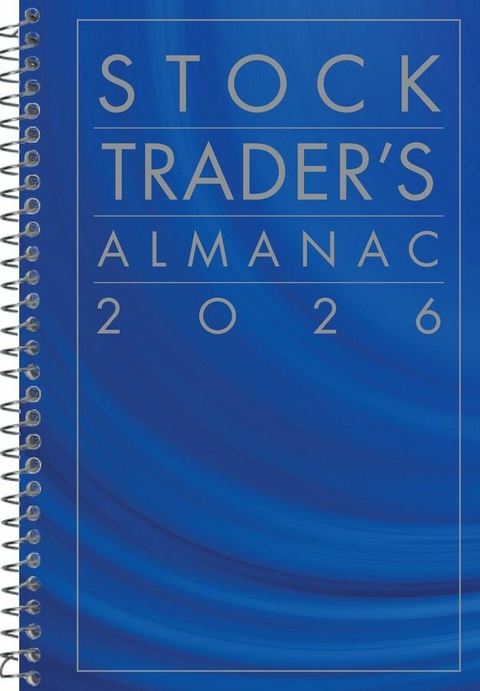
Stock Trader's Almanac 2026 (eBook)
447 Seiten
Wiley (Verlag)
9781394362707 (ISBN)
The 59th Annual Edition of the leading desk reference on US stock market trends, seasonal patterns, and cycles
In Stock Trader's Almanac 2026, veteran trader and market strategist Jeffrey Hirsch offers an up-to-date and effective guide through the complexities of the United States stock market. It catalogues the historical cycles, trends, and seasonal patterns that you need to understand to make sound investment decisions.
This is the 59th Annual Edition of the Almanac, thoroughly updated and revised to ensure it retains its place as the preeminent, hands-on guide for US stock traders. It's organized in an accessible calendar format, demonstrating the proven, proprietary strategies - based on decades of carefully collected data - like the 'January Barometer,' the 'Santa Claus Rally,' the 'Best Six Months,' and the four-year 'Presidential Election Cycle.'
Stock Trader's Almanac 2026 remains the most profitable and valuable trading reference on Wall Street. It includes:
- Explanations of how the four-year presidential election cycle affects the economy and the stock market
- How midterm election years are a bottom picker's paradise
- How to avoid the weak spot of the 4-year cycle Q2-Q3 midterm year and capitalize on the sweet spot that begins in Q4
- Why a 50% gain in the Dow is possible from its 2026 low to its 2027 high
- What the Twentieth Amendment to the Constitution of the United States has to do with the 'January Barometer' and what it means for you
- How to take advantage of regular, significant market bias at certain times of the day, week, month, and year
- How holidays predictably impact market behavior
- Seasonal opportunities and risks
- Pertinent statistics on past market performance
- Useful resources for portfolio planning, record keeping, and tax preparation
A favorite resource for top money managers since 1968, Stock Trader's Almanac 2026 is perfect for retail and institutional investment professionals seeking to understand recurring patterns in the US stock market and maximize their profit potential.
INTRODUCTION TO THE FIFTY-NINTH EDITION
We are honored to present the 59th annual edition of the Stock Trader’s Almanac. The Almanac provides you with the necessary tools and data to invest and trade successfully in the twenty-first century.
J.P. Morgan’s classic retort “Stocks will fluctuate” is often quoted with a wink-of-the-eye implication that the only prediction one can make about the stock market is that it will go up, down, or sideways. Many investors and traders agree that no one ever really knows which way the market will move. Nothing could be further from the truth.
We discovered many years ago that while stocks do indeed fluctuate, they do so in well-defined, often predictable patterns. These patterns recur too frequently to be the result of chance or coincidence. How else do we explain that since 1950 the Dow has gained 29918.50 points during November through April compared to 10536.53 May through October? (See page 54.)
The Almanac is a practical investment tool. It alerts you to those little-known market patterns and tendencies on which shrewd professionals enhance profit potential. You will be able to forecast market trends with accuracy and confidence when you use the Almanac to help you understand:
- How our presidential elections affect the economy and the stock market—just as the moon affects the tides. Many investors have made fortunes following the political-cycle. You can be sure that money managers who control billions of dollars are also political-cycle watchers. Astute people do not ignore a pattern that has been working effectively throughout most of our economic history.
- How the passage of the Twentieth Amendment to the Constitution fathered the January Barometer. This barometer has an outstanding record for predicting the general course of the stock market each year with only 12 major errors since 1950 for an 84.0% accuracy ratio. (See page 18.)
- Why there is a significant market bias at certain times of the day, week, month and year.
Even if you are an investor who pays scant attention to cycles, indicators, and patterns, your investment survival could hinge on your interpretation of one of the recurring patterns found within these pages. One of the most intriguing and important patterns is the symbiotic relationship between Washington and Wall Street. Aside from the potential profitability in seasonal patterns, there’s the pure joy of seeing the market very often do just what you expected.
The Stock Trader’s Almanac is also an organizer. Its wealth of information is presented on a calendar basis. The Almanac puts investing in a business framework and makes it easier because it:
- Updates investment knowledge and informs you of new techniques and tools.
- Is a monthly reminder and refresher course.
- Alerts you to both seasonal opportunities and dangers.
- Furnishes a historical viewpoint by providing pertinent statistics on past market performance.
- Supplies forms necessary for portfolio planning, record keeping, and tax preparation.
| The WITCH icon signifies THIRD FRIDAY OF THE MONTH on calendar pages and alerts you to extraordinary volatility due to expiration of monthly equity options, index options, and index futures contracts. “Triple-Witching” days appear during March, June, September, and December (see page 108). |
| The BULL icon on calendar pages signifies favorable trading days based on the S&P 500 rising 60% or more of the time on a particular trading day during the 21-year period January 2004 to December 2024. |
| A BEAR icon on calendar pages signifies unfavorable trading days based on the S&P falling 60% or more of the time for the same 21-year period. |
Clusters of two or more BULLs or BEARs can be especially helpful in identifying periods of strength or weakness throughout the year. Clusters can also be three out of four days or three out of five days. An example of four BEARs in five days can be observed on page 91 during the last full week of September. One of the most bullish weeks of the year is illustrated by a streak of five BULLs in a row during the first week of November on page 103.
On pages 123–130 you will find complete Market Probability Calendars both long term and the recent 21-year period for the Dow, S&P and NASDAQ, as well as for the Russell 1000 and Russell 2000 indices. To give you even greater perspective we have listed on the weekly planner pages next to the date every day that the market is open the market probability numbers for the same 21-year period for the Dow (D), S&P 500 (S) and NASDAQ (N). You will see a “D,” “S” and “N” followed by a number signifying the actual market probability number for that trading day based on the recent 21-year period.
Other seasonalities near the ends, beginnings, and middles of months; options expirations, around holidays and other times are noted for Almanac investors’ convenience on the weekly planner pages. All other important economic releases are provided in the Strategy Calendar every month in our digital newsletter, Almanac Investor, available at our website www.stocktradersalmanac.com. Please see the insert for a special offer for new subscribers.
One-year seasonal pattern charts for Dow, S&P 500, NASDAQ, Russell 1000, and Russell 2000 appear on pages 42 and 44. There is one chart of the Dow that spans our entire database starting in 1901, one each for the Dow and S&P 500 back to 1950 and one each for the younger indices. As 2026 is a midterm election year, each chart contains typical midterm election year performance compared to all years.
The Russell 2000 is an excellent proxy for small- and mid-caps and the Russell 1000 provides a broader view of large caps. Annual highs and lows for all five indices covered in the Almanac appear on pages 151–155. Top “10 Best & Worst” days, weeks, months, quarters and years for all five indices are listed on pages 174–183.
We have converted many of the paper forms in our Record Keeping section into spreadsheets for our own internal use. As a service to our faithful readers, we are making these forms available at our website www.stocktradersalmanac.com. Look for a link titled “Forms” at the bottom of the home page.
You can find all the market charts of midterm election years from 1942 to 2022 on page 26. “Midterm Election Years: Where Bottom Picker’s Find Paradise” on page 28 highlights the uncanny record of major market bottoms occurring in the midterm election year particularly in October. “Prosperity More Than Peace Determines the Outcome of Midterm Congressional Races” on page 32 shows how market performance and inflation impact the notorious loss of House seats by the president’s party in the midterms. “Why A 50% Move in the Dow Is Possible From Its 2026 Low to Its 2027 High” is detailed on page 34. Bullish market behavior around the midterm elections in November appears on page 102, “Midterm Election Time Unusually Bullish.”
“Welcome to the Sweet Spot of the 4-Year Cycle” on page 46 explains the usual weakness that occurs during Q2 and Q3 of the midterm setting up the “Sweet Spot” of the 4-Year Cycle from Q4 in the midterm year through Q2 pre-election year and beyond. On page 86, by popular demand, we have brought back the “Best Investment Books of the Year” with half a dozen hand-picked recently published investment and trading books from the brightest minds on Wall Street that run the gamut from technical analysis to quantitative research to dividend investing to the dos and don’ts of wealth management to Bitcoin.
“Bulls Win When Market Hits the January Trifecta” on page 20 shows a new indicator we built in 2013 that combines our Santa Claus Rally (page 118) and January Barometer (page 18) with the First Five Days (page 16), creating a more powerful indicator. On page 104 is a new trading strategy, “Traders Feast on Small Stocks Thanksgiving through Santa Claus Rally.”
“How to Trade Best Months Switching Strategies” appears on page 38. How “Summer Market Volume Doldrums Drives Worst Six Months” is updated on page 50. Revised sector seasonalities including several consistent shorting opportunities, appear on pages 94–98.
Our 2026 Outlook on pages 10–11 calls for tougher trading through the first three quarters of 2026 in line with the historic performance of midterm years. After modest gains during the first quarter look for the market to consolidate gains and retreat through Q2 and Q3, the 4-Year Cycle “Weak Spot,” with increased risk of recession and a bear market, before the bull returns and the market rallies in Q4 of 2026 at the outset of the “Sweet Spot” of the 4-Year Cycle.
We are constantly searching for new insights and nuances about the stock market and welcome any suggestions from our readers.
May 2026 bring you health, happiness, and success!
2026...
| Erscheint lt. Verlag | 11.9.2025 |
|---|---|
| Reihe/Serie | Almanac Investor Series |
| Sprache | englisch |
| Themenwelt | Wirtschaft ► Betriebswirtschaft / Management |
| Schlagworte | 2026 • 4-Year Presidential Election Cycle • behavioral • Best Six Month • cycles • Finance • Guide • Holiday • Investing • January Barometer • Market • Patterns • Santa Claus Rally • seasonality • Sell in May • Stock • Stocks • Timing • TIPS • Trades • Trading • Trends |
| ISBN-13 | 9781394362707 / 9781394362707 |
| Informationen gemäß Produktsicherheitsverordnung (GPSR) | |
| Haben Sie eine Frage zum Produkt? |
 EPUB (Adobe DRM)
Kopierschutz: Adobe-DRM
Adobe-DRM ist ein Kopierschutz, der das eBook vor Mißbrauch schützen soll. Dabei wird das eBook bereits beim Download auf Ihre persönliche Adobe-ID autorisiert. Lesen können Sie das eBook dann nur auf den Geräten, welche ebenfalls auf Ihre Adobe-ID registriert sind.
Details zum Adobe-DRM
Dateiformat: EPUB (Electronic Publication)
EPUB ist ein offener Standard für eBooks und eignet sich besonders zur Darstellung von Belletristik und Sachbüchern. Der Fließtext wird dynamisch an die Display- und Schriftgröße angepasst. Auch für mobile Lesegeräte ist EPUB daher gut geeignet.
Systemvoraussetzungen:
PC/Mac: Mit einem PC oder Mac können Sie dieses eBook lesen. Sie benötigen eine
eReader: Dieses eBook kann mit (fast) allen eBook-Readern gelesen werden. Mit dem amazon-Kindle ist es aber nicht kompatibel.
Smartphone/Tablet: Egal ob Apple oder Android, dieses eBook können Sie lesen. Sie benötigen eine
Geräteliste und zusätzliche Hinweise
Buying eBooks from abroad
For tax law reasons we can sell eBooks just within Germany and Switzerland. Regrettably we cannot fulfill eBook-orders from other countries.
aus dem Bereich