


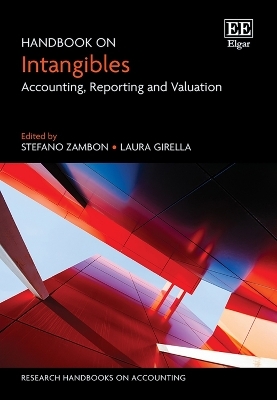
Handbook on Intangibles
Edward Elgar Publishing Ltd (Verlag)
978-1-0353-0636-7 (ISBN)
- Noch nicht erschienen (ca. Februar 2026)
- Versandkostenfrei
- Auch auf Rechnung
- Artikel merken
Adopting an original and innovative perspective, the Handbook collects 36 contributions that illustrate and critically discuss evidence and standpoints from diverse stakeholders, including policymakers, standard setters, international institutions, professionals and academics, taking into account micro and macro viewpoints. They argue that in a global digital economy, the ability to fund, reward and sustain innovation hinges on the visibility of the intangible assets driving it. Chapters examine several key areas concerning these resources, covering their accounting treatment, reporting and disclosure requirements, including sustainability, the associated risks and impacts, and the implications of digitization. The Handbook emphasizes that the effective management of intangibles is not only a matter of disclosure, but ultimately a matter of economic governance.
The Handbook on Intangibles is an essential reference for scholars and students in the fields of economics, banking and accounting. It is also of great benefit to investors, financial analysts and accounting and valuation professionals interested in the function and practice of intangibles.
Edited by Stefano Zambon, Professor of Business Economics, Department of Economics and Management, University of Ferrara and Laura Girella, Associate Professor of Business Economics, Department of Economics 'Marco Biagi', University of Modena and Reggio Emilia, Italy
Contents
1 Introduction: intangibles—a multi-perspective 1
Stefano Zambon and Laura Girella
PART I ACCOUNTING FOR INTANGIBLES
2 The harmful accounting for intangibles: response to adherents of the status quo 21
Baruch Lev
3 100 years of US GAAP for intangible items 35
Christine A. Botosan, Jeffrey Mechanick, and Joy Sy
4 Does capitalization of acquired in-process R&D convey information in the pricing process? 63
Dimos Andronoudis, Fathom Financial Consulting, Luminita Enache
5 Intangibles, firm value, and accounting relevance in COVID-19 89
Feng Gu
6 How could financial reporting evolve to provide better information about intangibles used in the entity’s operations? 118
Chiara Del Prete
7 An accounting for intangible assets that informs valuation 141
Richard Barker and Stephen Penman
8 Is this the end of intangibles? Re-framing the challenge of accounting for intangible assets 150
Alan Teixeira
9 The social costs of intangibles 170
Mario Abela
10 Impact accounts as a key input into accounting for intangibles 180
T. Robert Zochowski
PART II REPORTING AND DISCLOSURES ON INTANGIBLES
11 R&D disclosure in the annual report: empirical evidence from automotive and pharmaceutical companies 192
Alberto Quagli, Elisa Roncagliolo, and Lorenzo Simoni
12 Intangibles and equity investors 215
Jan Marton and Catalin Starica
13 A critical analysis of the contribution of Integrated Reporting to the recognition of intangibles 232
Ruth Dimes and Charl de Villiers
14 Disclosure of intangibles through Integrated Reporting: non-financial capital and climate risk management 246
Alexandre Garcia, Davi Ciasca, José Roberto Kassai, Solange Garcia dos Reis , Ticiane Santos, and Vania Borgerth
15 The evolution of Intellectual Capital reporting: a trust-based perspective 260
Maria Serena Chiucchi, Marco Giuliani, and Stefano Marasca
16 The relational capital along the supply chain: insights from sustainability reporting disclosures 278
Mariella Colantoni, Alessandro Lai, and Riccardo Stacchezzini
17 The new EU sustainability framework vis-à-vis integrated reporting and intangibles: a sytematic perspective 297
Alessandro d’Eri and Valerio Novembre
18 Making visible the invisible: intangibles, ESG and tax 310
Eelco van der Enden and Bronte Klein
19 Corporate governance, ESG and sustainability: the underexplored role of ‘green’ trade marks 326
Janice Denoncourt
20 A glance at reporting on intangible assets and resources from a German perspective 349
Georg Lanfermann and Kristina Schwedler
21 Japanese journey on intangibles as the key factor of value creation for a company 358
Takayuki Sumita
PART III INTANGIBLES AND RISKS
22 Intangible value and risks: regulation requirements, valuation practices and ways forward – a better risk awareness within valuation reports 395
Véronique Blum
23 Understanding risks related to intangibles and knowledge for sustainable business development 440
Susanne Durst
PART IV HUMAN CAPITAL AS AN INTANGIBLE: DIFFERENT PERSPECTIVES
24 Accounting and reporting for human capital in a public healthcare organization: do they promote effective human capital management to achieve social sustainability? 455
Caterina Cavicchi and Emidia Vagnoni
25 Integration of intangible assets by investors: application to human capital 469
Jean-Philippe Desmartin and Elise de Coligny
26 Talking about “human capital” or not: lessons from the French experiment of integrated reporting on the period 2014–2020 488
Stéphane Trébucq and Francis Gonzalez
PART V DIGITISATION AND INTANGIBLES
27 Potential impact of the digital economy on accounting: the challenge of intangible assets’ recognition 506
Anne Jeny
28 The hidden value of intangibles: a constructive de- and re-construction 528
Isabella Miller and Robert Obermaier
PART VI VALUATION AND MEASUREMENT OF INTANGIBLES
29 Does the Value Added Intellectual Coefficient (VAIC) add value to the IC research and practice? 545
Giuseppe Marzo
30 Valuation of intangible assets: an artistic science 567
André Gorius
31 Measuring stakeholder value: a globally integrated approach 581
Philip Sugai
32 The IVSC’s perspective on the valuation and measurement of intangible assets 600
Nicolas Konialidis and Richard Stewart
33 WIPO’s action plan on intangible asset finance 620
Michael Kos
34 The value of data in the economy 639
Simon Lange and Vincenzo Spiezia
35 Quantifying the value of data has profound implications for organizations 668
Sunil Soares and Matt Noll
36 The value contribution of a corporate brand: evidence from Bayer AG 688
Manfred Schwaiger, Sven Theobald, Wolfgang Stippler, and Sascha Raithel
| Erscheint lt. Verlag | 28.2.2026 |
|---|---|
| Reihe/Serie | Research Handbooks on Accounting series |
| Verlagsort | Cheltenham |
| Sprache | englisch |
| Maße | 169 x 244 mm |
| Themenwelt | Wirtschaft ► Betriebswirtschaft / Management ► Rechnungswesen / Bilanzen |
| ISBN-10 | 1-0353-0636-0 / 1035306360 |
| ISBN-13 | 978-1-0353-0636-7 / 9781035306367 |
| Zustand | Neuware |
| Informationen gemäß Produktsicherheitsverordnung (GPSR) | |
| Haben Sie eine Frage zum Produkt? |
aus dem Bereich


