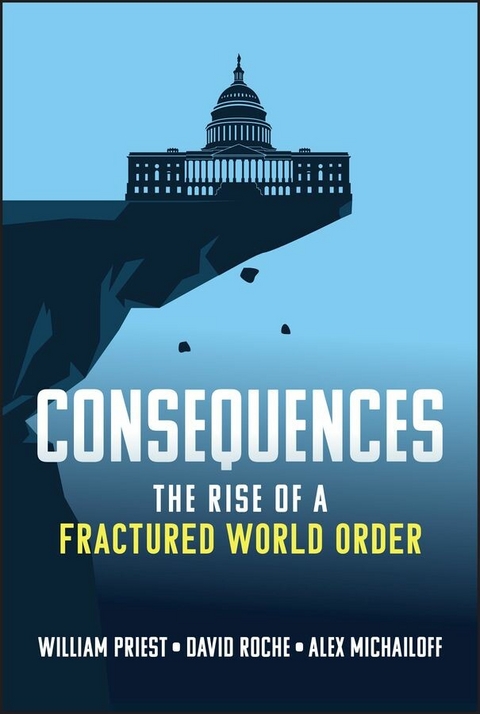
Consequences (eBook)
219 Seiten
Wiley (Verlag)
978-1-394-33938-9 (ISBN)
An engrossing and practical discussion of how to deal with contemporary challenges to democracy and civilization.
In Consequences: The Rise of a Fractured World Order, William Priest, David Roche, and Alex Michailoff deliver an engaging, timely, and insightful analysis of identifying the sources and challenges facing liberal democracies and their ability to confront autocracies and autocratic behavior. The authors identify and address structural flaws present in both democracies and autocracies.
The book explains why the creation and distribution of wealth matters in creating nations where democracy can flourish, and the populace at large can win. Strategies for the creation of wealth (broadly defined) and its equitable distribution combined with the democratic tools that voters, investors, and citizens have available make it more likely those strategies can be deployed. You'll also find:
- Detailed and accurate discussions of the end of the liberal world order, post-cold war historical shifts, and the challenges that lie ahead.
- Explorations of the threat to democracy posed by populist politics and philosophies.
- An analysis of the likelihood of contemporary political actors to reform our economics and politics, and the steps we can take if they fail to do so
A startlingly original and eye-opening read for executives, investors, policymakers, and regulators, Consequences is an essential resource for everyone interested in the interplay between politics, economics, and long-term investment outcomes.
William Priest is Vice Chairman of TD Wealth and Founder, Executive Chair, and Portfolio Manager of TD Epoch. Having developed and led three firms over a six-decade period, he has extensive experience in the field of economics and finance. He is the author of several published articles, papers, and books on investing and finance, including the books, The Financial Reality of Pension Funding Under ERISA, Free Cash Flow and Shareholder Yield: New Priorities for the Global Investor, and Winning at Active Management: The Essential Roles of Culture, Philosophy and Technology. He holds the Chartered Financial Analyst designation, is a former CPA, holds an AB from Duke University and an MBA with distinction from the University of Pennsylvania's Wharton Graduate School of Business. He is a member of the Council on Foreign Relations as well as a member of the Barron's Roundtable.
David Roche is Strategist at Quantum Economics and Geonomics, a Singapore-based think tank and investment advisory company. Well known for his original and provocative ideas, he concentrates on investment themes, based on fundamental long-term analysis, backed up by strongly held convictions. He has forecast some of the major turning points in global investments and forecasted the invasion of Ukraine and the advent of Grayzone Warfare between Democracies and Autocracies in April 2021. He previously worked as head of strategy at J.P. Morgan, Morgan Stanley and Independent Strategy. Author of seven books, he holds an MA from Trinity College Dublin and an MBA with the highest distinction from INSEAD.
Alex Michailoff is a financial consultant, and a graduate of the Dyson School of Applied Economics and Management at Cornell University.
CHAPTER ONE
EXTERNAL CHALLENGES
Why write this book? With so many books out there, why this one? What makes it worth your time? Simply put, if you are reading this, chances are you live in a democracy, and that is exactly who this book is for—people in places where open dialogue matters most. In autocracies, books like this one often do not see the light of day. Information that questions power or explores uncomfortable truths is frequently suppressed, making free access to ideas even more essential for those who can still freely engage. In a democracy, the ability to ask questions, even ones without clear answers, is more valuable than in an autocracy, where answers are given but never open to questioning. Freedom of inquiry is essential for progress, while unquestionable answers only serve to suppress it. Questions that cannot be answered are better than answers that cannot be questioned. This underscores why protecting democracy is not just important—it is necessary.
Democracies represent freedom and the rule of law. Yet, if you live in a democracy, you are part of a system struggling to compete with non-democratic nations. This struggle plays out on two main fronts: from external forces and internal challenges.
Freedom and economic prosperity go hand in hand. A great example of this connection is shown in the Freedom House Index, which is available online for everyone to explore. Just look at Taiwan—a flourishing democracy and a key player in the global economy—compared to China, where freedoms are tightly controlled.
Taiwan, a vibrant democracy, achieved a high freedom score of 94 out of 100, ranking second in Asia and seventh globally in 2025. This reflects its robust political rights and civil liberties, contributing to its status as a key player in the global economy.1
In contrast, China received a low freedom score of 9 out of 100 in 2025, categorizing it as “Not Free.” This score indicates significant restrictions on political rights and civil liberties, which can impede economic innovation and individual prosperity. It is no wonder that China is so interested in taking control over Taiwan, they would love to inherit its economic successes.2
While this example is extreme, we implore you to do your own research using Freedom House’s free resources and see how your home country stacks up against others.
With so much economic success this begs the question: Why are our democracies losing their global influence to autocratic nations where citizens are not as free?
THE GRAYZONE WAR: DEMOCRACIES VS AUTOCRACIES
The rise of successful non-democratic economies in countries like China has given their government more political power. They pose a threat to democracies, especially in trade and governance.
Autocratic leaders often view democracies as weak and corrupt. They propose their own models for how societies and the world should be organized. What was once a world inspired by the spread of democracy, with the US at the center, is now one shifting toward competing visions of governance and alternative political systems.
What about the countries that have not yet aligned themselves with the democratic or autocratic ways of life? Most of these countries belong to what many refer to as the Global South, a group of nations primarily in Asia, Africa, Latin America, and the Pacific. They are often characterized by lower income levels and histories of colonialism or economic dependency. These nations encompass a wide range of political systems and development stages. Unlike the industrialized democracies of the Global North, many Global South countries struggle with structural inequalities and governance issues. However, they are also dynamic, home to rapidly growing economies, rich cultural diversity, and youthful populations. According to the World Bank, within the next 50 years, one-third of the world’s working-age population will be African.3 Africa’s expanding working-age population is seen as a potential catalyst for accelerated economic progress, provided that investments are made in education and employment opportunities. Where African nations, along with many in Southeast Asia and Latin America, align themselves in this new conflict, might end up determining its outcome.
Many Global South governments are tempted by the Chinese autocratic model. Why? Because most Global South countries are not democracies themselves. They dislike the nations which were previously colonial powers that make up most of the democratic alliance. They also envy China’s authoritarian and meteoric rise to middle-income status. Since initiating market reforms in 1978, China has achieved remarkable economic growth, averaging 9.5% real Gross Domestic Product (GDP) growth annually through 2018, a pace the World Bank describes as “the fastest sustained expansion by a major economy in history.”4 This proof of concept has greatly aided China’s case to become the beacon of hope for emerging economies in the Global South. China believes democracy will die of its own accord, but with a little extra push, it will fall over the cliff a bit faster (see our cover), and then there will be a new world leader and way of life led by a superior autocratic system, at least in their eyes.
The most important external threat to democracy today is the Axis of Autocracies. This includes primarily China, Russia, North Korea, and Iran. Opposing it is what we might call the Alliance of Democracies, which includes all NATO countries and Asian democracies such as Japan, Korea, and Taiwan. But the leadership is really just a single nation, the US of America. The US is by far the largest contributor to NATO defense spending, accounting for the majority of the alliance’s total budget—reaching an estimated $755 billion in 2024, compared to $430 billion from all other NATO members combined. Beyond military expenditures, the US also plays a crucial role in NATO’s broader initiatives, including intelligence sharing, logistical support, and financial contributions to joint projects and operational missions.5
SOURCE: Data from IMF
The US’s leadership within the Alliance of Democracies extends beyond its military and economic influence; it also lies in its historical role as a global promoter of democratic ideals. Post–World War II, the US established frameworks and organizations like NATO, the United Nations (UN), the International Monetary Fund (IMF), and the World Bank to solidify collective security, ensuring that democracies could thrive against threats such as the Soviet Union. Other US-backed organizations further reinforced this global order, including the World Trade Organization (WTO), the Organization of American States (OAS), the International Atomic Energy Agency (IAEA), and economic alliances like the G7, G20, and Asia-Pacific Economic Cooperation (APEC), all designed to promote trade, security, and diplomatic cooperation. The US consistently leverages its diplomatic and financial might to stabilize regions, foster alliances, and counteract the growing influence of autocratic states.
The Alliance of Democracies defends the existing rule-based international order. The Axis of Autocracies has its own alternative versions.
RUSSIA
Russia’s ideology often ties its identity to historical control over territories like Ukraine, Belarus, and other Soviet-era states. This belief underpins much of its modern foreign policy and its attempts to reclaim the influence it lost after the Soviet Union’s collapse. Under President Vladimir Putin’s vision, the restoration of Russian greatness involves a return to the geopolitical dominance of its imperial and Soviet past. This includes undermining Ukraine’s sovereignty, demilitarizing former Warsaw Pact nations, and even pushing for NATO’s withdrawal from regions that were once within Moscow’s sphere of influence.
Putin’s speeches given in 2014, 2023, and 2024, along with his rambling propagandist theory of Slavic history published in his 5000-word essay at the time of the invasion of Ukraine, evidence his views. In his 2014 speech following the annexation of Crimea, President Vladimir Putin stated: “We are not simply close neighbors but, as I have said many times already, we are one people. Kiev is the mother of Russian cities. Ancient Rus is our common source, and we cannot live without each other.”6
The consequences of this ambition are far-reaching. Russia’s aggression in Ukraine—an area central to its claims of cultural and political history—not only leads to conflict but also destabilizes Europe’s eastern borders. Kremlin-backed forces target Ukraine’s critical infrastructure and civilian institutions to maintain leverage. Furthermore, Putin’s rhetoric frequently references a grand historical narrative designed to justify actions perceived by much of the global community as violations of international law.
The devastating methods used to achieve Putin’s vision are being witnessed daily in Ukraine. Russian forces have targeted civilian infrastructure, including hospitals, schools, and residential areas, leading to widespread destruction and displacement. Cities like Mariupol and Bakhmut have been reduced to rubble, and millions of Ukrainians have been forced to flee their homes, seeking refuge in neighboring countries or enduring harsh conditions in war-torn regions. These actions reflect not just a military strategy but an effort to...
| Erscheint lt. Verlag | 9.9.2025 |
|---|---|
| Sprache | englisch |
| Themenwelt | Wirtschaft ► Volkswirtschaftslehre |
| Schlagworte | autocracy • Big State • Chinese Politics • deglobalization • democratic decay • End of democracy • Equality • Future of Democracy • Geopolitics • Global Economics • Global politics • Populism • populist economics • populist politics • World Politics |
| ISBN-10 | 1-394-33938-0 / 1394339380 |
| ISBN-13 | 978-1-394-33938-9 / 9781394339389 |
| Informationen gemäß Produktsicherheitsverordnung (GPSR) | |
| Haben Sie eine Frage zum Produkt? |
 EPUB (Adobe DRM)
Kopierschutz: Adobe-DRM
Adobe-DRM ist ein Kopierschutz, der das eBook vor Mißbrauch schützen soll. Dabei wird das eBook bereits beim Download auf Ihre persönliche Adobe-ID autorisiert. Lesen können Sie das eBook dann nur auf den Geräten, welche ebenfalls auf Ihre Adobe-ID registriert sind.
Details zum Adobe-DRM
Dateiformat: EPUB (Electronic Publication)
EPUB ist ein offener Standard für eBooks und eignet sich besonders zur Darstellung von Belletristik und Sachbüchern. Der Fließtext wird dynamisch an die Display- und Schriftgröße angepasst. Auch für mobile Lesegeräte ist EPUB daher gut geeignet.
Systemvoraussetzungen:
PC/Mac: Mit einem PC oder Mac können Sie dieses eBook lesen. Sie benötigen eine
eReader: Dieses eBook kann mit (fast) allen eBook-Readern gelesen werden. Mit dem amazon-Kindle ist es aber nicht kompatibel.
Smartphone/Tablet: Egal ob Apple oder Android, dieses eBook können Sie lesen. Sie benötigen eine
Geräteliste und zusätzliche Hinweise
Buying eBooks from abroad
For tax law reasons we can sell eBooks just within Germany and Switzerland. Regrettably we cannot fulfill eBook-orders from other countries.
aus dem Bereich