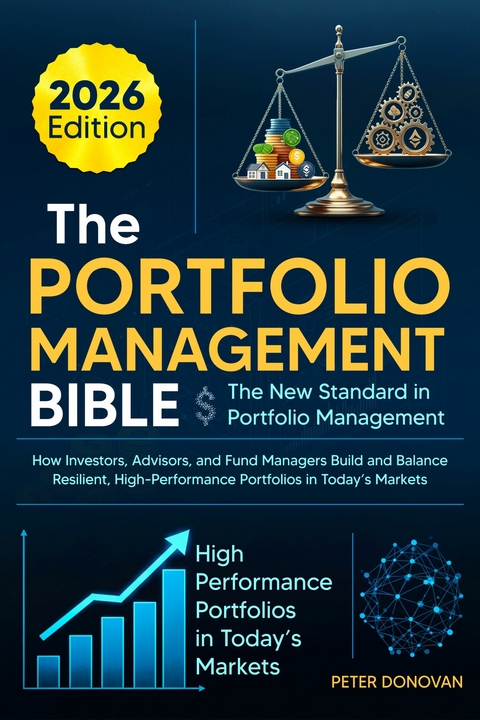
The Portfolio Management Bible (eBook)
110 Seiten
Publishdrive (Verlag)
978-0-00-105270-3 (ISBN)
⚠️ Wall Street Veteran Reveals: The #1 Portfolio Survival Playbook for the Next Market Crash ⚠️
INTRODUCTION
1. Why Portfolio Management Still Matters in the 21st Century
In a world dominated by algorithms, robo-advisors, and mobile trading platforms, it may seem that the traditional discipline of portfolio management has lost its relevance. Yet the opposite is true. At its core, portfolio management remains the foundation of sustainable wealth creation. It is the discipline that transforms a scattered collection of investments into a structured system capable of enduring volatility, adapting to shifting cycles, and compounding returns over time.
Financial markets have always been unpredictable, driven by economic forces, political events, technological innovation, and human psychology. This unpredictability is not a flaw of the system but its very nature. Prices surge and collapse, bull markets give way to bear markets, and entire asset classes fall in and out of favor. In such an environment, no investor — however skilled — can consistently predict short-term movements. The strength of portfolio management lies in recognizing this reality and building structures that can withstand shocks while continuing to deliver steady, long-term performance.
Central to this discipline is diversification. By allocating capital across equities, bonds, alternatives, and other asset classes, investors spread risk and avoid overexposure to any single outcome. When one sector falters, another may rise. This balance cushions portfolios from severe drawdowns and increases the likelihood of compounding over decades rather than just years. Diversification is not about eliminating risk but about managing it intelligently, ensuring that no single failure can derail long-term goals.
Effective portfolio management is also highly individual. Two investors may share similar resources but have very different objectives. A 30-year-old saving for retirement may accept higher risk in pursuit of growth, while a retiree seeking reliable income requires stability and lower volatility. Time horizon, personal goals, and tolerance for risk shape each portfolio in unique ways. This personalization highlights the strategic importance of asset allocation — the process of determining how much capital belongs in each category of investment. Research has shown that asset allocation, rather than security selection, is the primary driver of portfolio performance variability across time. The correct mix of equities, fixed income, and alternatives often matters far more than the particular stock or bond chosen.
Portfolio management also demands adaptability. Markets evolve, and so do investors’ circumstances. A strategy appropriate at the beginning of a career may no longer serve when retirement approaches. Regular reviews and adjustments are not optional; they are essential. Rebalancing ensures that portfolios remain aligned with both market conditions and investor objectives, rather than drifting into unintended exposures.
The modern era offers new tools that enhance, but do not replace, sound judgment. Advanced analytics, scenario simulations, and automated platforms can process enormous amounts of data at unprecedented speeds. Robo-advisors can suggest allocations based on algorithms, and artificial intelligence can detect patterns invisible to human eyes. Yet the foundation of portfolio management remains strategic planning, disciplined execution, and informed human decision-making. Numbers alone cannot capture investor psychology, nor can algorithms provide the patience and perspective required to navigate uncertainty.
Portfolio management today is not simply relevant — it is indispensable. In an environment defined by global interconnectedness, technological disruption, and constant change, the ability to design resilient portfolios is more critical than ever. The discipline provides investors with the framework to manage risk intelligently, capture opportunities across markets, and preserve wealth through unpredictable cycles.
2. The Evolution from Theory to Practice
Portfolio management has transformed from an academic framework into a practical discipline central to modern wealth management. Its history is a story of bold ideas, limitations revealed, crises endured, and technological breakthroughs that continue to shape how investors construct and adapt portfolios.
The formal foundation was established in the 1950s with Harry Markowitz’s Modern Portfolio Theory (MPT). His work introduced portfolio optimization, demonstrating that diversification across assets allows investors to maximize expected return for a given level of risk. This breakthrough earned him the Nobel Prize in Economics and created the intellectual groundwork for the profession.
Yet MPT was built on assumptions — rational investors, efficient markets, and reliable historical data — that rarely held true outside the classroom. Real markets displayed irrational behavior, sudden shocks, and inefficiencies that theoretical models could not fully capture. The reliance on past performance to forecast the future left investors vulnerable during times of disruption.
In response, additional models emerged. The Capital Asset Pricing Model (CAPM) refined the measurement of risk through beta, linking an asset’s performance to market fluctuations. The Efficient Market Hypothesis (EMH) argued that prices already reflected all available information, leaving little room for consistent outperformance. Each model contributed valuable insights, yet each carried restrictive assumptions. EMH, for example, overlooked the impact of behavioral biases, unequal access to information, and emotional decision-making — all of which profoundly influence markets.
The fragility of these frameworks was exposed during the 2008 global financial crisis. Established theories that assumed stability, rationality, and predictability proved inadequate as systemic shocks collapsed financial institutions and erased trillions in value. The crisis revealed that risk models based solely on historical data underestimated the possibility of rare but catastrophic events. It forced investors and managers to recognize the need for approaches that were adaptive, flexible, and rooted in a deeper understanding of market dynamics.
In the aftermath, portfolio management shifted decisively toward strategies that accepted market inefficiencies and acknowledged human behavior as central to outcomes. Adaptive allocation models, scenario planning, and stress testing became standard practice. Greater attention was paid to liquidity, correlations under stress, and the potential for extreme downside risk. The focus moved from maximizing short-term efficiency to building resilience across a range of possible futures.
Technological progress accelerated this evolution. Big data analytics, machine learning, and AI-driven platforms have enabled portfolio managers to process immense volumes of information, identify hidden correlations, and generate insights at unprecedented speed. Robo-advisors introduced algorithm-based portfolio construction and rebalancing, making structured investing accessible to a broader audience. Yet technology, while powerful, remains only a tool. Flash crashes and algorithmic trading disruptions remind us that reliance on machines cannot replace human judgment. Investment success still depends on the ability to interpret data within the context of human psychology, geopolitics, and structural economic shifts.
The movement from theory to practice illustrates the adaptive nature of portfolio management. Each stage — from MPT to post-crisis frameworks, from beta models to AI applications — reflects an ongoing attempt to balance quantitative rigor with real-world complexity. Portfolio management today is less about rigid formulas and more about integrating multiple perspectives: quantitative analysis, behavioral finance, forward-looking risk assessment, and technological tools.
Understanding this progression provides vital context for modern investors. It shows how theoretical models sparked revolutions, where they fell short, and how practice evolved to close the gap. It highlights why flexibility, skepticism toward rigid assumptions, and continual adaptation remain essential in navigating financial markets.
3. Who This Book Is For: Investors, Advisors, and Fund Managers
This book is designed for a wide range of readers united by a commitment to improving their financial decision-making. It provides a modern, evidence-based framework that connects academic theory with practical application, written in a clear style that avoids unnecessary jargon while preserving depth and rigor.
For individual investors, this volume acts as a professional guide brought into accessible form. It explains how the principles used by institutional managers can be applied to personal portfolios. Topics such as asset allocation, diversification, and risk management are presented in a way that emphasizes clarity and applicability. The book also highlights contemporary tools — exchange-traded funds, digital assets, ESG strategies, and AI-driven analysis — equipping readers with the knowledge to align their investments with long-term goals. Whether someone is beginning their journey or refining years of experience, the focus is on building confidence through disciplined and informed portfolio management.
For financial advisors, it serves as a trusted manual that balances theory with client-focused practice. Advisors will find structured guidance on constructing resilient portfolios, communicating complex ideas in straightforward terms, and addressing the behavioral biases that often drive client decisions. The book also explores the evolving toolkit available to professionals, ensuring that advisors can remain...
| Erscheint lt. Verlag | 10.9.2025 |
|---|---|
| Sprache | englisch |
| Themenwelt | Wirtschaft ► Betriebswirtschaft / Management ► Personalwesen |
| ISBN-10 | 0-00-105270-5 / 0001052705 |
| ISBN-13 | 978-0-00-105270-3 / 9780001052703 |
| Informationen gemäß Produktsicherheitsverordnung (GPSR) | |
| Haben Sie eine Frage zum Produkt? |
 EPUB (Adobe DRM)
Größe: 2,4 MB
Kopierschutz: Adobe-DRM
Adobe-DRM ist ein Kopierschutz, der das eBook vor Mißbrauch schützen soll. Dabei wird das eBook bereits beim Download auf Ihre persönliche Adobe-ID autorisiert. Lesen können Sie das eBook dann nur auf den Geräten, welche ebenfalls auf Ihre Adobe-ID registriert sind.
Details zum Adobe-DRM
Dateiformat: EPUB (Electronic Publication)
EPUB ist ein offener Standard für eBooks und eignet sich besonders zur Darstellung von Belletristik und Sachbüchern. Der Fließtext wird dynamisch an die Display- und Schriftgröße angepasst. Auch für mobile Lesegeräte ist EPUB daher gut geeignet.
Systemvoraussetzungen:
PC/Mac: Mit einem PC oder Mac können Sie dieses eBook lesen. Sie benötigen eine
eReader: Dieses eBook kann mit (fast) allen eBook-Readern gelesen werden. Mit dem amazon-Kindle ist es aber nicht kompatibel.
Smartphone/Tablet: Egal ob Apple oder Android, dieses eBook können Sie lesen. Sie benötigen eine
Geräteliste und zusätzliche Hinweise
Buying eBooks from abroad
For tax law reasons we can sell eBooks just within Germany and Switzerland. Regrettably we cannot fulfill eBook-orders from other countries.
aus dem Bereich