


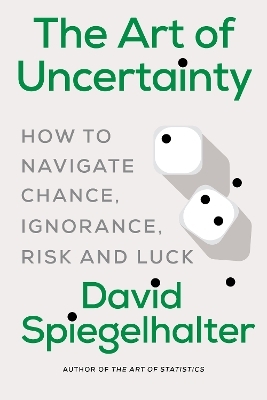
The Art of Uncertainty
How to Navigate Chance, Ignorance, Risk and Luck
Seiten
2026
WW Norton & Co (Verlag)
978-1-324-13072-7 (ISBN)
WW Norton & Co (Verlag)
978-1-324-13072-7 (ISBN)
- Noch nicht erschienen (ca. Juni 2026)
- Portofrei ab CHF 40
- Auch auf Rechnung
- Artikel merken
Named a Best Book of the Year by Forbes and The Economist
From our "greatest living statistical communicator" (Tim Harford) comes an invaluable, data-driven guide for understanding—and learning to embrace—risk and uncertainty in our daily lives.
How dangerous is our diet? How much of sports falls into the realm of luck? When authorities categorize a given event as “highly likely”—how likely is that, really? Whether we’re trying to decide if the benefits of a new medication are worth the chance of side effects or if artificial intelligence truly threatens humanity, our lives are riddled with uncertainties both everyday and existential—yet it can be difficult to know how to properly weigh all those unknowns. Luckily for us, renowned statistician David Spiegelhalter has spent his career dissecting data to resolve the apparently random and decode the many decisions we face with imperfect information. In The Art of Uncertainty, he shows how we can become better at dealing with what we don’t know to make smarter choices in a world so full of puzzling variables.
In lucid, lively prose, Spiegelhalter guides us through the principles of probability, illustrating how they can help us think more analytically about everything from medical advice to sports to climate change forecasts. He demonstrates how taking a mathematical approach to phenomena we might otherwise attribute to fate or luck can help us sort hidden patterns from mere coincidences, better evaluate cause and effect, and predict what’s likely to happen in the future. Along the way, we learn how a misinterpretation of a probability contributed to the infamous Bay of Pigs fiasco, why a ship twice the size of the Titanic sank without a trace, and why we can be so confident that no two properly shuffled decks of cards have ever been in the same order.
Sparkling with wit and fascinating real-world examples, this is an essential guide to navigating uncertainty while also retaining the humility to admit what we don’t, or simply cannot, know.
From our "greatest living statistical communicator" (Tim Harford) comes an invaluable, data-driven guide for understanding—and learning to embrace—risk and uncertainty in our daily lives.
How dangerous is our diet? How much of sports falls into the realm of luck? When authorities categorize a given event as “highly likely”—how likely is that, really? Whether we’re trying to decide if the benefits of a new medication are worth the chance of side effects or if artificial intelligence truly threatens humanity, our lives are riddled with uncertainties both everyday and existential—yet it can be difficult to know how to properly weigh all those unknowns. Luckily for us, renowned statistician David Spiegelhalter has spent his career dissecting data to resolve the apparently random and decode the many decisions we face with imperfect information. In The Art of Uncertainty, he shows how we can become better at dealing with what we don’t know to make smarter choices in a world so full of puzzling variables.
In lucid, lively prose, Spiegelhalter guides us through the principles of probability, illustrating how they can help us think more analytically about everything from medical advice to sports to climate change forecasts. He demonstrates how taking a mathematical approach to phenomena we might otherwise attribute to fate or luck can help us sort hidden patterns from mere coincidences, better evaluate cause and effect, and predict what’s likely to happen in the future. Along the way, we learn how a misinterpretation of a probability contributed to the infamous Bay of Pigs fiasco, why a ship twice the size of the Titanic sank without a trace, and why we can be so confident that no two properly shuffled decks of cards have ever been in the same order.
Sparkling with wit and fascinating real-world examples, this is an essential guide to navigating uncertainty while also retaining the humility to admit what we don’t, or simply cannot, know.
David Spiegelhalter is emeritus professor of statistics at the University of Cambridge, a former president of the Royal Statistical Society, and the author of the best-selling book The Art of Statistics. Knighted in 2014 for his services to medical statistics, he lives in Cambridge, UK.
| Erscheint lt. Verlag | 23.6.2026 |
|---|---|
| Zusatzinfo | 63 graphs, charts, and photographs |
| Verlagsort | New York |
| Sprache | englisch |
| Maße | 140 x 210 mm |
| Themenwelt | Mathematik / Informatik ► Mathematik |
| Wirtschaft ► Betriebswirtschaft / Management ► Unternehmensführung / Management | |
| Wirtschaft ► Volkswirtschaftslehre ► Ökonometrie | |
| ISBN-10 | 1-324-13072-5 / 1324130725 |
| ISBN-13 | 978-1-324-13072-7 / 9781324130727 |
| Zustand | Neuware |
| Informationen gemäß Produktsicherheitsverordnung (GPSR) | |
| Haben Sie eine Frage zum Produkt? |
Mehr entdecken
aus dem Bereich



aus dem Bereich
wie Teams funktionieren und wann sie effektiv arbeiten
Buch | Softcover (2024)
Vahlen (Verlag)
CHF 45,95
wie man Menschen wirklich weiterbringt
Buch | Softcover (2024)
Vahlen (Verlag)
CHF 37,65
ein Navigationssystem für Führungskräfte
Buch (2023)
Carl-Auer Verlag
CHF 48,90


