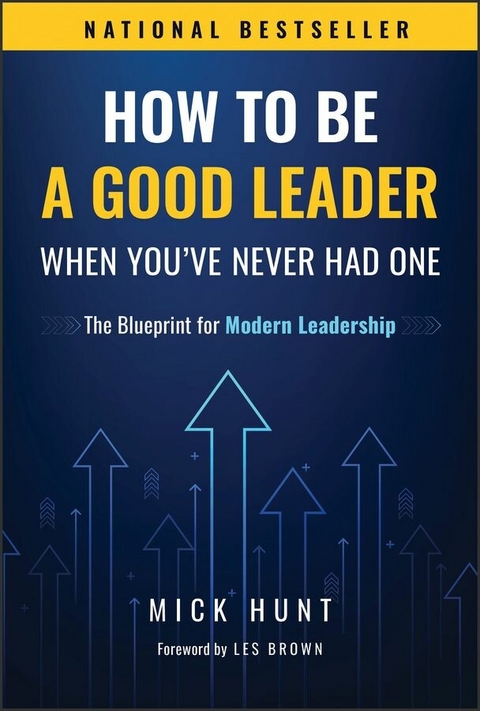
How to Be a Good Leader When You've Never had One (eBook)
193 Seiten
Wiley (Verlag)
978-1-394-35796-3 (ISBN)
A powerful leadership instruction manual designed to help you bring out the best in your team members
In How to Be a Good Leader When You've Never had One: The Blueprint for Modern Leadership, entrepreneur, podcaster, and leader, Mick Hunt, delivers a deeply honest story about leadership that offers hands-on insights and actionable frameworks you can apply at your organization today. The author provides strategies that are tailor-made for modern leaders who are engaging with a diverse workforce.
After a powerful foreword by Les Brown, How to Be a Good Leader When You've Never had One marries proven leadership strategies forged in the real world with a fresh perspective on work that is inspiring and practical.
Inside the book:
- A toolkit for modern leadership that leverages transparency, resilience, influence, listening, and vision
- Powerful case studies of real-life leaders - including soldiers, corporate executives, and healthcare leaders - who have found ways to overcome common leadership strategies and achieved extraordinary outcomes
- Strategies for addressing obstacles unique to leading a contemporary workforce
An exciting and inspiring new take on how to lead in the modern era, How to Be a Good Leader When You've Never had One is an essential resource for managers, executives, and other business leaders seeking an authentic, authoritative, and actionable playbook for the kind of leadership the world needs today.
MICK HUNT is a renowned leader, entrepreneur, and co-host of the popular Mick Unplugged podcast. He is the creator of the revolutionary MICK Factor framework, which challenges outdated leadership norms and inspires leaders to cultivate trust, foster creativity, and deliver extraordinary results.
A powerful leadership instruction manual designed to help you bring out the best in your team members In How to Be a Good Leader When You've Never had One: The Blueprint for Modern Leadership, entrepreneur, podcaster, and leader, Mick Hunt, delivers a deeply honest story about leadership that offers hands-on insights and actionable frameworks you can apply at your organization today. The author provides strategies that are tailor-made for modern leaders who are engaging with a diverse workforce. After a powerful foreword by Les Brown, How to Be a Good Leader When You've Never had One marries proven leadership strategies forged in the real world with a fresh perspective on work that is inspiring and practical. Inside the book: A toolkit for modern leadership that leverages transparency, resilience, influence, listening, and vision Powerful case studies of real-life leaders including soldiers, corporate executives, and healthcare leaders who have found ways to overcome common leadership strategies and achieved extraordinary outcomes Strategies for addressing obstacles unique to leading a contemporary workforce An exciting and inspiring new take on how to lead in the modern era, How to Be a Good Leader When You've Never had One is an essential resource for managers, executives, and other business leaders seeking an authentic, authoritative, and actionable playbook for the kind of leadership the world needs today.
Introduction: The Promise
On the morning of December 24, 1988, the world outside buzzed with the vibrant energy of Christmas Eve. Laughter echoed through the streets; homes twinkled with festive lights; and children, bundled in their winter best, played joyously in anticipation of the night's magic. Everywhere, the air was crisp with the promise of celebration, the excitement of the holiday palpable in the cold winter breeze.
Yet within the modest walls of our small home, the atmosphere was starkly different. I sat quietly on the edge of my bed, my ten‐year‐old self enveloped in a heavy silence that contrasted sharply with the merriment outside. This silence was only broken by the heart‐wrenching sobs of my mother, who sat beside me, her tears painting a story of struggle and despair. The sounds of children playing were distant, as if from another world—one where the shadows that loomed over our family didn't exist.
This was no ordinary Christmas Eve for us. It was a defining moment in my young life, a crossroads that would set the path I was to walk for years to come. My mother, a woman who had weathered countless storms of hardship, bore her suffering not as a shroud to hide in but as a stark, unyielding reminder of the battles she had endured. Each tear she shed carved deep emotional canyons through my young heart and, with each drop, a resolve formed within me, pushing me beyond the carefree innocence that defined childhood.
Her tears that day were like rivers, relentless and transformative, shaping the contours of my spirit. They told stories of lost dreams and enduring pain but also of an unspoken strength that had yet to be called upon. As the weak winter sunlight struggled through our threadbare curtains, casting faint shadows that danced quietly around our sparse room, the somber tone of our Christmas Eve was set.
Les Brown's voice, emanating from the old television in the corner, spoke of potential and possibility—his motivational tones a stark contrast to the palpable despair that filled our space. “Shoot for the moon,” he urged, his voice rich and persuasive, as if he could sense the weight of the moment. Just then, my mother turned to me, her eyes brimming with a complex tapestry of pain and hope. In her gaze, I saw not just a mother's love but also a warrior's resolve. Her eyes locked onto mine, conveying a depth of unspoken love and fierce determination that rooted me to the spot.
“You are my hope,” she whispered, her voice a tremulous thread of sound in the heavy air. “Because I love you, I won't leave.” Her words, more than a vow, were an anchor, a declaration of her unyielding presence despite the tempests we faced. This was her profound response to the silent pleas I had whispered night after night for us to escape the dark shadows that haunted our home. Her decision to stay, to fight rather than flee, was laden with a promise—a promise to forge a new path from the thorns of our shared pain.
As she pulled me into her embrace, the chaos of the world outside faded into a distant murmur. In that embrace, as our shared heartache wove a bond that no hardship could unravel, she whispered again, “You can do it.” It was more than encouragement; it was an invocation of my potential, a call to rise above our circumstances and claim the destiny that awaited.
In that moment, as her tears mingled with a quiet strength that only those who have faced despair can know, my because was born. Not just any promise but a life's mission, crystallized in the crucible of our family's struggles—a vow to transform our shared sorrow into a future replete with joy, to become a pillar of strength my sister could look up to, to embody the virtues of the man I was destined to become.
This early morning of stark contrasts, when the joy of the world outside was shadowed by the pain within our walls, became the foundation of my journey. It was here, in the depths of despair, that the seeds of my future were sown—seeds that would grow into a relentless pursuit of transformation.
On that pivotal Christmas Eve, as I sat engulfed in the shadows of our humble living room, a profound shift occurred within me. A ten‐year‐old boy's world was irrevocably altered—not by choice but by necessity. In the depths of familial turmoil, amid the quiet sobs of my mother, I felt a part of my childhood slip away, and, in its place, a premature mantle of manhood settled on my young shoulders. It was a transformation born not out of desire but out of an absolute necessity—a must‐have change that no child should ever have to endure but one that was essential for the survival and thriving of my family.
“This was not the life I chose, but it was the life that chose me, and I decided to rise—not just to survive, but to prevail,” I would later articulate, reflecting on that moment. This realization marked a turning point when because became significantly more potent than why. It wasn't about why I had to shoulder such a burden—it was because I had no choice but to forge a path forward, a path that promised a semblance of hope and stability for those I held dear.
In the faint glow of daybreak, as Brown's voice continued to resonate through the room, encouraging millions to reach for their dreams, I found my calling not in the dreams of a child but the resolve of a soul forged through adversity. “Change isn't just something you hope for; it's something you seize with both hands and mold into your destiny.” This mantra became my guiding light, driving me to transform despair into determination, vulnerability into strength.
The commitment I made that day as a young boy thrust too soon into manhood was sealed by the fierce embrace of my mother, who, in her infinite wisdom, whispered one final directive as I prepared to face the world: “When you shoot for the moon, don't miss.” This charge, heavy with the weight of our past struggles and the promise of our future dreams, was not merely a call to aim high but a command to strike true and without falter.
In the tender aftermath of my mother's tears, as her quiet resolve mingled with unwavering strength, the significance of my role not only as a future man but also as a brother became startlingly clear. For my sister, who is three and a half years younger than me, the stakes were just as high. Like me, she endured the emotional storms that swept through our household; like me, she needed a beacon of what strength and integrity should look like in a man.
At that moment, as I absorbed the weight of my mother's resolve and the depth of my own commitments, I understood that my role extended beyond the typical duties of a big brother. I was to be her protector, her guide, and above all, her example of how a man respects, supports, and perseveres. This was not a role I had asked for or one I had anticipated so early in life, but it was one I accepted without hesitation.
“For my sister, I vowed to be more than a guardian; I pledged to be a living example of the virtues we both deserved to see in the world,” I would often reflect, recognizing the dual responsibility I carried for both her and our future. My commitment to her was to demonstrate daily the character of the man I aimed to become, to show her through actions, not just words, what it meant to respect and uplift others, even amid our own struggles.
This nuanced understanding of my role reshaped the way I approached every challenge and opportunity that came my way. It wasn't just about overcoming obstacles; it was about setting a standard, about embodying the qualities I wished to instill in those looking up to me. “Don't miss” became not just my mantra but a principle that guided me through every decision, ensuring that every step I took was a step toward a brighter, more stable future for us all. This was the essence of our shared journey—from the depths of despair to the cusp of new beginnings—and it was a mandate to seize every moment, to fulfill every promise, and never to falter in the relentless pursuit of the future we dreamed of.
This promise, once whispered in the quiet solitude of a challenging youth, grew more profound with the arrival of my brother, mere days before I was to embark on the collegiate phase of my education. In the hospital, as I held him for the first time, feeling the delicate weight of new life in my arms, I renewed my vow with a deeper conviction.
To him, I promised to be more than just a brother; I pledged to be a beacon of reliability and a paragon of the values I hoped he would one day embody. “In your eyes, I see the future I am determined to secure for us,” I vowed, feeling the stirrings of a future shaped by the choices I would make from that moment forward.
Our father's departure marked a significant fracture in our family's structure, but it was not a break in our spirit. His legacy of unkept promises and abandoned responsibilities could have cast a long shadow over our future, but instead, I filled that void with a resolute commitment to uphold the very principles he had discarded. The MICK factor—Mental resilience, Impact, Character, and the will to Keep going—transitioned from abstract ideals to the very framework of my existence. These principles, which I would later repurpose for coaching private clients, became my compass, guiding my actions and decisions with a clarity born of necessity and nurtured by...
| Erscheint lt. Verlag | 8.9.2025 |
|---|---|
| Sprache | englisch |
| Themenwelt | Wirtschaft ► Betriebswirtschaft / Management ► Unternehmensführung / Management |
| Schlagworte | Authentic Leadership • Business Leadership • business leadership book • Contemporary Leadership • inspiring leadership • Leadership Book • leadership guide • leadership strategies • Leadership Style • leadership techniques • leadership tips • Les Brown • modern leadership |
| ISBN-10 | 1-394-35796-6 / 1394357966 |
| ISBN-13 | 978-1-394-35796-3 / 9781394357963 |
| Informationen gemäß Produktsicherheitsverordnung (GPSR) | |
| Haben Sie eine Frage zum Produkt? |
 EPUB (Adobe DRM)
Kopierschutz: Adobe-DRM
Adobe-DRM ist ein Kopierschutz, der das eBook vor Mißbrauch schützen soll. Dabei wird das eBook bereits beim Download auf Ihre persönliche Adobe-ID autorisiert. Lesen können Sie das eBook dann nur auf den Geräten, welche ebenfalls auf Ihre Adobe-ID registriert sind.
Details zum Adobe-DRM
Dateiformat: EPUB (Electronic Publication)
EPUB ist ein offener Standard für eBooks und eignet sich besonders zur Darstellung von Belletristik und Sachbüchern. Der Fließtext wird dynamisch an die Display- und Schriftgröße angepasst. Auch für mobile Lesegeräte ist EPUB daher gut geeignet.
Systemvoraussetzungen:
PC/Mac: Mit einem PC oder Mac können Sie dieses eBook lesen. Sie benötigen eine
eReader: Dieses eBook kann mit (fast) allen eBook-Readern gelesen werden. Mit dem amazon-Kindle ist es aber nicht kompatibel.
Smartphone/Tablet: Egal ob Apple oder Android, dieses eBook können Sie lesen. Sie benötigen eine
Geräteliste und zusätzliche Hinweise
Buying eBooks from abroad
For tax law reasons we can sell eBooks just within Germany and Switzerland. Regrettably we cannot fulfill eBook-orders from other countries.
aus dem Bereich