


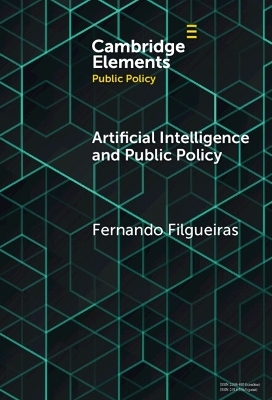
Artificial Intelligence and Public Policy
Seiten
2026
Cambridge University Press (Verlag)
978-1-009-57223-1 (ISBN)
Cambridge University Press (Verlag)
978-1-009-57223-1 (ISBN)
- Noch nicht erschienen (ca. Januar 2026)
- Versandkostenfrei
- Auch auf Rechnung
- Artikel merken
In a global landscape shaped by technology, artificial intelligence (AI) is emerging as a disruptive force, redefining the very essence of governance. This Element delves into the intricate relationship between AI and the policy process. The rise of AI introduces an unprecedented 'sociotechnical reengineering.'
In a global landscape increasingly shaped by technology, artificial intelligence (AI) is emerging as a disruptive force, redefining not only our daily lives but also the very essence of governance. This Element delves deeply into the intricate relationship between AI and the policy process, unraveling how this technology is reshaping the formulation, implementation, and advice of public policies, as well as influencing the structures and actors involved. Policy science was based on practice knowledge that guided the actions of policymakers. However, the rise of AI introduces an unprecedented sociotechnical reengineering, changing the way knowledge is produced and used in government. Artificial intelligence in public policy is not about transferring policy to machines but about a fundamental change in the construction of knowledge, driven by a hybrid intelligence that arises from the interaction between humans and machines.
In a global landscape increasingly shaped by technology, artificial intelligence (AI) is emerging as a disruptive force, redefining not only our daily lives but also the very essence of governance. This Element delves deeply into the intricate relationship between AI and the policy process, unraveling how this technology is reshaping the formulation, implementation, and advice of public policies, as well as influencing the structures and actors involved. Policy science was based on practice knowledge that guided the actions of policymakers. However, the rise of AI introduces an unprecedented sociotechnical reengineering, changing the way knowledge is produced and used in government. Artificial intelligence in public policy is not about transferring policy to machines but about a fundamental change in the construction of knowledge, driven by a hybrid intelligence that arises from the interaction between humans and machines.
1. Introduction; 2. Policy process, knowledge, and AI; 3. AI instruments in the policy process; 4. Modeling a disruptive policy cycle with AI; 5. Governing AI in the policy cycle; 6. Concluding remarks; References.
| Erscheint lt. Verlag | 31.1.2026 |
|---|---|
| Reihe/Serie | Elements in Public Policy |
| Zusatzinfo | Worked examples or Exercises |
| Verlagsort | Cambridge |
| Sprache | englisch |
| Gewicht | 500 g |
| Themenwelt | Geisteswissenschaften ► Philosophie ► Erkenntnistheorie / Wissenschaftstheorie |
| Informatik ► Theorie / Studium ► Künstliche Intelligenz / Robotik | |
| Sozialwissenschaften ► Politik / Verwaltung ► Staat / Verwaltung | |
| Wirtschaft ► Volkswirtschaftslehre ► Wirtschaftspolitik | |
| ISBN-10 | 1-009-57223-7 / 1009572237 |
| ISBN-13 | 978-1-009-57223-1 / 9781009572231 |
| Zustand | Neuware |
| Informationen gemäß Produktsicherheitsverordnung (GPSR) | |
| Haben Sie eine Frage zum Produkt? |
Mehr entdecken
aus dem Bereich


aus dem Bereich
Eine praxisorientierte Einführung
Buch | Softcover (2025)
Springer Vieweg (Verlag)
CHF 53,15
Künstliche Intelligenz, Macht und das größte Dilemma des 21. …
Buch | Softcover (2025)
C.H.Beck (Verlag)
CHF 25,20
Buch | Softcover (2025)
Reclam, Philipp (Verlag)
CHF 11,20


