


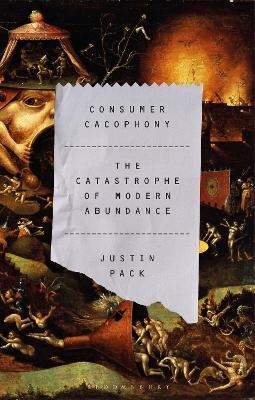
Consumer Cacophony
The Catastrophe of Modern Abundance
Seiten
2026
Bloomsbury Academic (Verlag)
978-1-350-50093-8 (ISBN)
Bloomsbury Academic (Verlag)
978-1-350-50093-8 (ISBN)
- Noch nicht erschienen (ca. März 2026)
- Portofrei ab CHF 40
- Auch auf Rechnung
- Artikel merken
Everyone is producing but no one is thinking about whether we should. This incisive account explains the causes and devastating consequences of the abundance that results.
There is too much. Too much to read, too much to watch, too much to try, too much to buy. For the modern consumer, it’s hard to hear and hard to think amid all of this noise.
This book argues such that cacophony is a nihilistic abundance, threatening not only the physical environment that we live in, but also the coherence of our spiritual and cultural worlds. While we wrestle with the economic, political and environmental impact of too much, we do so in the midst of a crisis in the culture of thinking and feeling.
Understanding that contemporary philosophy often fail to engage with these challenges, Justin Pack turns to thinkers including Nietzsche, Ortega y Gasset, Arendt, Zygmunt Bauman and Charles Taylor to explore the various threats of overproduction. Drawing together what are often seen as separate problems requiring different solutions – material abundance, environmental crisis, the decline of thoughtfulness – Consumer Cacophony’s case studies are drawn from across society and culture, but particularly the phenomena of academic overproduction and social media. This is a thoughtful, incisive account of that global overproduction and its devastating consequences.
There is too much. Too much to read, too much to watch, too much to try, too much to buy. For the modern consumer, it’s hard to hear and hard to think amid all of this noise.
This book argues such that cacophony is a nihilistic abundance, threatening not only the physical environment that we live in, but also the coherence of our spiritual and cultural worlds. While we wrestle with the economic, political and environmental impact of too much, we do so in the midst of a crisis in the culture of thinking and feeling.
Understanding that contemporary philosophy often fail to engage with these challenges, Justin Pack turns to thinkers including Nietzsche, Ortega y Gasset, Arendt, Zygmunt Bauman and Charles Taylor to explore the various threats of overproduction. Drawing together what are often seen as separate problems requiring different solutions – material abundance, environmental crisis, the decline of thoughtfulness – Consumer Cacophony’s case studies are drawn from across society and culture, but particularly the phenomena of academic overproduction and social media. This is a thoughtful, incisive account of that global overproduction and its devastating consequences.
Justin Pack is a Lecturer at California State University, Stanislaus, USA. He studies thoughtlessness and has written books on thoughtlessness in higher education, thoughtlessness and the environmental crisis, thoughtlessness and money, and meritocracy and conservative Christianity.
1. Introduction
2. Nietzsche’s Instincts against Cacophony
3. Ortega y Gasset
4. Arendt
5. The Dual Structure of Cacophony
6. Why did the problem of cacophony disappear?
7. The Ethics of Academic Production
8. Building Counterhegemony
| Erscheint lt. Verlag | 19.3.2026 |
|---|---|
| Verlagsort | London |
| Sprache | englisch |
| Maße | 138 x 210 mm |
| Gewicht | 260 g |
| Themenwelt | Geisteswissenschaften ► Philosophie |
| Sozialwissenschaften ► Politik / Verwaltung ► Politische Systeme | |
| Sozialwissenschaften ► Soziologie | |
| Wirtschaft ► Volkswirtschaftslehre | |
| ISBN-10 | 1-350-50093-3 / 1350500933 |
| ISBN-13 | 978-1-350-50093-8 / 9781350500938 |
| Zustand | Neuware |
| Informationen gemäß Produktsicherheitsverordnung (GPSR) | |
| Haben Sie eine Frage zum Produkt? |
Mehr entdecken
aus dem Bereich


aus dem Bereich
Das politische System der USA und die Zukunft der Demokratie
Buch | Hardcover (2025)
C.H.Beck (Verlag)
CHF 39,20
Russland, Europa, Amerika
Buch | Softcover (2025)
C.H.Beck (Verlag)
CHF 25,20


