


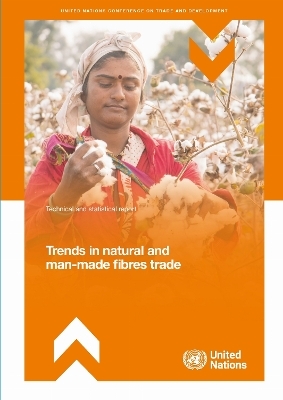
Trends in Natural and Man-made Fibres Trade
Seiten
2025
United Nations (Verlag)
978-92-1-154315-5 (ISBN)
United Nations (Verlag)
978-92-1-154315-5 (ISBN)
- Titel z.Zt. nicht lieferbar
- Portofrei ab CHF 40
- Auch auf Rechnung
- Artikel merken
Examining global fibre industry integration, the analysis reveals varied approaches: China's extensive, low-cost processing across all stages; India's targeted strength in cotton and jute; Vietnam and Türkiye’s process-driven model with imported raw materials; and Italy’s focus on high-value, design-led fabric exports.
This study points to different production and trade integration approaches adopted by countries in the global fibre industry. China has integrated the textile and textile products industries, maintaining a strong presence at all processing stages, dominating fabric exports in most fibre types. China’s predominance can be explained by its vast processing capacity, its domestic production of both natural and man-made fibres, which has allowed its textile and apparel industries to produce low-cost and versatile textile products as demanded inter alia by the fashion industry. India follows a similar but more focused approach, concentrating on sectors where it has a strong presence, particularly cotton and jute. In contrast, countries such as Viet Nam and Türkiye have adopted a process-oriented integration model, specializing in yarn and fabric production, and relying heavily on imported raw materials. Italy represents yet another approach, focusing on high-value segments and building competitive advantage through design and quality in high-end fabric exports. The remainder of the analysis is organized as follows. First, it examines production and trade patterns for different fibre types and product categories, providing detailed data on volumes and values. Second, it analyzes market access conditions, including both tariff and NTMs, and their evolution over time. Third, it examines production and trade integration patterns.
This study points to different production and trade integration approaches adopted by countries in the global fibre industry. China has integrated the textile and textile products industries, maintaining a strong presence at all processing stages, dominating fabric exports in most fibre types. China’s predominance can be explained by its vast processing capacity, its domestic production of both natural and man-made fibres, which has allowed its textile and apparel industries to produce low-cost and versatile textile products as demanded inter alia by the fashion industry. India follows a similar but more focused approach, concentrating on sectors where it has a strong presence, particularly cotton and jute. In contrast, countries such as Viet Nam and Türkiye have adopted a process-oriented integration model, specializing in yarn and fabric production, and relying heavily on imported raw materials. Italy represents yet another approach, focusing on high-value segments and building competitive advantage through design and quality in high-end fabric exports. The remainder of the analysis is organized as follows. First, it examines production and trade patterns for different fibre types and product categories, providing detailed data on volumes and values. Second, it analyzes market access conditions, including both tariff and NTMs, and their evolution over time. Third, it examines production and trade integration patterns.
| Erscheinungsdatum | 04.10.2025 |
|---|---|
| Verlagsort | New York |
| Sprache | englisch |
| Maße | 210 x 297 mm |
| Gewicht | 490 g |
| Themenwelt | Technik |
| Wirtschaft ► Volkswirtschaftslehre ► Makroökonomie | |
| ISBN-10 | 92-1-154315-0 / 9211543150 |
| ISBN-13 | 978-92-1-154315-5 / 9789211543155 |
| Zustand | Neuware |
| Informationen gemäß Produktsicherheitsverordnung (GPSR) | |
| Haben Sie eine Frage zum Produkt? |
Mehr entdecken
aus dem Bereich
aus dem Bereich
Buch | Softcover (2024)
Schäffer-Poeschel (Verlag)
CHF 48,95
Kompakt und prüfungsrelevant für Wirtschaftswissenschaftler
Buch | Softcover (2021)
Vahlen, Franz (Verlag)
CHF 16,65
Kontroversen, Daten und Fakten zur Nachhaltigkeit
Buch | Softcover (2025)
Kohlhammer (Verlag)
CHF 54,60


