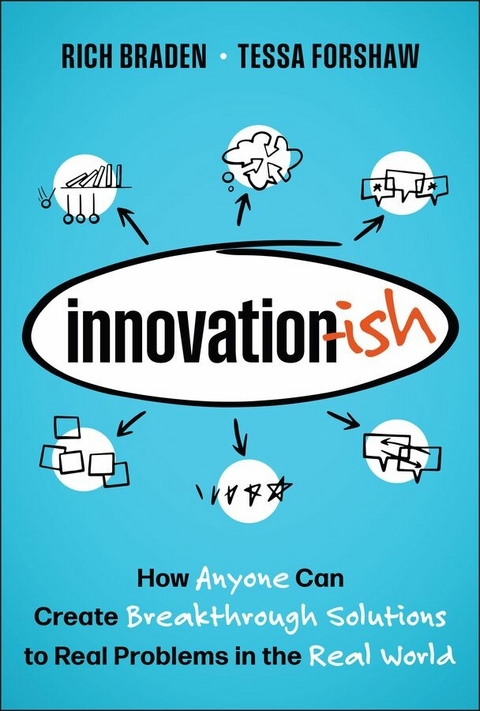
Innovation-ish (eBook)
380 Seiten
Wiley (Verlag)
978-1-394-31894-0 (ISBN)
In a World Where Problems are Everywhere, See Opportunity. Your Essential Guide to Everyday Innovation.
Innovation-ish: How Anyone Can Create Breakthrough Solutions to Real Problems in the Real World is your no-nonsense guide to unlocking your innate creativity. Expertly crafted by design strategist Richard Braden and cognitive scientist Tessa Forshaw, this book skips the fluff and dives straight into actionable strategies to ignite your innovative potential.
Shadow Rich and Tessa through their years of experience. Get behind the scenes access to classrooms, companies, and institutions alongside students and professionals, just like you. Hear stories of real people with real challenges and how they learn and discover innovative new solutions by unlocking their creative potential.
Innovation-ish shows you how to solve problems and generate solutions in a huge variety of personal and professional situations. It's a must-read for people at any stage of life and at any point on their innovation journey.
- If you're new to innovation, this new way of thinking about innovation gives you an easy way in and helps set you on the path.
- If you've been trying to innovate and haven't been successful, Innovation-ish explains why you've been struggling and how to turn your project around.
- If you're experiencing 'imposter syndrome,' Innovation-ish reassures you that you're in the right place and have what you need to do it.
- If you have been successful, Innovation-ish helps you amplify it.
They demystify the myths that surround innovation, reveal the six mindsets that underlie innovation, and show how the moves you make drive innovation forward. And they share the latest relevant cognitive science research in a compelling and digestible way - no degree required.
After years as design educators at Harvard and Stanford and consulting with clients around the world they have seen that anyone, regardless of their background, can be Innovation-ish. Packed with clear, actionable steps, it's the definitive guide for managers, executives, entrepreneurs, founders, and team leaders ready to turbocharge their organizations, projects, and careers.
With an Innovation-ish approach, you can solve problems and generate solutions to challenges in your personal life, a small business, a startup or in any department or function of any type of organization.
All you need is an open mind and small sense of adventure. Let's go!
RICH BRADEN is the founder and CEO of the San Francisco-based consulting firm, People Rocket. The company People Rocket partners with leaders and teams to innovate with confidence to drive clarity, effective execution, and strategic agility in complex, fast-changing environments. For the past 15 years he has been a design educator at universities around the world including Stanford University and Harvard University.
TESSA FORSHAW, PHD, is a cognitive scientist, senior researcher, and co-founder of the Next Level Lab at Harvard University. She teaches design thinking, creativity, and innovation at the Harvard Innovation Lab and Harvard University DCE. She also served on the Teaching Faculty at Stanford's design school for several years, and has worked in innovation consultancies across the world.
In a World Where Problems are Everywhere, See Opportunity. Your Essential Guide to Everyday Innovation. Innovation-ish: How Anyone Can Create Breakthrough Solutions to Real Problems in the Real World is your no-nonsense guide to unlocking your innate creativity. Expertly crafted by design strategist Richard Braden and cognitive scientist Tessa Forshaw, this book skips the fluff and dives straight into actionable strategies to ignite your innovative potential. Shadow Rich and Tessa through their years of experience. Get behind the scenes access to classrooms, companies, and institutions alongside students and professionals, just like you. Hear stories of real people with real challenges and how they learn and discover innovative new solutions by unlocking their creative potential. Innovation-ish shows you how to solve problems and generate solutions in a huge variety of personal and professional situations. It s a must-read for people at any stage of life and at any point on their innovation journey. If you're new to innovation, this new way of thinking about innovation gives you an easy way in and helps set you on the path. If you've been trying to innovate and haven't been successful, Innovation-ish explains why you've been struggling and how to turn your project around. If you're experiencing imposter syndrome, Innovation-ish reassures you that you're in the right place and have what you need to do it. If you have been successful, Innovation-ish helps you amplify it. They demystify the myths that surround innovation, reveal the six mindsets that underlie innovation, and show how the moves you make drive innovation forward. And they share the latest relevant cognitive science research in a compelling and digestible way - no degree required. After years as design educators at Harvard and Stanford and consulting with clients around the world they have seen that anyone, regardless of their background, can be Innovation-ish. Packed with clear, actionable steps, it's the definitive guide for managers, executives, entrepreneurs, founders, and team leaders ready to turbocharge their organizations, projects, and careers. With an Innovation-ish approach, you can solve problems and generate solutions to challenges in your personal life, a small business, a startup or in any department or function of any type of organization. All you need is an open mind and small sense of adventure. Let's go!
Chapter 1
Innovation Hesitation
“Hands up if you're an innovator – if you think you're creative.”
After 15 years of teaching creativity and innovation, we have asked this question to hundreds of groups all over the world. In this instance, we were in front of a roomful of managers and top employees of a global quick-service restaurant, the superstars of their business. They were agile, used to adjusting quickly to changing market conditions and solving complex problems, week after week. They had decades of experience and had won many industry awards because of it.
Despite their achievements, not a single hand went up. These were high-performing professionals actively seeking new ideas to tackle persistent supply-chain challenges, yet they didn't see themselves as innovators. The hesitation in the room was striking. How could this be?
We have encountered the same response in nearly every one of the organizations we've worked with or classes we have taught. Even our students at leading universities around the world are often reluctant to call themselves innovators. A few hands may go up, although never more than 10 percent of the class.
Yet, when we visit elementary school classrooms nearly every eight- and nine-year-old eagerly raises their hand. They are delighted to share their ideas, bursting with confidence in their ability to be creative.
How is it that elementary school kids display more creative confidence than top business leaders and university students? Why don't we see that same energy and boldness in high-achieving professionals? The reality is that years of doubt, scrutiny, cultural norms, and rigid structures have chipped away at their belief in their own creative abilities. The confidence they once had as children has eroded. They've become paralyzed by doubt.
We regularly work with major global organizations, from Coca-Cola Company to the Australian Department of Foreign Affairs and Trade. Again and again, we see that this loss of confidence holds back even the most capable and successful of teams.
Holding Ourselves Back
This reluctance isn't just an individual experience, it's part of a larger pattern we call Innovation Hesitation. Across industries, we've seen hesitation show up in predictable ways that block creative potential, no matter how capable someone is. It takes three primary forms: the Creativity Gap, Innovation Mythology, and Cognitive Caution.
Innovation Hesitation is the Creativity Gap, Innovation Mythology, and Cognitive Caution.The first source of this hesitation is the Creativity Gap that our students and clients feel about their creative capacity, which we described above. They often hold the belief that innovation is reserved for a select few. Iconic innovators are celebrated in books, movies, and news stories, reinforcing the idea that only a select few are truly creative.
This leads people to question themselves:
Who am I to be an innovator?
Often, it's grounded in self-doubt and imposter syndrome. People feel like they're not creative enough or not allowed to participate in real innovation, and this prevents them from engaging in creative problem-solving, further reinforcing their own self-doubt and self-perception as non-creatives.
The Creativity Gap can look like a junior employee hesitating to share a new process improvement idea because they assume only senior leaders drive innovation, or a team defaulting to the “way we've always done it” rather than experimenting with a new approach.
We also see it when a student tells us that they want to start a small business or side project and doubts their ability to come up with original ideas, or when they suggest an out-of-the-box idea, that is quickly shut down because it was “silly.”
The Creativity Gap is fueled by the headlines of books, movies, and articles that tell us stories about what innovation should look like. But, it shows up in small moments for people. Hesitation, self-doubt, imposter syndrome, and the implicit assumption that it is for someone else.
Faced with this hesitation, many people look for inspiration from those they perceive as “real” innovators. They turn to places like Silicon Valley, where innovation is portrayed as larger-than-life. New ideas, new disruptions, new products, and new dreams ignite everywhere. Circular glass and steel buildings rise like sentinels across the landscape, while bright colors, open spaces, and modular furniture serve as the backdrop to where the future is invented. It is the big idea capital.
In these designated “innovation centers,” you find 3D printers, laser cutters, walls covered with sticky notes, and racks of craft supplies ready to be turned into prototypes at 3 p.m. or 3 a.m., whenever the “Eureka!” moment strikes. Posters on the wall explain the “recipe” of innovation; the creative process is diagrammed and documented so that all the technicians and thinkers can align with the magic that produces the next great thing.
It's easy to believe that if you just had the right environment filled with 3D printers, sticky notes, and late-night brainstorming sessions, that you could innovate like the best.
Sure, it's an intoxicating image. There's just one problem. It's not true!
While these images are loosely based on high-level facts, they don't reflect the common-day reality. As former residents ourselves, we love Silicon Valley, the people, and the vibe – but true innovation rarely happens like this. Strip away that image to its foundation: one genius, by themself, follows a secret process and has a revolutionary idea in a moment of epiphany because they are using sticky notes in a brightly colored room.
The belief in these mythical innovation stories can make real innovation feel unreachable, and that is why Innovation Mythology is our second Innovation Hesitation.
Within the Innovation Mythology there are many common mythical tales and characters. For instance, the Special Places myth is the notion of innovation hubs filled with special buildings and sticky notes that makes people believe innovation only happens in high-tech labs, incubators, or trendy coworking spaces. In reality, true innovation happens anywhere. Wherever people are willing to test ideas, adapt, and engage with real-world problems innovation can happen.
The myth of the Lone Genius tells us that breakthroughs come from a single, brilliant mind working in isolation. History shows that the best ideas emerge through collaboration, iteration, and shared knowledge. The famous stories of “lightbulb moments” – the Eureka myth – convinces us that great ideas strike like lightning, when in fact, they evolve over time through trial, failure, and refinement.
These stories might sound harmless, but they shape behavior. For instance, we have often seen schools or companies spending millions of dollars to build special innovation buildings so that they can do innovation. Or a product management team waiting for a “big idea” to strike before getting started on a new product feature, rather than testing small, imperfect concepts and iterating. Innovation Mythology isn't just misleading, it delays progress, and reinforces a deeper, more instinctive apprehension.
When individuals hesitate to innovate, entire organizations stagnate. It spreads through teams and organizations, and entire businesses miss opportunities and fail to adapt. They hold back from taking risks, and in today's world, where change happens faster than ever before, that hesitation can have serious consequences.
The third form of Innovation Hesitation isn't external; instead, Cognitive Caution is deeply ingrained in how our brains function. Our minds are wired to avoid uncertainty, ambiguity, and risk in order to protect us from harm. However, these same instincts can hold us back from taking the necessary risks that drive innovation.
For more than 100 years since its founding in 1888, the Eastman Kodak Company dominated the photography industry. They transformed photography and placed portable cameras in the hands of everyday people. Families, for the first time, could capture those spontaneous moments in their lives, such as their children's first steps. Their iconic “Kodak Moments” became part of everyday language, making photography a staple of modern life.
Then, in 1975, Kodak engineer Steven Sasson invented the world's first digital camera. Kodak's response was something like: “That's a nice idea, but don't tell anyone about it. That's how you shoot yourself in the foot!” Kodak was focused on protecting its dominance in the film market. They dismissed digital photography, fearing it would disrupt their core business. Meanwhile, competitors asked a different question: How can photography evolve in a digital world? By the time Kodak recognized the shift, it was too late. In 2012, Kodak filed for bankruptcy.
Kodak's hesitation wasn't due to a lack of talent or knowledge; it was a perfect example of Cognitive Caution at work. Cognitive Caution is the cognitive instinct to cling to safety and the known world. That means sometimes protecting the familiar at the expense of progress. This natural instinct can work against us, preventing us from taking the very leaps necessary for innovation.
People often prefer predictability and have a tendency to...
| Erscheint lt. Verlag | 3.9.2025 |
|---|---|
| Sprache | englisch |
| Themenwelt | Wirtschaft ► Betriebswirtschaft / Management ► Unternehmensführung / Management |
| Schlagworte | business creativity book • business innovation book • can I learn to be creative? • can you teach creativity? • how to teach creativity? • Innovation Book • Innovation framework • Innovation guide • innovation playbook • Innovation Roadmap |
| ISBN-10 | 1-394-31894-4 / 1394318944 |
| ISBN-13 | 978-1-394-31894-0 / 9781394318940 |
| Informationen gemäß Produktsicherheitsverordnung (GPSR) | |
| Haben Sie eine Frage zum Produkt? |
 EPUB (Adobe DRM)
Kopierschutz: Adobe-DRM
Adobe-DRM ist ein Kopierschutz, der das eBook vor Mißbrauch schützen soll. Dabei wird das eBook bereits beim Download auf Ihre persönliche Adobe-ID autorisiert. Lesen können Sie das eBook dann nur auf den Geräten, welche ebenfalls auf Ihre Adobe-ID registriert sind.
Details zum Adobe-DRM
Dateiformat: EPUB (Electronic Publication)
EPUB ist ein offener Standard für eBooks und eignet sich besonders zur Darstellung von Belletristik und Sachbüchern. Der Fließtext wird dynamisch an die Display- und Schriftgröße angepasst. Auch für mobile Lesegeräte ist EPUB daher gut geeignet.
Systemvoraussetzungen:
PC/Mac: Mit einem PC oder Mac können Sie dieses eBook lesen. Sie benötigen eine
eReader: Dieses eBook kann mit (fast) allen eBook-Readern gelesen werden. Mit dem amazon-Kindle ist es aber nicht kompatibel.
Smartphone/Tablet: Egal ob Apple oder Android, dieses eBook können Sie lesen. Sie benötigen eine
Geräteliste und zusätzliche Hinweise
Buying eBooks from abroad
For tax law reasons we can sell eBooks just within Germany and Switzerland. Regrettably we cannot fulfill eBook-orders from other countries.
aus dem Bereich