
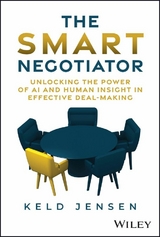
The Smart Negotiator (eBook)
353 Seiten
Wiley (Verlag)
978-1-394-25572-6 (ISBN)
Reinvent your approach to negotiation
In The Smart Negotiator: Unlocking the Power of AI and Human Insight, internationally renowned trainer, speaker, and professor Dr. Keld Jensen takes you on a groundbreaking journey to redefine what it means to be a smart negotiator in a world where human skills meet the transformative capabilities of artificial intelligence. Through engaging commentary, real-world case studies, and AI-driven examples, this book unveils a new perspective on strategic negotiation-where timeless principles like trust and cooperation are amplified by cutting-edge technology.
By harnessing the synergy between human intuition and AI-driven insights which will be explored in the pages of this book, negotiators will learn to expand the room for value creation and achieve unprecedented results for themselves and their counterparts.
This book delivers unique concepts and tools including:
- SMARTnerships: Understand the revolutionary approach to negotiation that emphasizes collaboration and mutual benefit over traditional adversarial tactics.
- Tru$tCurrency: Discover how trust, now measurable with data and AI tools, becomes a negotiator's most valuable asset.
- NegoEconomics?: Leverage AI to uncover hidden opportunities for mutual gain, transforming potential conflicts into collaborative successes.
- AI in Negotiation: Apply the concept that both parties are committed to the discovery of mutual gain.
With practical advice, step-by-step guides, and ethical considerations, this book is essential for any business leader or professional negotiator navigating the complexities of today's AI-driven landscape.
KELD JENSEN, DBA, is a globally recognized negotiation expert, author of 27 books, and professor at leading universities. He is the founder of the SMARTnership Negotiation Organization, ranked among the world's top 3 negotiation programs. He has advised on deals exceeding $12 billion.
Reinvent your approach to negotiation In The Smart Negotiator: Unlocking the Power of AI and Human Insight, internationally renowned trainer, speaker, and professor Dr. Keld Jensen takes you on a groundbreaking journey to redefine what it means to be a smart negotiator in a world where human skills meet the transformative capabilities of artificial intelligence. Through engaging commentary, real-world case studies, and AI-driven examples, this book unveils a new perspective on strategic negotiation where timeless principles like trust and cooperation are amplified by cutting-edge technology. By harnessing the synergy between human intuition and AI-driven insights which will be explored in the pages of this book, negotiators will learn to expand the room for value creation and achieve unprecedented results for themselves and their counterparts. This book delivers unique concepts and tools including: SMARTnerships: Understand the revolutionary approach to negotiation that emphasizes collaboration and mutual benefit over traditional adversarial tactics. Tru$tCurrency: Discover how trust, now measurable with data and AI tools, becomes a negotiator's most valuable asset. NegoEconomics : Leverage AI to uncover hidden opportunities for mutual gain, transforming potential conflicts into collaborative successes. AI in Negotiation: Apply the concept that both parties are committed to the discovery of mutual gain. With practical advice, step-by-step guides, and ethical considerations, this book is essential for any business leader or professional negotiator navigating the complexities of today's AI-driven landscape.
INTRODUCTION
The Evolving World of Negotiation
I claimed in a recent article that negotiation as a science hasn't truly progressed since 1776, the year the Scottish philosopher Adam Smith published The Wealth of Nations.
Walking the Scottish Highlands, Smith envisioned how nations could trade collaboratively, laying the foundation for negotiation as a discipline.
Fast-forward to 1976, when Mr. Iwar Unt, founder of the organization I head today, published his first book in Sweden, or jump to 1981 and the world's best-selling negotiation book, Getting to Yes, by Roger Fisher and William Ury—negotiation had remained relatively unexplored as a professional science. Since then, hundreds of books have advocated collaboration over zero-sum tactics. However, the win-lose approach still dominates, leaving much value untapped.
Do we need more books on negotiation?
The short answer is no. The challenge isn't a lack of knowledge about effective negotiation but a failure to apply it. If more books equaled better negotiators, every industry would have mastered the science by now.
New negotiation books emerge monthly, promising fresh perspectives, yet the issue persists. Effective negotiation already has well-established principles—creating long-term value for both sides. What's missing isn't theory or tools but a change in mindset and practice.
You might find this message strange, coming from someone who has written 27 books on negotiation. But I believe the focus must shift from piling on techniques to understanding what negotiation is—and what it isn't. Successful negotiation isn't about clever tricks but about creating and distributing value, a process requiring consistency, context awareness, and a deep understanding of the people involved.
A Forgotten Potential in Negotiation
Negotiation is one of humanity's oldest tools for resolving conflict and creating opportunities. From bartering in ancient marketplaces to today's complex multinational deals, its essence remains unchanged: finding common ground. Yet, despite advances in technology and behavioral science, negotiators still fall into predictable traps, leaving significant value on the table. Why? Because traditional models focus on claiming value rather than creating it.
This book challenges these outdated notions. By integrating the SMARTnership framework, the revolutionary concept of NegoEconomics, and the transformative potential of AI, it lays the groundwork for moving negotiation from a transactional practice to a transformational one.
Capitalizing on Potential
A critical aspect of successful negotiation is identifying and capitalizing on untapped potential. Research shows that up to 42 percent of the potential value in negotiations remains unutilized. This gap is the basis of NegoEconomics (negotiation economics).
This “lost” value stems from the asymmetry in each party's costs and benefits for negotiation variables. Consider transportation costs. You know it costs your business $20,000, but you might be unaware of your counterpart's cost—say, $15,000. In traditional, zero-sum negotiation, this information remains hidden. However, in an interest-based SMARTnership approach, utilizing NegoEconomics, you and your counterpart would share these details, uncovering a $5,000 negotiable advantage. This is NegoEconomics in action.
Is Negotiation a Science or an Art?
We often hear terms like “the art of negotiation” or “the science of negotiation,” but what do these actually mean? If negotiation were purely an art, perhaps some would be born with a talent for it, like painters or musicians. If it were purely a science, it would rely entirely on structured methods and practice. In reality, negotiation is both—a skillset blending intuition, experience, and practice.
Some naturally enjoy negotiating, but not due to an inherent talent; they appreciate the process and rewards. Yet enjoyment alone doesn't make one a skilled negotiator. To truly excel, we must study, refine, and continuously adapt our approach, just as with any evolving field.
Reflecting on my first book, published in 1998, I was struck by how much negotiation practices have changed. People negotiate differently today than they did 30 years ago. In fact, studies show that 20 percent of professional negotiators are not particularly skilled, often because they dislike negotiating. Ask yourself, “Do I enjoy negotiation?” If so, that's a solid start. If not, there's still room to develop and, potentially, to find enjoyment through mastery. That's where this book can help.
Introduction to a New Era: Negotiation in a World of Sharks—and AI
“Execution trumps talent.”
—Robert Herjavec, Shark Tank
Millions tune in weekly to watch the sharks of Shark Tank negotiate high-stakes deals. Adapted globally from the original Japanese Dragons' Den, the show simplifies negotiation for entertainment while dealing with real stakes: millions of dollars and entrepreneurs' dreams.
While entertaining, Shark Tank reinforces a narrative that negotiation is a zero-sum game, where one party wins and the other loses. Hollywood often amplifies this perspective, portraying negotiation as a battlefield rather than a collaborative opportunity. This portrayal has led many professionals to view negotiation as inherently adversarial—a mindset that undermines the potential for creating mutual value.
The sharks are often called the best negotiators in the world. This book briefly examines that claim, looking at their methods and tactics. But it doesn't stop there. Beyond Shark Tank, this book explores successful negotiations in various domains, analyzing what we can learn from those who excel at creating value, fostering trust, and achieving mutually beneficial agreements.
Studying these examples highlights principles and practices that elevate negotiation from mere transactions to strategic collaborations.
Experience alone does not guarantee expertise in negotiation. Too often, individuals claim decades of experience without realizing they may have been repeating the same flawed approach year after year. Twenty-three years of negotiation does not equate to growth if those years are built on the repetition of ineffective strategies. True mastery comes not from the length of time spent negotiating but from the continuous refinement of skills, thoughtful reflection on outcomes, and the willingness to evolve methods based on proven principles and new insights. Without this, what appears to be 23 years of experience is, in reality, one year of poor negotiation repeated 23 times. This book challenges that mindset, providing the tools to break that cycle and achieve measurable progress.
While Shark Tank simplifies negotiation for TV, its lessons are invaluable. The show's format mirrors real challenges negotiators face, offering insights into creating value under pressure. However, it is equally important to unlearn the adversarial mindset and embrace a more collaborative approach—one that this book guides you through.
The New Negotiator at the Table: Artificial Intelligence
In the spring of 2022, a mid-sized manufacturing company faced a critical supplier negotiation that would determine its future. The traditional approach would have been to squeeze the supplier on price, potentially damaging a long-term relationship. Instead, they employed an AI-enhanced SMARTnership approach. The AI analyzed years of transaction data, numerous variables, existing contracts, market trends, and supply chain patterns, revealing opportunities for value creation that neither party had considered. The result? A deal that increased profits for both parties by 27 percent and strengthened their strategic partnership.
This is not a unique story. Across industries and cultures, AI and SMARTnership negotiation are transforming how we negotiate, not by replacing human negotiators, but by augmenting their capabilities in ways that align perfectly with the principles of SMARTnership negotiation.
The Evolution of Negotiation: From Zero-Sum to AI-Enhanced Value Creation
For centuries, negotiation has been viewed as a battlefield where one party's gain must come at another's expense. This mindset, deeply rooted in the traditional “win-lose” approach, has led to countless missed opportunities and destroyed relationships. Even after groundbreaking works like Getting to Yes were published in 1981, the fundamental approach to negotiation remained largely unchanged.
Consider these sobering statistics:
- 42 percent of the values in a negotiation are never capitalized.
- 33 percent of negotiations beneficial for both parties fail to reach an agreement.
- 35 percent more profit is achieved in high-trust negotiations compared to those with low trust.
- 84 percent of negotiators believe they are negotiating the wrong variables in a negotiation.
The SMARTnership approach was developed to address these challenges by emphasizing trust, transparency, and mutual gain. Now, with the advent of AI, we have the tools to implement these principles more effectively than ever before.
Understanding AI's Role in Modern Negotiation
AI is not just another...
| Erscheint lt. Verlag | 3.9.2025 |
|---|---|
| Sprache | englisch |
| Themenwelt | Wirtschaft ► Betriebswirtschaft / Management ► Unternehmensführung / Management |
| Schlagworte | AI • ai in negotiation • Artificial Intelligence • business negotiation • business trust • enterprise negotiation • executive negotiation • keld jensen • Negotiation • negotiation tactics • smartnership • trustcurrency • win the deal |
| ISBN-10 | 1-394-25572-1 / 1394255721 |
| ISBN-13 | 978-1-394-25572-6 / 9781394255726 |
| Informationen gemäß Produktsicherheitsverordnung (GPSR) | |
| Haben Sie eine Frage zum Produkt? |
 EPUB (Adobe DRM)
Kopierschutz: Adobe-DRM
Adobe-DRM ist ein Kopierschutz, der das eBook vor Mißbrauch schützen soll. Dabei wird das eBook bereits beim Download auf Ihre persönliche Adobe-ID autorisiert. Lesen können Sie das eBook dann nur auf den Geräten, welche ebenfalls auf Ihre Adobe-ID registriert sind.
Details zum Adobe-DRM
Dateiformat: EPUB (Electronic Publication)
EPUB ist ein offener Standard für eBooks und eignet sich besonders zur Darstellung von Belletristik und Sachbüchern. Der Fließtext wird dynamisch an die Display- und Schriftgröße angepasst. Auch für mobile Lesegeräte ist EPUB daher gut geeignet.
Systemvoraussetzungen:
PC/Mac: Mit einem PC oder Mac können Sie dieses eBook lesen. Sie benötigen eine
eReader: Dieses eBook kann mit (fast) allen eBook-Readern gelesen werden. Mit dem amazon-Kindle ist es aber nicht kompatibel.
Smartphone/Tablet: Egal ob Apple oder Android, dieses eBook können Sie lesen. Sie benötigen eine
Geräteliste und zusätzliche Hinweise
Buying eBooks from abroad
For tax law reasons we can sell eBooks just within Germany and Switzerland. Regrettably we cannot fulfill eBook-orders from other countries.
aus dem Bereich