


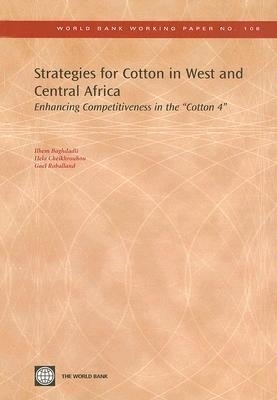
Strategies for Cotton in West and Central Africa
Enhancing Competitiveness in the 'Cotton-4'
Seiten
2007
World Bank Publications (Verlag)
978-0-8213-7131-2 (ISBN)
World Bank Publications (Verlag)
978-0-8213-7131-2 (ISBN)
- Titel z.Zt. nicht lieferbar
- Portofrei ab CHF 40
- Auch auf Rechnung
- Artikel merken
Identifies key reforms and defines strategies to enhance the competitiveness of the cotton sector in West and Central Africa. This work associates the areas of improvement with the following three targets: increasing yields to produce larger volumes, reducing cost and increasing the reliability of grading, and enhancing sales revenues.
Based on comprehensive empirical studies, the paper identifies key reforms and defines strategies to enhance the competitiveness of the cotton sector in West and Central Africa. Lessons learned from the 1990s suggest that transferring public property to private enterprises is not enough, by itself, to put the sector back on a sustainable path.The cotton sector in most West and Central African countries is critical in terms of its contribution to GDP and exports as well as poverty reduction. Until recently, the cotton sector was characterized by a vertically integrated monopolistic structure, whereby all transactions in the chain including, ginning, transportation and input supply were handled by the State Owned cotton company. However during the late 1990s, a number of internal and external factors created the need to reassess the structure of the cotton industries in the region.This assessment revealed that, in this new context, vertically integrated monopolies were too costly to ensure vertical coordination of the cotton supply chain. Areas of improvement are associated with the following three targets: increasing yields to produce larger volumes, reducing cost and increasing the reliability of grading, and enhancing sales revenues. The paper explains how these targets can be effectively pursued through sector reforms.
Based on comprehensive empirical studies, the paper identifies key reforms and defines strategies to enhance the competitiveness of the cotton sector in West and Central Africa. Lessons learned from the 1990s suggest that transferring public property to private enterprises is not enough, by itself, to put the sector back on a sustainable path.The cotton sector in most West and Central African countries is critical in terms of its contribution to GDP and exports as well as poverty reduction. Until recently, the cotton sector was characterized by a vertically integrated monopolistic structure, whereby all transactions in the chain including, ginning, transportation and input supply were handled by the State Owned cotton company. However during the late 1990s, a number of internal and external factors created the need to reassess the structure of the cotton industries in the region.This assessment revealed that, in this new context, vertically integrated monopolies were too costly to ensure vertical coordination of the cotton supply chain. Areas of improvement are associated with the following three targets: increasing yields to produce larger volumes, reducing cost and increasing the reliability of grading, and enhancing sales revenues. The paper explains how these targets can be effectively pursued through sector reforms.
| Erscheint lt. Verlag | 30.8.2007 |
|---|---|
| Reihe/Serie | World Bank Working Paper |
| Verlagsort | Washington |
| Sprache | englisch |
| Maße | 180 x 251 mm |
| Gewicht | 208 g |
| Themenwelt | Wirtschaft ► Volkswirtschaftslehre |
| Weitere Fachgebiete ► Land- / Forstwirtschaft / Fischerei | |
| ISBN-10 | 0-8213-7131-2 / 0821371312 |
| ISBN-13 | 978-0-8213-7131-2 / 9780821371312 |
| Zustand | Neuware |
| Informationen gemäß Produktsicherheitsverordnung (GPSR) | |
| Haben Sie eine Frage zum Produkt? |
Mehr entdecken
aus dem Bereich


aus dem Bereich
Aufruf an Deutschland und Europa
Buch | Softcover (2026)
Springer Fachmedien Wiesbaden GmbH (Verlag)
CHF 46,15
Buch | Softcover (2024)
Kohlhammer (Verlag)
CHF 75,60


