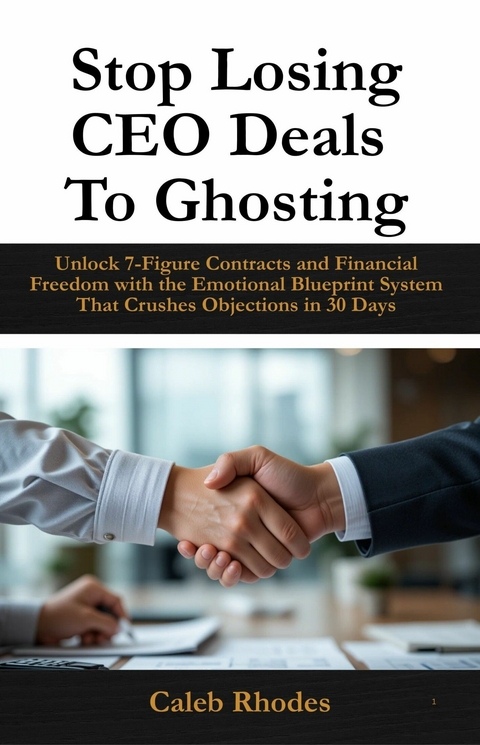
Stop Losing CEO Deals to Ghosting (eBook)
110 Seiten
Publishdrive (Verlag)
978-0-00-104237-7 (ISBN)
Stop Losing CEO Deals to Ghosting: Unlock 7-Figure Contracts
Are you tired of losing high-stakes deals to silent ghosting? You've delivered a flawless pitch and presented a powerful, data-backed solution, only to be met with a sudden, frustrating silence. You’re not alone. The problem isn’t your product; it's a gap in understanding what CEOs truly want and what makes them say 'yes.'
This book is your essential guide to navigating the invisible world of CEO decision-making. Author Caleb Rhodes, a seasoned deal-maker, reveals his 'Emotional Blueprint System'—a powerful framework for moving beyond sales tactics to build a profound connection with top-level executives.
Who This Book Is For: This book is for every sales professional, founder, and business leader who sells to CEOs, founders, or C-suite executives. It is designed for those who are ready to stop just selling products and start solving problems on a strategic, emotional level.
What You Will Learn and Gain:
Understand the CEO's 'Emotional Blueprint': Discover the 10 hidden drivers—from their desire for clarity and control to their fear of reputation damage and bad investments—that dictate every major decision.
Identify and Solve Their Deepest Fears: Learn to identify the unspoken fears that lead to deal-killing ghosting, and get a step-by-step roadmap for turning that fear into confidence.
Position Your Deal as a Path to Their Dreams: Move beyond talking features and learn to position your solution as a direct path to the CEO's ultimate dreams—whether it's market dominance, financial freedom, or a lasting legacy.
Master the Art of the 'Visionary Close': Learn a powerful, new closing method that isn't about high-pressure tactics but about strategic alignment and inviting the CEO to step into their own future.
Unique Tools and Resources:
Unlike other sales books that focus on generic tactics, this guide provides a practical playbook based on real-world experience:
The Emotional Blueprint Framework: A detailed guide to the psychological and strategic levers that influence a CEO's decisions.
Real-World Case Studies: See how these principles work in action with narratives from a variety of industries, including tech, e-commerce, and healthcare.
Actionable Checklists and Scripts: Use the included a 'CEO Deal-Closing Checklist' and 'CEO-Centric Pitch Deck Template' to transform your approach from a generic presentation to a powerful, engaging story.
By the end of this book, you won't just be a deal-maker; you will be a 'deal-shaper'. You will have the key to the CEO's mind and the ability to forge lasting partnerships that unlock bigger, more meaningful deals
Chapter 1: The CEO’s Emotional Blueprint — What They Truly Want in a Deal
The day my colleague Daniel was ghosted by Global Retail Inc. wasn’t a failure; it was a revelation. It was the moment I realized that we were so focused on the logic of our product that we completely missed the emotional logic of our audience. We had built a perfect machine, but we were trying to sell it to someone who cared more about the destination than the engine itself. We were trying to sell a car, but the CEO wanted to buy freedom.
Think about it. A CEO’s mind is a fortress. It is protected with the highest security. Every meeting you schedule, every email you send, every word you speak must contain a valuable treasure inside to justify the time they spend opening the vault. When we think of CEOs, we often picture them as purely logical, data-driven machines. We assume they make decisions based on numbers, spreadsheets, and ROI calculations alone. But that’s a dangerous oversimplification. At the heart of every CEO is a human being with a unique set of desires, fears, and emotional drivers that influence every single decision they make, big or small.
So, how do we get past the gatekeepers and inside the fortress? We have to understand the foundational elements of their emotional blueprint. These aren't just personality traits; they are deeply ingrained strategic imperatives born from the relentless pressure of their role. Let's break down the ten elements that form the core of the CEO's psyche.
1. Clarity and Transparency: The Compass of Confidence
Have you ever felt that sinking feeling when you're in a meeting and the person on the other side is speaking in jargon and buzzwords, and you have no idea what they're actually promising? That's exactly how a CEO feels when a pitch is muddled.
CEOs operate on an extremely tight schedule, and their minds are a constant whirlwind of competing priorities. They simply don't have the mental bandwidth to decipher vague promises or ambiguous proposals. They crave clarity like a parched traveler craves water in the desert. They need to know, without a shadow of a doubt, what they are getting, when they are getting it, and what the precise outcome will be. This isn't just about understanding the product; it's about understanding the entire path forward. The deal is a compass, not just a destination. Your offering isn’t just a product; it’s a tool that helps the CEO navigate their market, guiding them toward their true north of growth and stability.
A recent study by Forrester found that 82% of B2B buyers—which includes CEOs and high-level executives—value a clear, transparent sales process more than any other factor. In a world of over-promising and under-delivering, a transparent deal stands out. I worked with a startup called "ClearPath Analytics" that sold a data visualization tool. Instead of promising "smarter data," their CEO, a woman named Emily, mandated a "30-day Clarity Challenge." She offered a free, no-obligation audit of a potential client's current data flow, culminating in a clear, single-page report showing exactly where their system was inefficient. The report was so simple and transparent that the CEOs they pitched to felt they were already getting value. This approach led to a 60% increase in their close rate because they were building trust from day one by providing pure, undiluted clarity.
Key takeaway: Don’t just sell the product, sell the path. Use a simple, straightforward cause-and-effect structure in your pitch: "Because our software automates the reporting process, you will save 15 hours per week, allowing your team to focus on strategic initiatives."
2. Speed and Efficiency: Time is the CEO’s Currency
Do you feel like you are always one step behind? Like there are not enough hours in the day to get everything done? That’s the default state of a CEO.
For a CEO, time isn't just money; it's the most valuable currency they possess. Every minute they spend in a meeting, reading a report, or approving a document is a minute they could have spent on strategic planning, leadership, or building relationships. They are constantly looking for ways to reclaim their time. An inefficient process is a leaky bucket. Every unnecessary step, every redundant form, is a hole in their bucket, causing them to lose time, money, and momentum. Your solution helps them patch the leaks. When you're in a conversation with a CEO, you need to be speaking directly to this need.
This is a powerful concept to lean into. A consulting firm called "FlowState," which specializes in streamlining workflows for healthcare CEOs, always opens with a single, compelling question: "If you could reclaim just one hour of your week, what would you do with it?" This simple question immediately reframes the conversation from a transaction to a liberation of their most precious resource. Their proposal then clearly outlines not just what their service does, but how it eliminates unnecessary approvals, cuts down on inter-departmental communication lag, and reduces the time it takes to onboard new staff. Their materials even included a simple chart (as depicted below) showing the time saved and the ROI of that time.
3. ROI and Measurable Outcomes: The Proof is in the Numbers
Have you ever bought something that promised the moon, only to find it didn't even deliver a pebble? The CEO has been there, and they're not going back.
The CEO is a chess master, not a checkers player. They aren't thinking one or two moves ahead; they're calculating the long-term impact of your solution on their entire board. For them, a deal is an investment, not an expense. They are constantly asking, "What will I get out of this?" and "Can you prove it?" They need to know that your solution will not only solve a problem but also generate a positive, measurable return on investment. ROI is a seed you plant. You don't just state the return; you plant a seed of potential in their mind, then nurture it with data and case studies until they can clearly envision it growing into a full-fledged, profitable tree.
This is where the power of data and specific case studies comes in. I recall working with an ad agency that was pitching a new marketing strategy to the CEO of a mid-sized e-commerce company. Instead of just showing them mock-ups of ads, they built a detailed ROI calculator. The tool, which they named the "ProfitPredictor," was a simple spreadsheet where the CEO could input their current customer acquisition cost and lifetime value. The agency's projections were pre-populated, and the tool would instantly show them the potential increase in profit from the new campaign. This wasn't just a sales tactic; it was a way of proving, in their own terms, that the ROI was a certainty, not just a possibility.
Quick Takeaway Box:
- Clarity: Use simple language and clear next steps.
- Speed: Frame your solution as a way to save them time.
- ROI: Show them the numbers. Make it impossible to ignore the financial benefit.
4. Trust and Credibility: The Foundation of Influence
Think of the person you go to for advice—the one whose opinion you trust implicitly. What did they do to earn that trust?
Trust is the bedrock of every successful relationship, and it’s no different in the world of high-stakes deals. A CEO is a risk manager. Every decision they make carries a level of risk, and they will only move forward if they believe the person on the other side of the table is credible, honest, and truly has their best interests at heart. A sales pitch is a bridge, not a wall. A good pitch doesn’t just lay out facts; it creates a sturdy bridge of trust and understanding, allowing the CEO to safely cross from their problem to your solution.
A 2023 study published in the Journal of Marketing Research found that perceived trustworthiness of a vendor was the single most important factor in B2B purchase decisions, outweighing even price and product features. So, how do you build this trust? You don't just claim it; you demonstrate it. This involves sharing social proof, like testimonials and case studies, but it also involves showing your vulnerability. I remember a small software company, “CodeGuard,” that provided cybersecurity solutions. Their CEO, Marcus, was pitching a CEO of a healthcare tech firm. Instead of just talking about their product's features, Marcus opened the conversation by sharing a story about a previous client who experienced a minor breach despite their product, and how his team worked around the clock to fix it, even though it wasn't their fault. This honest, authentic story, which showed that they were committed to their clients no matter what, earned them the deal and a long-term partnership.
5. Control and Ownership: The Illusion of Autonomy
Have you ever been told exactly what to do, with no room for your own input? It’s a frustrating and powerless feeling. CEOs feel this, too.
CEOs are, by nature, people who want to be in control. They are the decision-makers, the leaders, the architects of their company's future. While they might be open to new ideas, they will resist anything that makes them feel like they are relinquishing power or becoming a passive participant. The sales process is a co-pilot relationship. You're not the captain telling them where to go; you are their co-pilot, helping them navigate a complex flight path. Your job is to make them feel like they are steering the ship, even when you're the one providing the flight plan.
So how do you do this? You use questions to draw them in and provoke thought. Instead of saying, "You need our software to do X," you ask, "From your perspective, what is...
| Erscheint lt. Verlag | 1.9.2025 |
|---|---|
| Sprache | englisch |
| Themenwelt | Wirtschaft ► Betriebswirtschaft / Management ► Marketing / Vertrieb |
| ISBN-10 | 0-00-104237-8 / 0001042378 |
| ISBN-13 | 978-0-00-104237-7 / 9780001042377 |
| Informationen gemäß Produktsicherheitsverordnung (GPSR) | |
| Haben Sie eine Frage zum Produkt? |
 EPUB (Adobe DRM)
Größe: 1,6 MB
Kopierschutz: Adobe-DRM
Adobe-DRM ist ein Kopierschutz, der das eBook vor Mißbrauch schützen soll. Dabei wird das eBook bereits beim Download auf Ihre persönliche Adobe-ID autorisiert. Lesen können Sie das eBook dann nur auf den Geräten, welche ebenfalls auf Ihre Adobe-ID registriert sind.
Details zum Adobe-DRM
Dateiformat: EPUB (Electronic Publication)
EPUB ist ein offener Standard für eBooks und eignet sich besonders zur Darstellung von Belletristik und Sachbüchern. Der Fließtext wird dynamisch an die Display- und Schriftgröße angepasst. Auch für mobile Lesegeräte ist EPUB daher gut geeignet.
Systemvoraussetzungen:
PC/Mac: Mit einem PC oder Mac können Sie dieses eBook lesen. Sie benötigen eine
eReader: Dieses eBook kann mit (fast) allen eBook-Readern gelesen werden. Mit dem amazon-Kindle ist es aber nicht kompatibel.
Smartphone/Tablet: Egal ob Apple oder Android, dieses eBook können Sie lesen. Sie benötigen eine
Geräteliste und zusätzliche Hinweise
Buying eBooks from abroad
For tax law reasons we can sell eBooks just within Germany and Switzerland. Regrettably we cannot fulfill eBook-orders from other countries.
aus dem Bereich