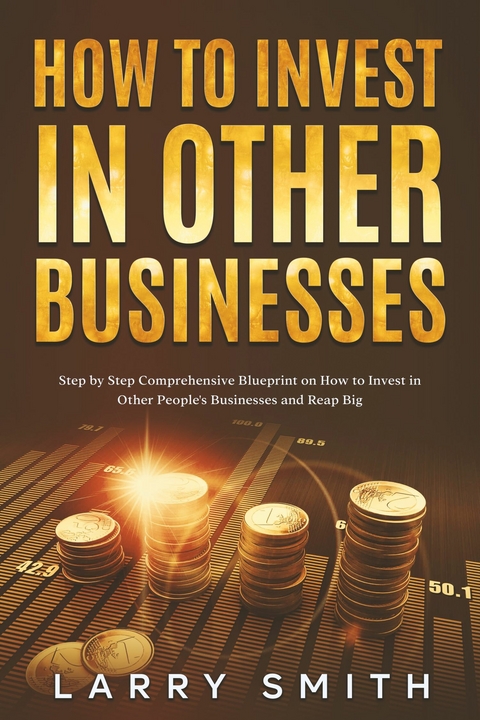
How to Invest in Other Businesses (eBook)
69 Seiten
Fanton Publishers (Verlag)
978-0-00-103597-3 (ISBN)
Are you considering investing in other people's businesses?
And would you want to know how best to go about that to ensure that you do not lose your money and make the best investment decisions?
Well, if that is the case, then
This step-by-step blueprint will show you how to invest in other people's businesses and reap big!
Investing in other businesses is one of the best ways to make money and get an exhilarating experience from helping others. The expectation of discovering a hidden gem, investing in a promising idea, and possibly being part of a business's success story is unbelievably thrilling for investors.
While investing in other businesses, when done right can be quite fulfilling and the possibility of reaping big is there, it is not really that straightforward.
Perhaps you have an opportunity to invest in another business and have all manner of questions going through your mind...
How do I know if a business is promising enough to invest in?
What factors should I consider when deciding which businesses to invest in?
How much should I invest?
How can I mitigate risks when investing in other people's businesses?
What are the possible returns of investing in other people's businesses?
This guide comprehensively discusses these and other questions concerning investing in other people's businesses so you can invest while you are very knowledgeable on the topic.
More precisely, we shall cover the following:
The importance of investing in other businesses
The risks associated with investing in other businesses
The different types of investments possible in other businesses
How to evaluate potential investments
Steps on how to invest in various types of investments
How to negotiate investment terms
And much more!
Even if you've never invested in other people's businesses, this guide will use simple and understandable language to show you how to get started. Also, it provides research-backed tips and information you can bet on to grow your investment portfolio.
Chapter 1: Understanding the Basics of Investing in Other People's Businesses
"If you don't find a way to make money while you sleep, you will work until you die."
Warren Buffet
When Warren Buffet said, "If you don't find a way to make money while you sleep, you will work until you die," he highlighted the importance of passive income.
In simpler terms, if you depend entirely on active income (i.e., income earned through work), you may work for the rest of your life to make ends meet.
Passive income is income you earn without your active participation. It is money that you make when you are not actively working. It can include rental income, dividend payments, and investment interest.
On the other hand, active income is the one you earn through active work or direct participation, such as a salary or hourly wages.
Warren Buffet's quote reminds you to consider the long term and proactively plan for your financial future. You can avoid the trap of working until you die to make ends meet and work toward achieving financial freedom by finding ways to earn money while you sleep.
But how?
Investing in other people's businesses is one of the best ways to achieve this because it allows you to earn money without actively participating in the business's day-to-day operations.
Depending on the type of investment, you may earn income through dividends, profit sharing, or capital appreciation.
And why is this important?
Importance of Investing in Other Businesses
- Potential for High Returns
One of the main reasons it is essential to invest in other people's businesses is the potential for high returns. Investing in different companies can earn you a share of the profits as the business grows and becomes more successful. This can lead to significant financial rewards, mainly if you invest in a company that experiences rapid growth.
For example, investing in a publicly traded company's stock may mean earning passive income through dividend payments. Alternatively, suppose you invest in a privately held company through angel investing, venture capital, or private equity; you may earn passive income through profit sharing or appreciation in the value of your investment.
- Allows for Investment Portfolio Diversification
Another benefit of investing in other people's businesses is it allows you to diversify your investment portfolio. Diversification is vital to managing risk in your investment portfolio.
In other words, investing in various businesses across different industries can spread your risk and avoid overexposure to any one company or industry. This can help to protect your portfolio from market fluctuations and potential losses.
- It Contributes to Your Economical and Societal Quota
It is also a great way to contribute your quota to economic and societal development. You can support other entrepreneurs and small business owners while positioning yourself to benefit from their success.
By helping and supporting entrepreneurs and small business owners, you are aiding in creating jobs, accelerating economic growth, and improving your community. It is a great way to give back to your community or support causes you care about.
And,
Investing in socially responsible or impact-driven businesses can help support initiatives that align with your values and positively impact the world.
- It Provides Personal Benefits
In addition to financial returns, investing in other businesses can also provide personal benefits. By investing in a business, you may have the opportunity to work closely with the business owner or management team, providing input and support to help the company succeed. This investment can likely be a valuable learning experience, providing insights into a business's inner workings and helping you develop your business acumen.
- It gives You More Investment Opportunities
Investing in other businesses can provide access to new and exciting investment opportunities that traditional investments, such as stocks and bonds, may not offer.
For example, by investing in private companies, you can get in on the ground floor of a promising new venture that has yet to go public, resulting in significant rewards as the company grows and expands.
- Provides Tax Incentives
Investing in other companies can also provide tax incentives. Depending on your investment structure and your country's tax laws, you may be able to take advantage of tax breaks and deductions that can lower your overall tax liability.
For example, in the United States, some investments in small businesses can qualify for a tax credit that can offset a portion of your investment.
- It Builds Your Network and Relationships
It can also provide opportunities for networking and building relationships. By working closely with the business owner or management team, you can develop connections and establish a rapport that will likely be valuable in your personal and professional life.
- It is a Fulfilling Experience
Lastly, investing in other people's businesses is a fulfilling and rewarding experience. You may feel satisfied and proud for helping a promising venture succeed.
But what are the risks that come with this kind of investment?
Let's find out!
Risks of Investing in Other People's Businesses
While investing in other people's businesses is an innovative and rewarding investment strategy, it's essential to understand that risks are also involved.
It's essential to be aware of these risks before investing and to consider them carefully when deciding whether to invest in a particular business.
These risks include:
- Business Risk
The success of the business you invest in is never guaranteed, and the industry or company can always fail.
Even with meticulous due diligence, predicting a company's future success or failure is impossible. The risk of a company failing is most significant in its early stages, and many startups fail within the first few years of operation.
- Market Risk
This is the risk that the business's market will change, causing the company to suffer.
Various factors, such as changes in customer behavior, technological advancements, or regulatory changes, can all contribute to market risks.
- Liquidity Risk
Liquidity issues can also make investing in other people's businesses quite risky.
Unlike public stocks or bonds, private investments are likely challenging to sell and take time to find a buyer.
Meaning,
If you need to access your funds quickly, you may be unable to do so, and you may have to wait a long time before being able to sell your investment.
- Dilution Risk
There is also a risk of dilution when investing in startups or early-stage businesses. As the company grows, it may need to raise more capital, which could dilute ownership stake.
This means that your percentage ownership of the company decreases, potentially lowering the value of your investment.
- Management Risk
A company's success is frequently determined by its management team's ability to execute its strategy effectively.
If the management team is incapable or inexperienced, the business may fail, jeopardizing your investment.
- Legal and Regulatory Risk
Investing in other people's businesses may expose you to legal and regulatory risks
Private companies are subject to various laws and regulations, and failure to comply can result in financial penalties, lawsuits, or other legal issues.
So,
To avoid potential issues, carefully review the legal and regulatory compliance of the business you are considering investing in.
- Financial Risk
Financial risks associated with private businesses may also impact the value of your investment.
For example, the company may have high debt levels, limited cash flow, or other financial issues that affect its ability to pay bills, meet obligations, and grow the company.
Therefore, it is critical to carefully review the company's financial statements and assess its financial health before investing.
- Concentration Risk
Investing in other people's businesses can also carry concentration risk.
What does this mean?
If you put a large portion of your portfolio into a single company, you may be exposed to a higher level of risk if the company fails or performs poorly.
And that's why diversification is essential for reducing this risk.
- Scams and Fraud
Unfortunately, investing in other people's businesses can also expose you to the risk of scams and fraud.
Some unscrupulous individuals may attempt to sell you fraudulent investment opportunities, promising high returns with little to no risk.
To avoid this,
It's essential to thoroughly research any investment opportunity before investing and to be wary of any deal that seems too good to be true.
By being aware of these risks and taking steps to mitigate them, you can make informed investment decisions and potentially achieve significant returns through investing in other people's...
| Erscheint lt. Verlag | 9.5.2025 |
|---|---|
| Sprache | englisch |
| Themenwelt | Wirtschaft ► Betriebswirtschaft / Management ► Finanzierung |
| ISBN-10 | 0-00-103597-5 / 0001035975 |
| ISBN-13 | 978-0-00-103597-3 / 9780001035973 |
| Informationen gemäß Produktsicherheitsverordnung (GPSR) | |
| Haben Sie eine Frage zum Produkt? |
 EPUB (Adobe DRM)
Größe: 4,2 MB
Kopierschutz: Adobe-DRM
Adobe-DRM ist ein Kopierschutz, der das eBook vor Mißbrauch schützen soll. Dabei wird das eBook bereits beim Download auf Ihre persönliche Adobe-ID autorisiert. Lesen können Sie das eBook dann nur auf den Geräten, welche ebenfalls auf Ihre Adobe-ID registriert sind.
Details zum Adobe-DRM
Dateiformat: EPUB (Electronic Publication)
EPUB ist ein offener Standard für eBooks und eignet sich besonders zur Darstellung von Belletristik und Sachbüchern. Der Fließtext wird dynamisch an die Display- und Schriftgröße angepasst. Auch für mobile Lesegeräte ist EPUB daher gut geeignet.
Systemvoraussetzungen:
PC/Mac: Mit einem PC oder Mac können Sie dieses eBook lesen. Sie benötigen eine
eReader: Dieses eBook kann mit (fast) allen eBook-Readern gelesen werden. Mit dem amazon-Kindle ist es aber nicht kompatibel.
Smartphone/Tablet: Egal ob Apple oder Android, dieses eBook können Sie lesen. Sie benötigen eine
Geräteliste und zusätzliche Hinweise
Buying eBooks from abroad
For tax law reasons we can sell eBooks just within Germany and Switzerland. Regrettably we cannot fulfill eBook-orders from other countries.
aus dem Bereich