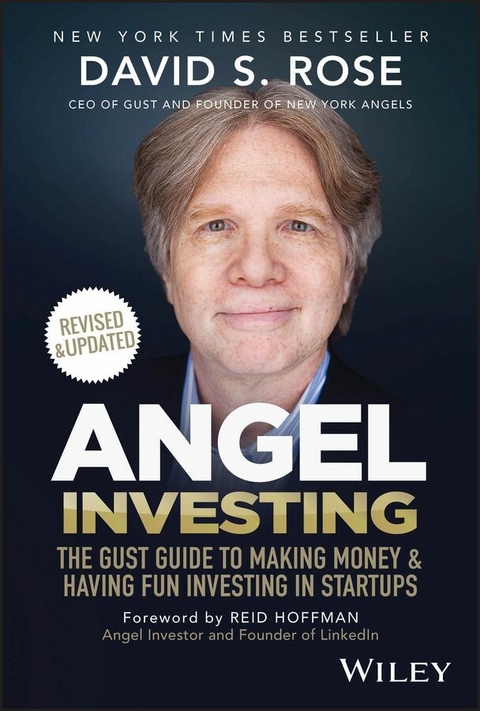
Angel Investing (eBook)
373 Seiten
Wiley (Verlag)
978-1-394-33142-0 (ISBN)
A practical roadmap to achieve annual returns of 25% or more with a well-designed angel portfolio
Angel Investing is a comprehensive, entertaining guide that walks readers through every step of the way to becoming a successful angel investor. From building your reputation as a smart investor, to negotiating fair deals, to adding value to your portfolio companies and helping them implement smart exit strategies, this book provides both the fundamental strategies and the specific tools you need to take full advantage of this rapidly growing asset class.
Written by David S. Rose, the founder of Gust, the global platform that powers the world of organized professional angel investing, this book delivers insights on:
- Why everyone with six figures to invest should consider angel investing, plus the non-financial rewards of angel investing
- How to source and identify high-potential opportunities, and build your angelic reputation so that the best deals come to you
- The impact of AI and advancing technology on angel investing and why you absolutely must completely understand the concept of exponential growth
- The impact of crowdfunding, syndicates, and the global revolution on angel investing
- Major angel investing blogs, groups, and courses to explore
Angel Investing is an essential read for all investors seeking to establish a long-term view and approach to angel investing as a serious part of an alternative asset portfolio while also enjoying being an integral part of exciting new ventures.
DAVID S. ROSE is a serial entrepreneur, Inc. 500 CEO, and renowned early stage investor, described by Forbes as 'New York's Archangel'. He is the Founder of New York Angels, Associate Founder of Singularity University, and Founder of Gust, the global startup platform connecting over a million startups with over 100,000 investors.
A practical roadmap to achieve annual returns of 25% or more with a well-designed angel portfolio Angel Investing is a comprehensive, entertaining guide that walks readers through every step of the way to becoming a successful angel investor. From building your reputation as a smart investor, to negotiating fair deals, to adding value to your portfolio companies and helping them implement smart exit strategies, this book provides both the fundamental strategies and the specific tools you need to take full advantage of this rapidly growing asset class. Written by David S. Rose, the founder of Gust, the global platform that powers the world of organized professional angel investing, this book delivers insights on: Why everyone with six figures to invest should consider angel investing, plus the non-financial rewards of angel investing How to source and identify high-potential opportunities, and build your angelic reputation so that the best deals come to you The impact of AI and advancing technology on angel investing and why you absolutely must completely understand the concept of exponential growth The impact of crowdfunding, syndicates, and the global revolution on angel investing Major angel investing blogs, groups, and courses to explore Angel Investing is an essential read for all investors seeking to establish a long-term view and approach to angel investing as a serious part of an alternative asset portfolio while also enjoying being an integral part of exciting new ventures.
Introduction: How I Became an Angel Investor
ONE DAY DURING my junior year in college, I received a letter from my great-uncle Dave, inviting me to join him for lunch in New York the following month. It seemed that a few of his close friends would be joining us, which was disappointing, because I enjoyed talking one-on-one with Uncle Dave. Imagine my surprise when the other three guests arrived … and it turned out that every one of them was a Nobel Laureate!
Although the intervening years have clouded my memory of exactly what we talked about that day with Rosalyn Yalow, I. I. Rabi, and Murray Gell-Mann, I recall being fascinated by how familiar my 84-year-old great-uncle was with the subjects being discussed, and how intimately these three intellectual giants conversed with their close friend. They were far from the only such luminaries who made up Great-Uncle Dave's regular circle of acquaintances.
David Rose, after whom I have the privilege of being named, was an extraordinary person. Born in Jerusalem in the 19th century, he moved to New York as a child, where he grew up in poverty on the Lower East Side, and ended his formal schooling after the ninth grade. As an industrious entrepreneur, he founded several companies with his older brother Sam (my grandfather), including the family construction and real estate development business, which is still going strong over a century later.
But the most interesting thing to me about Uncle Dave was his propensity for finding and supporting a wide range of technological innovation. It turns out that this boy from the streets, with little technical education but boundless energy and curiosity, had met with Albert Einstein, was the closest of friends with Vladimir Zworykin (inventor of the television tube), and described himself as an “innovation catalyst” decades before the term angel investor was coined. He would learn of a potentially exciting new technical development, bring it to the attention of an appropriate scientist or university, and provide the Seed funding that would enable them to research and commercialize it.
He was the primary supporter behind the development of the portable artificial kidney developed by Dr. Willem Kolff (who invented the artificial heart), the hyperbaric operating unit at Mt. Sinai Hospital, vascular stapling for rapid surgery, and the Foundation for Medical Technology, one of the leading funders of new medical instrumentation. He also personally invented through-the-wall air conditioning for high-rise residential construction.
The effects of his investments reverberate even today. To assist with the development of a novel desalination project that he cofounded in Israel in the 1960s, he hired a young graduate student named Yossi Vardi, who went on to become the youngest ever Israeli Minister of Development and today is one of the world's leading angel investors himself (with even more companies in his portfolio than I have).
The inspiration that David Rose provided to me was carried on in turn by my father, Daniel Rose, who won Ernst & Young's Entrepreneur of the Year award when he was in his 70s, and who to this day is developing new projects and new ventures in his late 90s! Their legacy has given me a unique perspective on the financing and development of entrepreneurship. While I am not alone in being a fifth-generation entrepreneur, I do believe that I may be one of the world's few third-generation angel investors.
With all of these role models in front of me, I began my own entrepreneurial career bright and early at the age of six, charging my friends five cents each to get a peek at my newborn baby brother. When I was eight, my father gave me a bound notebook so that I could write down all my inventions, and by the time I was out of elementary school, I had a graphic design business that produced marketing materials for my other brother, who performed as a magician at children's parties. In high school, I founded an in-school movie program, co-opting a maintenance man to serve as a projectionist of films that I got corporations to send me for free. By college, I was buying firewood wholesale and selling it retail and was running the school's print shop with a staff of dozens of apprentices. In the 1970s I was profiled in the college's daily newspaper as an “Entrepreneur” (their quotes, which just shows you how unfamiliar the term was back then).
After finishing my MBA in the early 1980s, I cofounded my first technology-related business with Dr. Peter Garrity, one of my business school professors. The Computer Classroom was one of the world's first corporate computer training programs, teaching executives how to use spreadsheets and word processing programs. I was also fully engaged in my day job of real estate development, but continued to start tech companies on the side. One of them developed enough traction in the nascent wireless communications space that I finally transitioned into the tech world full time.
Thanks to an amazing amount of luck, my first business managed to get funding from a top-tier venture capital fund in the early 1990s and eventually grew into a multinational, internet-based communications company with 120 people on staff. When the dot-com crash came along with the new millennium and wiped out a decade's worth of effort, my long-suffering spouse suggested that I take a vacation from entrepreneurship and get a “real” job.
So I became an angel investor.
The result is that over the past twenty-five years I have had just about as much fun as it is possible to have with your clothes on. Twenty years ago I founded New York Angels, which today is one of the most active angel groups in the world, having put more than $150 million to work across more than 500 early-stage ventures. I've personally invested in over 120 innovative companies, and had exits—some in the seven figures—based on acquisitions by companies like Amazon, Uber, Google, Facebook, Intel, CBS, Kodak, and others. Along the way I've met some of the most extraordinary entrepreneurs and investors in the business and had the opportunity to teach and mentor hundreds of others through my lectures at Yale, Harvard, Columbia, and other business schools, as well as my TED Talks on pitching to investors, which have been viewed nearly two million times. I founded the Finance, Entrepreneurship & Economics program at Singularity University, was named Mentor of the Year by New York University's Stern School of Business, “Patriarch of Silicon Alley” by Red Herring magazine, “New York's Archangel” by Forbes, and received an honorary doctorate from Stevens Institute of Technology.
After all this, my wonderful spouse finally relented and let me get back into the entrepreneurial business, which enabled me to found Gust, the online platform that today powers the global angel investing industry. Gust has been used by over a million startups in 192 countries to collaborate with more than 75,000 serious angel investors. It has been the official platform of many of the world's national angel investor federations and has tracked the investment of billions of dollars in early-stage angel and Seed investments.
These experiences on both sides of the entrepreneurial finance table have provided me with a unique, birds' eye view of the world of early-stage investing. They have made it clear that angel investing has moved from being a casual sport of the super-rich to a legitimate asset class for everyone with a level of assets or income that would qualify them as an Accredited Investor.
There is a major change sweeping through the world of business that began in the 20th century and took off in the 21st, whose full import is just beginning to sink in. Advances in technology are accelerating at a truly extraordinary rate, and the effect will be to turn upside down virtually everything that we think we know about business and finance. Every year or so, the power of technology is doubling at the same time its cost is being halved, and every year technology is being applied to an ever-increasing number of new industries. As a result, it is not an exaggeration to state that any company designed for success in the 20th century is doomed to failure in the 21st. This is a great opportunity for people who have even a moderate amount of capital to invest (usually north of $100K) and are willing and able to take prudent risks with a portion of it: angel investors!
Consider just a few examples: commercial airlines, retail booksellers, higher education, agriculture, music and entertainment, consumer electronics, even the urban taxi business. In every case, an existing industry is being completely upended by changes in technology, regulations, and/or marketplaces. More than 90 percent of today's Fortune 500 companies were not even on the list when it was first compiled in 1955. The result is that the biggest, most valuable companies of tomorrow are just being formed today, but rarely do public stock market investors manage to participate in the explosive early growth phase of their value creation.
There is, however, a way for private investors to take part, by investing in—and supporting—a company from its very beginnings. This form of investment can be extraordinarily lucrative. When Ben Silberman approached New York Angels in April 2009 seeking a small investment in his interactive mobile catalog idea, he valued his company at $2.5 million. In January 2024, just 15 years later, Pinterest was valued at over $25 billion—an increase of 1 million percent. As...
| Erscheint lt. Verlag | 26.8.2025 |
|---|---|
| Vorwort | Reid Hoffman |
| Sprache | englisch |
| Themenwelt | Wirtschaft ► Betriebswirtschaft / Management |
| Schlagworte | angel investing capital • angel investing companies • angel investing deal screening • angel investing due diligence • angel investing groups • angel investing regulations • angel investing strategy • angel investing technology • Reid Hoffman |
| ISBN-10 | 1-394-33142-8 / 1394331428 |
| ISBN-13 | 978-1-394-33142-0 / 9781394331420 |
| Informationen gemäß Produktsicherheitsverordnung (GPSR) | |
| Haben Sie eine Frage zum Produkt? |
 EPUB (Adobe DRM)
Kopierschutz: Adobe-DRM
Adobe-DRM ist ein Kopierschutz, der das eBook vor Mißbrauch schützen soll. Dabei wird das eBook bereits beim Download auf Ihre persönliche Adobe-ID autorisiert. Lesen können Sie das eBook dann nur auf den Geräten, welche ebenfalls auf Ihre Adobe-ID registriert sind.
Details zum Adobe-DRM
Dateiformat: EPUB (Electronic Publication)
EPUB ist ein offener Standard für eBooks und eignet sich besonders zur Darstellung von Belletristik und Sachbüchern. Der Fließtext wird dynamisch an die Display- und Schriftgröße angepasst. Auch für mobile Lesegeräte ist EPUB daher gut geeignet.
Systemvoraussetzungen:
PC/Mac: Mit einem PC oder Mac können Sie dieses eBook lesen. Sie benötigen eine
eReader: Dieses eBook kann mit (fast) allen eBook-Readern gelesen werden. Mit dem amazon-Kindle ist es aber nicht kompatibel.
Smartphone/Tablet: Egal ob Apple oder Android, dieses eBook können Sie lesen. Sie benötigen eine
Geräteliste und zusätzliche Hinweise
Buying eBooks from abroad
For tax law reasons we can sell eBooks just within Germany and Switzerland. Regrettably we cannot fulfill eBook-orders from other countries.
aus dem Bereich