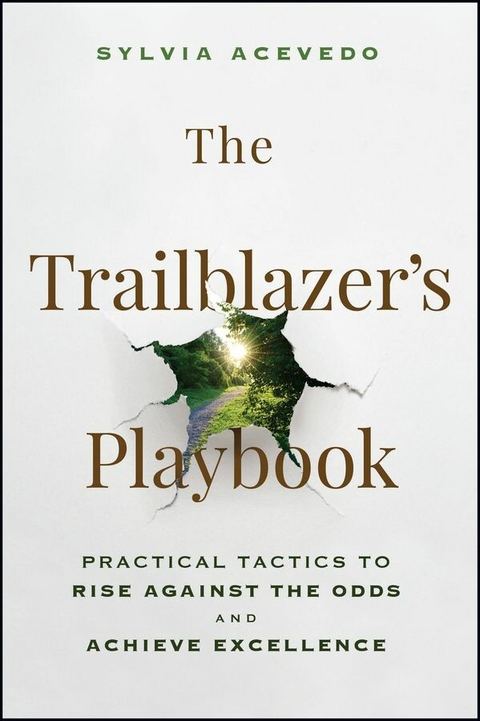
The Trailblazer's Playbook (eBook)
238 Seiten
Wiley (Verlag)
978-1-394-31892-6 (ISBN)
Discover how you can achieve the impossible from someone who's done it before
In The Trailblazer's Playbook: Practical Tactics to Rise Against the Odds to Achieve Excellence, celebrated executive, entrepreneur, and engineer and rocket scientist Sylvia Acevedo delivers an insightful and transformative manifesto for everyone who dares to defy the odds and achieve greatness. The author chronicles the relentless pursuit of excellence and the resilience you'll need to overcome extraordinary challenges.
The book takes you through an odyssey of the most pivotal moments in Acevedo's life, chronicling her trailblazing career and the tragedies she overcame to achieve personal growth. It's packed with practical advice and actionable strategies you can apply immediately to your own life to help you conquer obstacles, overcome loss, embrace risk, and seize opportunities.
You'll also find:
- 'The Story of the Three No's' - a demonstration of how relentless determination can turn setbacks into opportunities
- Discussions of the importance of personal and mental health and the freedom offered by forgiveness
- Strategies for defining and communicating your value in a way that's aligned with your strategic goals
Perfect for professionals, aspiring leaders, and anyone driven to overcome challenges and realize their full potential, The Trailblazer's Playbook is also a must-read for early-career professionals and students just beginning their own careers.
SYLVIA ACEVEDO is an engineer, entrepreneur, former CEO, and NASA rocket scientist with a legacy of leadership in technology, business, and public service. She currently serves on the boards of Qualcomm and Credo and speaks nationally and internationally on STEM, cybersecurity, leadership, and inspiring high performance.
1
Convince Yourself
The Power of Clarity
It started as a simple question, asked during a conversation with the Stanford researcher in the mid‐aughts: Why did I excel in math and science? At the time, I didn't have an answer. It felt natural to say, “I just liked it.” But looking back now, I see it wasn't that simple. My success was rooted in pivotal moments from my childhood—moments that shaped my belief in myself before anyone else did.
Convincing yourself is the first and, perhaps, hardest step. It is far easier to accept the world's expectations for you, especially when they're set low. For me, this first step took shape in a desert town, in the shadow of a father's attention I desperately craved.
My mother was very strict, but her love was always abundant, warm, and unconditional. However, my father's love and approval were harder to earn. His praise wasn't freely given, and the yearning for his love and approval instilled in me a powerful motivation to excel, to prove myself worthy of his acknowledgment. It was through this pursuit that I began to carve out my identity, reinforcing a sense of self‐worth and determination that would shape my path forward.
I grew up in a very traditional household. My parents, Ofelia Monge Acevedo and Benito Manuel Acevedo, met in El Paso, Texas, at a church social at the First Spanish Baptist Church. They were young adults when they started their family: first Mario, then two years later, I was born, followed by my sister Laura four years later, and then my brother Armando eight years later.
My father, a college graduate who had an ROTC scholarship from Texas Western College (now UTEP), fulfilled his military commitment by serving in the Army, first on active duty and then in the reserves. I was born while he was stationed at Ellsworth Air Force Base in South Dakota, a world far from the Chihuahuan Desert of the arid Southwest where my parents felt at home.
After my father's tour of service was over, our family moved to Las Cruces, New Mexico, bringing us closer to our roots in the Southwest and for a time, when my father couldn't find work, to live with other family members.
After my father got a job at White Sands Missile Range, we moved our family of five, two adults and three children, to a rental house on a dirt street in Las Cruces, New Mexico. My father, a traditional family patriarch, favored my older brother Mario—a dynamic that ignited a fierce competitive spirit within me as I craved my father's attention and set out to excel in everything that Mario did that my father valued, whether it was schoolwork, reading, or even firing pistols. Mario had a natural talent for reading, art, and model airplane building—interests that my father didn't nurture. But in subjects my father really cared about, reading, math, and science, I was determined to match, if not surpass, my brother.
My father, a dedicated reader of books and magazines, would often spend evenings at the small adobe building that housed the Thomas Branigan Library, just a short walk from our home. I longed to join him and my older brother on their library visits, anticipating the day I could explore that world alongside them. One evening, my brother returned home with a stack of books and proudly showed off his new library card. Instantly, I wanted one too, but my father was hesitant, unsure if I was responsible enough to care for borrowed books as someone who wasn't even in first grade.
Determined, I asked what I needed to do so I could have my own library card. My father set a condition: I could have one if I saved five dollars, enough to cover any possible damages or losses. Although this requirement hadn't been applied to my brother, it offered me a clear path forward to obtain the coveted library card. I threw myself into the pursuit of earning every coin, taking on extra chores, checking vending machines, and looking for any coins, whatever I could find to fill my piggy bank. One day, my mother agreed that my piggy bank felt heavy enough to hold at least five dollars. Together, we cracked it open, and I carefully counted the stacks of pennies, nickels, dimes, and the occasional quarter. To my delight, I had surpassed the five‐dollar goal.
My mother took me to the local Doña Ana Bank, where I opened a savings account and received a savings passbook. That evening, when my father came home, I could hardly contain my excitement as I proudly showed him my passbook, proof that I had met his challenge. My father, holding my new savings passbook, finally agreed to take me to the library along with my older brother. We went to the library and later, as I held my very own library card in my hands, I realized something powerful: if I set a goal, worked hard, and didn't give up, I could achieve it.
Paid to Save Money
At the time, I didn't fully grasp the significance of being the only one in my family with a savings account. We lived entirely on cash, stretching each paycheck to make ends meet. A checking or savings account wasn't part of our world—it simply wasn't how we operated. Yet, without realizing it, my parents had already given me a foundation in hustle, discipline, and financial independence.
My father lived in the world of books and science, not finance, so it wasn't surprising that it was my mother who took me to the bank. My mother understood that even though she and my father didn't have a bank account or a credit card, the act of opening one for me, her eldest daughter, was a step toward something bigger. My mother saw a future for me where I could have choices, security, and the ability to shape my own financial destiny.
Once I had the savings passbook, I wanted to fill the rest of the pages. I still remember the thrill of adding a few more dollars to my account and handing my passbook to the bank teller. She entered my deposit—but then, on a separate line, added another amount. Confused, I asked what it was. With a smile, she explained that it was interest—money the bank paid me just for keeping my savings there. Even better, she said the more I saved, the more the bank would add each month. She told me that when I had saved $500—an astonishing sum for me at the time, a hundred times my initial deposit—she told me I could open a CD (certificate of deposit), where the bank would pay me even more interest. That moment wasn't just a lesson in financial literacy—it set me on a trajectory of disciplined saving, a principle that helped me reach my financial goals throughout my life. That small moment, that first deposit, planted a seed. It showed me that wealth wasn't just about what you earned—it was about what you saved, and didn't spend, so that it grew over time.
It was a lesson I carried forward, shaping my belief in what was possible. Later, I realized that small triumphs like this were lessons and preparation for much bigger dreams.
Family Heartbreak
Even though the streets in our neighborhood were unpaved, I didn't see it as a hardship—I saw it as home. I never thought about what we didn't have or that most families were just getting by. What mattered was the energy of the neighborhood—kids always outside playing, and a park just a few blocks away where every day felt like an adventure. There was a tiny corner store where a single penny could buy a piece of candy, and shelves conveniently stocked with basic food necessities. To me, it wasn't about what we lacked—it was about the fun and simple joys that were waiting just outside our front door.
But one day, everything changed. A meningitis epidemic swept through our dirt‐road community, leaving heartbreak in its wake—shattering families, altering futures, and claiming far too many children's lives. My younger sister, Laura, just 19 months old, was among its victims. Her fever soared to dangerous heights, and when the fever finally broke, the damage was done—irreversible brain damage that would alter the course of her life forever. She would never be able to read beyond a first‐grade level, her world now shaped by limitations that blindsided our entire family, changing everything in an instant.
Laura had been the spark of our family, a whirlwind of energy who lit up every room she entered. Determined to keep up with my brother and me, she had skipped the crawling stage entirely, launching straight into walking as if she couldn't wait to chase after life. But after the illness, everything shifted. Laura's life trajectory changed, as did our family's. Though she recovered physically and always had an engaging personality, her abilities were forever impacted, and we struggled to adjust to this new reality.
We were thrust into an unfamiliar world, one where love and resilience were tested in ways we never saw coming. But it wasn't just the challenges ahead—it was us. The foundation of our family had shifted, altered by the weight of grief, uncertainty, and the unspoken struggles that followed. We weren't just navigating a new reality; we were a different family now, forever changed.
My father carried on, going to work each day to provide for our family, as if nothing had changed. But for my mother, everything had. Shaken by the realization that the epidemic had only spread in our dirt‐road neighborhood, she became determined to move us somewhere safer—a neighborhood with paved streets.
Until Laura's...
| Erscheint lt. Verlag | 26.8.2025 |
|---|---|
| Sprache | englisch |
| Themenwelt | Sachbuch/Ratgeber ► Beruf / Finanzen / Recht / Wirtschaft ► Bewerbung / Karriere |
| Wirtschaft ► Betriebswirtschaft / Management | |
| Schlagworte | business self-help book • Career guide • career help • Career self-help • determined leadership • inspirational leadership • inspiring leadership examples • Leadership Book • leadership examples • leadership guide • leadership handbook • Self-Help Book |
| ISBN-10 | 1-394-31892-8 / 1394318928 |
| ISBN-13 | 978-1-394-31892-6 / 9781394318926 |
| Informationen gemäß Produktsicherheitsverordnung (GPSR) | |
| Haben Sie eine Frage zum Produkt? |
 EPUB (Adobe DRM)
Kopierschutz: Adobe-DRM
Adobe-DRM ist ein Kopierschutz, der das eBook vor Mißbrauch schützen soll. Dabei wird das eBook bereits beim Download auf Ihre persönliche Adobe-ID autorisiert. Lesen können Sie das eBook dann nur auf den Geräten, welche ebenfalls auf Ihre Adobe-ID registriert sind.
Details zum Adobe-DRM
Dateiformat: EPUB (Electronic Publication)
EPUB ist ein offener Standard für eBooks und eignet sich besonders zur Darstellung von Belletristik und Sachbüchern. Der Fließtext wird dynamisch an die Display- und Schriftgröße angepasst. Auch für mobile Lesegeräte ist EPUB daher gut geeignet.
Systemvoraussetzungen:
PC/Mac: Mit einem PC oder Mac können Sie dieses eBook lesen. Sie benötigen eine
eReader: Dieses eBook kann mit (fast) allen eBook-Readern gelesen werden. Mit dem amazon-Kindle ist es aber nicht kompatibel.
Smartphone/Tablet: Egal ob Apple oder Android, dieses eBook können Sie lesen. Sie benötigen eine
Geräteliste und zusätzliche Hinweise
Buying eBooks from abroad
For tax law reasons we can sell eBooks just within Germany and Switzerland. Regrettably we cannot fulfill eBook-orders from other countries.
aus dem Bereich