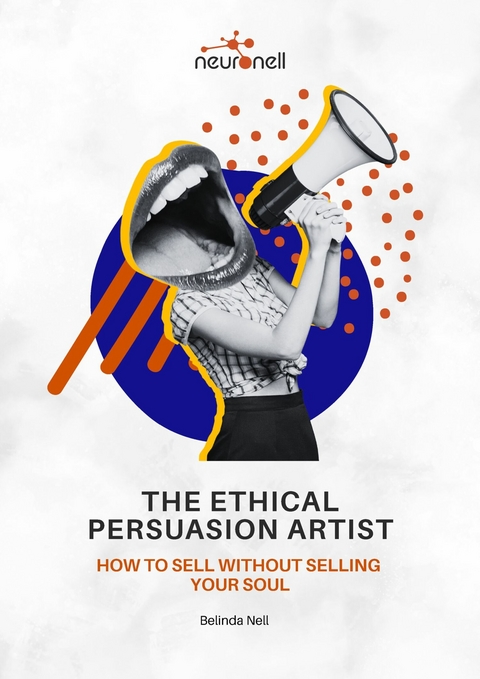
The Ethical Persuasion Artist (eBook)
482 Seiten
Publishdrive (Verlag)
978-0-00-103101-2 (ISBN)
The Sales Book That Won't Make You Want to Hide Under Your Desk
You've thrown more cash at sales courses than most people spend on a decent car. You've endured countless webinars promising to transform your pipeline and sat through seminars where shouty motivational speakers flog their next course for roughly the price of a kidney.
Yet here you are, still wondering how to close deals without feeling like a complete fool.
Say hello to The Ethical Persuasion Artist, the sales book that talks to you like a grown-up instead of a walking wallet with abandonment issues.
The sales industry overflows with people teaching techniques they've never actually used to close proper deals with real money. It's like taking driving lessons from someone whose only experience with cars involves watching Top Gear.
Your prospects can detect desperation quicker than a dodgy prawn sandwich. They've been pitched at more times than a county cricket match, and they're thoroughly cheesed off with salespeople who sound like they've consumed a corporate jargon manual for breakfast.
This book takes a different approach entirely and won't cure your insomnia!
It's written by someone who's actually sold things. Proper things. To genuine companies. With actual budgets. Groundbreaking stuff, really.
You'll understand why emotions drive 95% of buying decisions, which explains why your perfectly logical presentations keep losing to competitors who grasp that people buy with their hearts and justify with their calculators.
We'll examine the psychology of trust building because relationships matter more than your quarterly targets, and customers can tell when you're more interested in your commission than their actual problems.
You'll learn to communicate across cultures without accidentally insulting anyone's business practices, family traditions, or preferred biscuit dunking methods.
We'll tackle virtual selling reality, because video calls aren't disappearing, and neither is your need to build genuine connections through a laptop screen whilst your cat attempts to gate-crash every important meeting.
You won't discover cheesy closing techniques, manipulation tactics that make you feel grubby, or scripts that make you sound like a malfunctioning chatbot.
You will find research-backed strategies that work, genuine conversations you can have with actual humans, and approaches that help you sleep better knowing you're genuinely helping people solve problems.
Perfect for sales professionals who want to close more deals without losing their dignity, are fed up with courses costing more than a small house deposit, believe business relationships should be built on mutual respect rather than mutual deception, and suspect there might be a better way to sell without checking their soul at reception.
Stop wasting money on sales training that doesn't work. Start building communication skills that turn prospects into advocates and transactions into proper relationships.
Your bank account will thank you. Your conscience will thank you. Your prospects might actually thank you too.
1
Chapter 1: Why Words Win Wars (And Close Deals)
“The difference between the almost right word and the right word is really a large matter—it’s the difference between the lightning bug and the lightning.” — Mark Twain
The $1 Billion Dollar Smile
In 1997, Walmart entered Germany with the same swagger that had conquered American retail. After acquiring two German retail chains for nearly $2 billion, the world’s largest retailer was confident it would replicate its American success in Europe’s largest economy.
Nine years later, Walmart fled Germany with its tail between its legs, selling its 85 stores to rival Metro at a pre-tax loss of $1 billion. What went wrong wasn’t the business model, the pricing strategy, or even the competition. It was words and the complete misunderstanding of how they land in different cultures.
Walmart trained its German cashiers to smile at customers and greet them warmly, following the successful American model of “service with a smile.” Unfortunately, nobody told Walmart that in German culture, smiling at strangers feels about as comfortable as a root canal. As Hans-Martin Poschmann, a union secretary, explained: “People found these things strange; Germans just don’t behave that way.”
The company also instituted morning exercises and motivational chants for employees. Picture dozens of German workers forced to do jumping jacks while chanting corporate slogans before their shift. It’s like asking introverts to perform improv comedy. The practices that build team spirit in American culture made German workers deeply uncomfortable, as if they’d been sentenced to participate in a particularly awkward corporate summer camp.
German customers didn’t just feel awkward; they felt manipulated by what they perceived as “plastic smiles” and corporate theatrics. When you’re used to efficient, no-nonsense service, suddenly being greeted by someone grinning like they’ve won the lottery feels deeply suspicious.
The language failure went deeper than cultural tone-deafness. Walmart operated its German locations from offices in the United Kingdom, making English the corporate language. Many older German managers didn’t speak English, creating constant communication breakdowns that would make a game of telephone look efficient. Key managers from the acquired stores left, taking crucial supplier relationships with them. Major brands like Adidas, Samsonite, and Nike refused to work with Walmart.
This wasn’t just cultural insensitivity; it was cultural arrogance that cost $1 billion. The same words and behaviours that built Walmart’s empire in America destroyed its dreams in Germany faster than you could say “Guten Tag.”
The KFC Revolution: When Words Create Empires
While Walmart was failing spectacularly in Germany, another American company was writing a very different story in China. In 1987, Kentucky Fried Chicken opened its first restaurant in Beijing and fundamentally changed how global businesses should think about communication.
Unlike McDonald’s, which entered China three years later with about as much cultural awareness as a tourist wearing socks with sandals, KFC made a radical decision: it wouldn’t try to be KFC. Sam Su, who led KFC’s China operations, understood that “China doesn’t have the same culture of individualism that is present in the United States.”
Su’s strategy was revolutionary: KFC “would not be seen as a foreign presence but as part of the local community.” Instead of parachuting in American executives who couldn’t tell Beijing from Bangkok, KFC hired Chinese managers who understood both the restaurant business and Chinese consumers while having experience with Western business practices. “It was a foot in both worlds,” noted Harvard’s Mary Shelman.
The language strategy extended to every aspect of the business. Instead of hiring managers from America who would need subtitles to understand their customers, KFC hired managers from Taiwan who understood Chinese culture and could bridge Eastern and Western business practices. This “Taiwan Gang” had up to 10 years of experience in fast food and formed local partnerships to create localized menus and management practices.
The results were spectacular. By 1988, the Beijing KFC outlet had the highest volume sales of any KFC restaurant in the world. Today, KFC operates over 11,900 outlets across China and was named the most powerful foreign brand in China in 2013. Not bad for a company that started by selling chicken to a nation that had never heard of the Colonel.
Meanwhile, McDonald’s struggled with cultural communication like a fish trying to climb a tree. McDonald’s adopted the slogan “Get together at McDonald’s; enjoy the happiness of family life.” This messaging worked brilliantly in America but landed in China with all the impact of a wet napkin. Instead, KFC adopted traditional Chinese themes in their commercials and marketing.
The communication difference was profound: In China, McDonald’s became associated with Western food, while KFC was considered locally adapted. Words didn’t just determine market perception; they determined market dominance. McDonald’s learned the hard way that what works in Kansas doesn’t necessarily work in Kunming.
The Neuroscience of First Impressions
Dr. Alexander Todorov’s Princeton laboratory houses some of the most sophisticated brain imaging equipment in the world. His research team has spent over a decade studying what happens in the human brain during those crucial first moments of meeting someone new.
The results should terrify every salesperson.
Using brain scanners, Todorov discovered that people form lasting judgements about trustworthiness, competence, and likability in just 100 milliseconds. That’s one-tenth of a second, faster than you can say “nice to meet you.” These snap judgments occur before conscious thought and predict with startling accuracy whether someone will purchase from you, recommend you to colleagues, negotiate cooperatively or aggressively, or remember you positively months later.
Even more unsettling: these judgements are nearly impossible to change. People shown faces for just 100 milliseconds made trust assessments that barely budged even after 30 minutes of additional exposure. Your first impression isn’t just important; it’s practically permanent.
The Brain’s Ancient Alarm System
The amygdala, our brain’s ancient alarm system, makes these lightning-fast assessments. When you speak your first words, this almond-sized structure is rapidly firing questions: Friend or foe? Competent or incompetent? Trustworthy or suspicious? High status or low status?
Get these first moments right, and the amygdala relaxes, allowing rational evaluation to begin. Get them wrong, and you’re fighting an uphill battle against neurological resistance that makes climbing Everest look easy.
The Language Trigger Points
Consider how different opening statements activate completely different neural pathways:
Defensive Activation: “Hi, I’m James from TechSolutions Ltd. I’m calling to see if you’d be interested in our new software platform that could potentially help streamline your operations and maybe save you some money.”
This statement triggers multiple alarm bells. “I’m calling” signals interruption and intrusion. “See if you’d be interested” screams agenda-driven sales pitch. “Could potentially” reeks of uncertainty and overselling. “Maybe save you some money” sounds like the weakest value proposition since “Buy now, regret later.”
Collaborative Activation: “Hi, I’m James. I’m calling because manufacturing companies in your region are facing some unique challenges with supply chain visibility, and I’m curious whether you’re experiencing similar pressures.”
This statement activates cooperation circuits. Industry-specific knowledge signals competence. “Curious whether” suggests genuine interest rather than a hidden agenda. “Similar pressures” demonstrates peer understanding. No immediate sales pitch creates a trustworthy first impression.
The Apple Store Revolution: Psychology in Action
When Steve Jobs announced Apple would open retail stores, industry experts predicted spectacular failure. Gateway Country stores had flopped harder than a comedy special about tax law. Dell had abandoned retail entirely. The conventional wisdom was clear: people won’t buy computers without extensive price comparisons and technical specifications.
But Jobs understood something revolutionary about purchase psychology. People don’t buy features; they buy feelings. They don’t want technical specifications; they want their lives transformed.
Apple banned traditional computer retail language entirely. Out went phrases like “This laptop has 1GB of RAM,”...
| Erscheint lt. Verlag | 20.8.2025 |
|---|---|
| Sprache | englisch |
| Themenwelt | Wirtschaft ► Betriebswirtschaft / Management ► Marketing / Vertrieb |
| ISBN-10 | 0-00-103101-5 / 0001031015 |
| ISBN-13 | 978-0-00-103101-2 / 9780001031012 |
| Informationen gemäß Produktsicherheitsverordnung (GPSR) | |
| Haben Sie eine Frage zum Produkt? |
 EPUB (Adobe DRM)
Größe: 1,9 MB
Kopierschutz: Adobe-DRM
Adobe-DRM ist ein Kopierschutz, der das eBook vor Mißbrauch schützen soll. Dabei wird das eBook bereits beim Download auf Ihre persönliche Adobe-ID autorisiert. Lesen können Sie das eBook dann nur auf den Geräten, welche ebenfalls auf Ihre Adobe-ID registriert sind.
Details zum Adobe-DRM
Dateiformat: EPUB (Electronic Publication)
EPUB ist ein offener Standard für eBooks und eignet sich besonders zur Darstellung von Belletristik und Sachbüchern. Der Fließtext wird dynamisch an die Display- und Schriftgröße angepasst. Auch für mobile Lesegeräte ist EPUB daher gut geeignet.
Systemvoraussetzungen:
PC/Mac: Mit einem PC oder Mac können Sie dieses eBook lesen. Sie benötigen eine
eReader: Dieses eBook kann mit (fast) allen eBook-Readern gelesen werden. Mit dem amazon-Kindle ist es aber nicht kompatibel.
Smartphone/Tablet: Egal ob Apple oder Android, dieses eBook können Sie lesen. Sie benötigen eine
Geräteliste und zusätzliche Hinweise
Buying eBooks from abroad
For tax law reasons we can sell eBooks just within Germany and Switzerland. Regrettably we cannot fulfill eBook-orders from other countries.
aus dem Bereich