


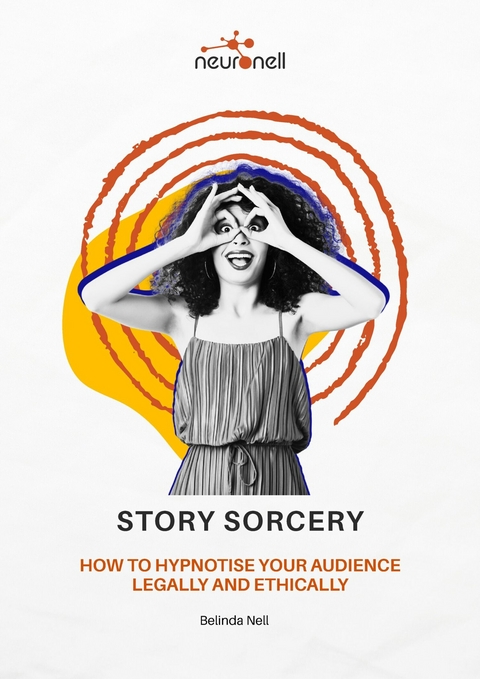
Story Sorcery (eBook)
320 Seiten
Publishdrive (Verlag)
978-0-00-103097-8 (ISBN)
Ever wondered why your brilliant marketing campaigns land with all the grace of a giraffe on roller skates?
Welcome to the delightfully twisted world where neuroscience meets marketing, and your customer's brain becomes your secret weapon (ethically, of course).
Story Sorcery reveals the shocking truth: whilst you've been crafting logical arguments about features and benefits, your customers' brains have already decided whether they fancy you or not. In roughly 13 milliseconds. That's faster than it takes you to realise you've put odd socks on.
Drawing from cutting-edge research at Harvard, MIT, and Stanford, this book exposes the beautiful chaos happening inside every customer's head. You'll discover why 95% of purchasing decisions happen unconsciously, how stories literally rewire listener's brains, and why Pepsi's Kendall Jenner advert became a $6 billion lesson in what not to do.
Inside this brain-bending journey, you'll learn:
Why your reptilian brain acts like the world's most paranoid bouncer
How to speak to all three brains in your customer's head (yes, they have three)
The neuroscience behind why people queue for hours to buy things they could order online
Ethical influence techniques that make customers thank you instead of tolerate you
Why that 'visual information is processed 60,000 times faster than text' statistic is complete bollocks
Perfect for:
Marketers tired of shouting into the digital void
Business owners who want customers to actually listen
Anyone curious about why humans make beautifully irrational decisions
People who enjoy science served with a generous helping of wit
This isn't about manipulation, it's about communication that works with human nature instead of wrestling against it. Because understanding minds isn't just good business; it's good karma.
Warning: May cause sudden clarity about why your previous marketing felt like performing Shakespeare to a room full of goldfish.
1
Chapter 1: The Attention Hijacking Handbook
Or How to Stop Being Invisible in a Noisy World
The Neuroscience of Attention (Why Your Brain Has Trust Issues)
Your potential customer’s brain is essentially drowning in information every day. Researchers estimate that our senses gather approximately 11 million bits of information per second from our environment, which is equivalent to having thousands of conversations happening simultaneously whilst trying to focus on just one. Meanwhile, your conscious mind can only process about 40 bits per second. It is rather like trying to drink from a fire hose whilst someone throws buckets of additional water at your face.
Your marketing message is competing with all of this for a slice of attention that lasts, on average, somewhere between a few seconds to a few minutes depending on the context. The widely cited claim that human attention spans have dropped to 8 seconds (shorter than a goldfish’s alleged 9 seconds) has become something of an internet legend. Whilst a Microsoft study in 2015 did explore attention patterns, the specific “8 versus 9 seconds” comparison appears to have originated from unverified sources rather than actual research. What we do know is that our brains have become remarkably efficient at filtering information, which makes genuine attention increasingly valuable.
For context on just how fleeting attention can be, consider that researchers measured goldfish attention spans not with tiny questionnaires (though that would be amusing), but by observing their ability to navigate mazes and respond to stimuli. Turns out goldfish can actually maintain focus for months when properly motivated, which probably makes them better at completing projects than most of us.
How do you cut through this chaos and actually reach your customer’s brain?
The Neuroscience of Attention (Why Your Brain Has Trust Issues)
Your brain has evolved an incredibly sophisticated filtering system called the Reticular Activating System (RAS). Think of it as a bouncer for your consciousness, deciding what information gets into your awareness and what gets ignored faster than a telemarketer’s phone call.
The RAS is a real neurological structure, a network of neurons located in your brainstem that genuinely does act as a filter for consciousness. Research shows this system helps regulate wakefulness, attention, and the filtering of sensory information. It decides what’s important enough to bring to your conscious awareness whilst filtering out the constant barrage of irrelevant stimuli.
Research from MIT shows that our brains can process visual information in as little as 13 milliseconds. But the crucial part is this: within those first few milliseconds, your RAS has already decided whether something is:
- Important enough to notice
- Threatening enough to avoid
- Boring enough to ignore
This system exists because if we consciously processed every piece of information our senses receive, we would be completely paralysed by overwhelm. Instead, our RAS acts like an incredibly efficient assistant, filtering for:
Survival-relevant information (threats, opportunities, basic needs)
Goal-relevant information (things related to current objectives)
Novel or unexpected information (pattern breaks, surprises)
Emotionally charged information (anything that triggers feelings)
Understanding this system is the key to creating marketing that actually gets noticed rather than filtered out with the digital detritus.
I once worked with a cybersecurity company that was struggling to get its message heard in a crowded market. Every competitor was screaming about “advanced threat protection” and “enterprise-grade security.” Our breakthrough came when we realised we were all speaking the same boring language to the RAS.
Instead of leading with features, we started our campaigns with: “Last Tuesday at 3:47 PM, someone tried to steal your customer database.”
That pattern interrupt, the specificity, the immediacy, the implied threat, cut through the noise like a fire alarm. Their lead generation increased by 287% in the first quarter.
Epic Fail Alert: When Good Intentions Meet Bad Filtering
In 2018, a well-meaning charity organisation launched a campaign to raise awareness about homelessness. They placed realistic-looking homeless people (actually actors) in high-traffic areas of London, complete with cardboard signs asking for help.
The campaign failed spectacularly. Not only did people ignore the actors, but security guards repeatedly asked them to move along, and several were nearly arrested for vagrancy.
What went wrong: The campaign triggered the RAS’s “ignore the familiar” response. Urban brains are trained to filter out homelessness as part of the normal city background. The more realistic the campaign, the more effectively it was ignored.
The lesson: Fighting the RAS’s natural filtering rarely works. It is far more effective to work with these systems than against them.
The charity later pivoted to a campaign showing homeless people in unexpected contexts, a rough sleeper reading Dostoevsky, another solving complex mathematics problems. This pattern interrupt forced people to notice and reconsider their assumptions.
Pattern Interrupts: The Art of Productive Disruption
One of the most powerful ways to capture attention is through pattern interrupts, unexpected elements that break people’s standard information processing patterns.
Consider these examples from successful email campaigns:
Traditional subject lines:
“Our Spring Sale is Here!” - Predictable, easily filtered
“Save 25% on All Products” - Standard promotional language
Pattern interrupt subject lines:
“I probably shouldn’t tell you this…” - Creates curiosity gap
“Your competitor just rang…” - Unexpected and specific
The pattern interrupt works because it creates what psychologists call a “cognitive itch”, an unresolved loop that the brain wants to close. It is the exact mechanism that makes you unable to ignore a half-finished crossword puzzle or a song with the last note missing.
Netflix has mastered this with their cliffhanger episode endings. As showrunner Shonda Rhimes once joked, “I’m not in the entertainment business, I’m in the sleep deprivation business.”
Brain Hack #1: The Incomplete Loop Technique
Based on research from Dr. Bluma Zeigarnik (the Zeigarnik Effect), our brains have a strong tendency to remember interrupted or incomplete tasks better than completed ones. This is a genuine psychological phenomenon that has been studied extensively since the 1920s, though results have been mixed in replication studies.
The effect occurs because incomplete tasks create psychological tension that keeps them active in our memory until resolved. Whilst not every study has replicated Zeigarnik’s original findings consistently, the core principle remains valuable for marketers.
How to apply this:
Headlines that create curiosity gaps: “The marketing mistake that cost Nike millions (and how they fixed it)”
Email sequences that end with cliffhangers: “Tomorrow I’ll reveal the surprising reason this campaign failed…”
Social media posts that start conversations: “I’m about to share something controversial about customer personas…”
Real-world success story: When Buffer tested curiosity-gap subject lines against completion-focused ones, they saw significant improvements in open rates. The key difference was creating genuine intrigue whilst delivering on the promise.
The Contrast Principle: Making Your Message Pop
Neuroscientist Dr. David Eagleman’s research shows that our brains are wired to notice differences rather than absolutes. We do not see “red”, we see “redder than the background.” This explains why sameness is the enemy of attention.
This principle explains why the iPhone’s original advertising was so effective. While every phone company was highlighting technical specifications, Apple showed a finger touching a screen. The contrast was so stark that it redefined an entire industry.
Evidence-based contrast strategies:
Before/After Narratives: Case studies structured as transformation stories consistently outperform feature-focused content because they highlight contrast between states.
Problem/Solution Frameworks: Messages that clearly establish a problem before presenting the solution create natural contrast that makes the solution more memorable.
Unexpected Comparisons: When Buffer compared their social media tool to...
| Erscheint lt. Verlag | 22.8.2025 |
|---|---|
| Sprache | englisch |
| Themenwelt | Wirtschaft ► Betriebswirtschaft / Management ► Marketing / Vertrieb |
| ISBN-10 | 0-00-103097-3 / 0001030973 |
| ISBN-13 | 978-0-00-103097-8 / 9780001030978 |
| Informationen gemäß Produktsicherheitsverordnung (GPSR) | |
| Haben Sie eine Frage zum Produkt? |
 EPUB (Adobe DRM)
Größe: 2,2 MB
Kopierschutz: Adobe-DRM
Adobe-DRM ist ein Kopierschutz, der das eBook vor Mißbrauch schützen soll. Dabei wird das eBook bereits beim Download auf Ihre persönliche Adobe-ID autorisiert. Lesen können Sie das eBook dann nur auf den Geräten, welche ebenfalls auf Ihre Adobe-ID registriert sind.
Details zum Adobe-DRM
Dateiformat: EPUB (Electronic Publication)
EPUB ist ein offener Standard für eBooks und eignet sich besonders zur Darstellung von Belletristik und Sachbüchern. Der Fließtext wird dynamisch an die Display- und Schriftgröße angepasst. Auch für mobile Lesegeräte ist EPUB daher gut geeignet.
Systemvoraussetzungen:
PC/Mac: Mit einem PC oder Mac können Sie dieses eBook lesen. Sie benötigen eine
eReader: Dieses eBook kann mit (fast) allen eBook-Readern gelesen werden. Mit dem amazon-Kindle ist es aber nicht kompatibel.
Smartphone/Tablet: Egal ob Apple oder Android, dieses eBook können Sie lesen. Sie benötigen eine
Geräteliste und zusätzliche Hinweise
Buying eBooks from abroad
For tax law reasons we can sell eBooks just within Germany and Switzerland. Regrettably we cannot fulfill eBook-orders from other countries.
aus dem Bereich


