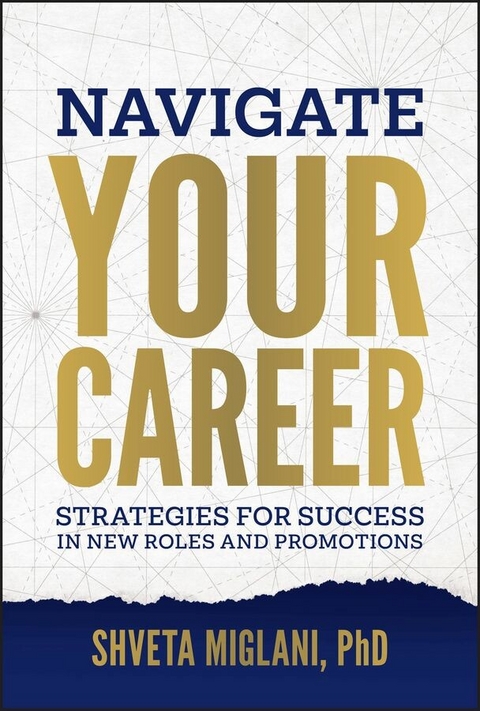
Navigate Your Career (eBook)
249 Seiten
Wiley (Verlag)
978-1-394-35787-1 (ISBN)
Increase your impact in your next job and accelerate your career with straightforward and proven workplace techniques
In Navigate Your Career: Strategies for Success in New Roles and Promotions, career, organization, and leadership development expert Shveta Miglani delivers an original and exciting new guide to navigating your career. With anecdotes and real-life experiences from leaders at Amazon, the Boston Celtics, Mastercard and Adobe, the author walks you through seven key ways you can make your professional journey more rewarding and successful at every stage.
You'll find easy-to-implement advice you can use today to help you realize your work goals, including setting appropriate, realistic, and measurable goals to working with your organization's proprietary technology as a new hire. You'll discover how to learn about the business of your new company, understand your firm's culture, and how to meet your professional and personal development benchmarks.
Inside the book:
- How to develop and maintain a sense of authenticity in the workplace that allows you to thrive without pretense
- Strategies for navigating remote, on-site, and hybrid work roles, and how to handle the unique challenges that come with each type of position
- Ways to build strong relationships with people at your new job, including how to find the right mentors
Perfect for professionals stepping into a new role at a new company, Navigate Your Career: Strategies for Success in New Roles and Promotions is also a must-read book for every ambitious person-at any stage of their career-who wants to maximize the impact they have on their organization and make their professional lives more rewarding.
SHVETA MIGLANI, PhD, is a seasoned leadership development and talent management executive with over 22 years of experience guiding and transforming human resources teams. Her expertise spans HR strategy, organizational development, and leadership coaching-helping companies foster a culture of growth, innovation, and long-term success. With a deep understanding of how to drive meaningful and lasting change, Shveta has been instrumental in shaping workplaces that empower professionals and enhance business outcomes.
Increase your impact in your next job and accelerate your career with straightforward and proven workplace techniques In Navigate Your Career: Strategies for Success in New Roles and Promotions, career, organization, and leadership development expert Shveta Miglani delivers an original and exciting new guide to navigating your career. With anecdotes and real-life experiences from leaders at Amazon, the Boston Celtics, Mastercard and Adobe, the author walks you through seven key ways you can make your professional journey more rewarding and successful at every stage. You'll find easy-to-implement advice you can use today to help you realize your work goals, including setting appropriate, realistic, and measurable goals to working with your organization's proprietary technology as a new hire. You'll discover how to learn about the business of your new company, understand your firm's culture, and how to meet your professional and personal development benchmarks. Inside the book: How to develop and maintain a sense of authenticity in the workplace that allows you to thrive without pretense Strategies for navigating remote, on-site, and hybrid work roles, and how to handle the unique challenges that come with each type of position Ways to build strong relationships with people at your new job, including how to find the right mentors Perfect for professionals stepping into a new role at a new company, Navigate Your Career: Strategies for Success in New Roles and Promotions is also a must-read book for every ambitious person at any stage of their career who wants to maximize the impact they have on their organization and make their professional lives more rewarding.
Introduction
By failing to prepare, you are preparing to fail.
—Benjamin Franklin
ON MARCH 30, 1994, INDRA NOOYI joined her new role as a corporate strategist at PepsiCo. Before PepsiCo, she had worked for quite a few years as a product manager and strategic consultant at companies like Johnson & Johnson, Motorola, Boston Consulting Group, and ABB. She was an experienced professional when she joined PepsiCo. In the first few months of starting her role, she did all the right things. She met with her team and department heads and, most important, she asked questions of her boss about PepsiCo's finances, structure, and priorities. Doing this helped her to excel in her role and to use all the key resources around her to learn about PepsiCo's culture and its people. She met the team in different locations around the world in her initial months to learn directly from the source about the inner workings of different functions. She put in hours to study, prepare, and continue to learn by surrounding herself with various resources and giving it all she had.
Nooyi knew, to ramp up in her new role, she would need to invest equal time in all the areas, stakeholders, and the business. She went on to become the CEO of PepsiCo from 1996 to 2012, and one could say her initial steps of strategizing in her new role helped to lay that foundation. Nooyi's example serves as a powerful reminder that, regardless of your level in your professional career, strategically planning your path before joining a job is a crucial investment of your time.
Regardless of your level in your professional career, strategically planning your path before joining a job is a crucial investment of your time.
Evolution of Work
Since the late 18th century, the Industrial Revolution has profoundly transformed work, shifting it from agrarian economies to industrialized urban centers. Factories centralized production, introducing mass manufacturing techniques that demanded long hours—often 12 to 16 hours a day, six days a week—with low wages and little regard for worker safety. Child labor was prevalent, and working conditions were hazardous. Despite these grueling hours, wages were meager, with men earning slightly more than women, and children, who also worked in factories, earning the least. The factory environment was hazardous, with little regard for worker safety, as machines lacked safety covers and accidents were common. Children as young as five were employed to operate machinery, often because their small fingers could handle delicate tasks. In Norman Ware’s book, The Industrial Worker 1840‐1860, he highlights about the working conditions during the Industrial Revolution. Factory workers, including children, endured long hours—sometimes exceeding 12 to 16 hours a day—with minimal breaks. The work environments were poorly ventilated, dimly lit, and filled with hazardous machinery, leading to frequent injuries. Employers prioritized efficiency over worker safety, and labor laws were virtually nonexistent. Over time, labor movements and government regulations improved conditions, but the early years of industrialization were marked by exploitation and hardship.
Over time, these harsh realities spurred the rise of labor unions and movements advocating for workers' rights, better wages, and safer working environments. Today, the work landscape has changed dramatically. Modern workplaces typically feature standard eight‐hour workdays, five days a week, with paid holidays and vacation time. Strict safety regulations and labor laws now protect workers, who receive fair wages, health insurance, retirement plans, and other benefits. A greater emphasis on work‐life balance has become more common and includes flexible working hours and remote work options.
Today, companies allocate substantial resources to identify and hire the right candidates for their job openings. These resources encompass financial investments, equity, time, and energy. This holds particularly true in high‐growth organizations, where the competition for top talent is fierce. Each new hire represents a significant financial commitment for the company even before they officially begin their role. Research consistently shows that the highest turnover rates within organizations occur among newcomers. Even if a company experiences just a few instances of turnover, the associated costs—both in terms of hiring and training—are substantial.
Organizations are keenly aware of the significant resources they invest in hiring and onboarding new employees. They are committed to your success and have put in place various processes, resources, and support systems to help you thrive. However, your active engagement and proactive approach are crucial to fully benefit from this supportive environment. As you embark on your new role, remember that your success is directly tied to the company's ability to achieve its business goals.
Starting a new professional chapter, whether it's a shift within your current organization or a leap to a new one, requires a strategic approach. The foundational elements of this process are largely the same, though each path demands specific considerations.
As you embark on your new role, remember that your success is directly tied to the company's ability to achieve its business goals.
Take Brandon Clark, for example. His insights from his career trajectory have been invaluable. As the head of global learning and development at Adobe, Brandon's prior experiences at Walmart and Workday provided him with unique perspectives on navigating career transitions.
In our conversation for this book, Brandon recounted his strategies for success when moving between roles. At Walmart, he experienced several internal role changes, where the expectation to dive in and perform was intense, leaving little room for reflection. However, his move to Workday marked a significant change, as he took a six‐week hiatus to reflect and strategize, crafting a detailed notebook during this period.
During our book interviews, he emphasized the importance of self‐promotion but noted that the true test comes with the actual work. Questions like “Why does the company need me?” and “What unique contributions can I bring?” were central to his preparation.
Brandon opened up about the doubts that surface after a long tenure with one company, questioning one's ability to succeed elsewhere. This is a nod to the phenomenon of “imposter syndrome,” a term introduced in the late 1970s by psychologists Pauline Rose Clance and Suzanne Imes. The term describes an individual's internal conflict when they doubt their capabilities despite evident success, a common experience during promotions or when taking on larger responsibilities. This feeling is far more common than most people realize, affecting everyone from entry‐level employees to seasoned executives. It's that nagging doubt that despite your achievements, you're not as competent as others perceive you to be. Even some of the most successful leaders have faced these same feelings, proving that imposter syndrome is just a part of the human experience.
Through his period of reflection, Brandon was able to align his thoughts and bolster his confidence for his new role at Workday. His commitment to continuous learning didn't halt when he joined the new company. He keenly observed the organizational dynamics, engaged with key stakeholders early, and crafted a vision for his team, all actions that were instrumental in his successful transition. His time at Workday was a big success as he created a strong impact through his work, built a team of leaders, and continued to achieve personal success in his career journey. He took those learnings to his role at Adobe and today he is a successful leader there.
Career Planning
Let's take a moment to pause before diving into the rest of the chapters and discuss the concept of career planning, which is something I knew little about early in my career. Planning helps you find the right role and achieve success. With online tools like LinkedIn, professionals have more opportunities to seek new careers than before. However, without a strategy, these tools can cause confusion and lead to poor decisions. Being approached by recruiters online can feel validating, yet be cautious about making jumps without thoroughly considering what you want in your next career move. Although you might choose to engage with a recruiter who reached out to you, you need to develop a plan to be ready to accept the right offer.
As an executive career coach, I often get questions from clients about when to change jobs or which option to choose between two offers. For example, I worked with a finance leader in his early 30s who moved to the United States for a new role with his current company. The company had been supportive, giving him additional projects and opportunities to learn. When he approached me, he had the option to stay in his current role and wait for a promotion his manager had verbally promised or take another role with higher prospects of exposure and learning, which came with a promotion. He was torn and unable to focus as this decision weighed heavily on his mind.
I asked him to list his “must haves” (the nonnegotiables important to him at that phase of his life) and “nice to haves” (things he could be flexible about). Initially he resisted, thinking he could process everything in his head. I...
| Erscheint lt. Verlag | 19.8.2025 |
|---|---|
| Sprache | englisch |
| Themenwelt | Sachbuch/Ratgeber ► Beruf / Finanzen / Recht / Wirtschaft ► Bewerbung / Karriere |
| Wirtschaft ► Betriebswirtschaft / Management | |
| Schlagworte | Career Advancement • career strategy • company culture • job strategy • leadership development • Leadership Strategy • Leadership Style • professional development • professional strategy • Promotion Strategy • Remote work culture • remote work strategy |
| ISBN-10 | 1-394-35787-7 / 1394357877 |
| ISBN-13 | 978-1-394-35787-1 / 9781394357871 |
| Informationen gemäß Produktsicherheitsverordnung (GPSR) | |
| Haben Sie eine Frage zum Produkt? |
 EPUB (Adobe DRM)
Kopierschutz: Adobe-DRM
Adobe-DRM ist ein Kopierschutz, der das eBook vor Mißbrauch schützen soll. Dabei wird das eBook bereits beim Download auf Ihre persönliche Adobe-ID autorisiert. Lesen können Sie das eBook dann nur auf den Geräten, welche ebenfalls auf Ihre Adobe-ID registriert sind.
Details zum Adobe-DRM
Dateiformat: EPUB (Electronic Publication)
EPUB ist ein offener Standard für eBooks und eignet sich besonders zur Darstellung von Belletristik und Sachbüchern. Der Fließtext wird dynamisch an die Display- und Schriftgröße angepasst. Auch für mobile Lesegeräte ist EPUB daher gut geeignet.
Systemvoraussetzungen:
PC/Mac: Mit einem PC oder Mac können Sie dieses eBook lesen. Sie benötigen eine
eReader: Dieses eBook kann mit (fast) allen eBook-Readern gelesen werden. Mit dem amazon-Kindle ist es aber nicht kompatibel.
Smartphone/Tablet: Egal ob Apple oder Android, dieses eBook können Sie lesen. Sie benötigen eine
Geräteliste und zusätzliche Hinweise
Buying eBooks from abroad
For tax law reasons we can sell eBooks just within Germany and Switzerland. Regrettably we cannot fulfill eBook-orders from other countries.
aus dem Bereich