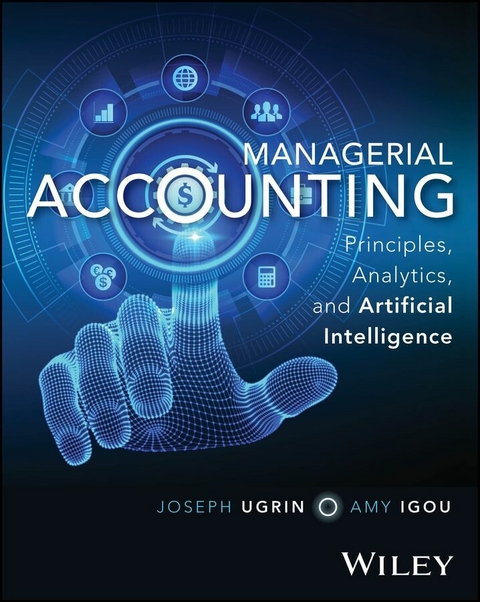
Managerial Accounting (eBook)
874 Seiten
Wiley (Verlag)
978-1-394-26584-8 (ISBN)
Timely managerial accounting textbook with coverage of artificial intelligence, automation, and analytics
Recent developments in technology are transforming the field of managerial accounting. In Managerial Accounting: Principles, Analytics, and Artificial Intelligence, readers will learn to identify, measure, analyze, interpret, and communicate financial and operational information for internal decision-making, with a focus on the crossover between managerial accounting and information systems, artificial intelligence, and automation.
Along with providing key foundational information on essential topics, including job order costing, cost behavior and cost-volume-profit analysis, and planning and budgeting for operations, this book includes real-world business examples from various industries that emphasize how business owners utilize accounting to make decisions and plan for the future, which enable readers do the same in their own positions. Ancillary materials hosted on a companion website combined with the textbook make a complete 'course in a box.'
For undergraduates in business and accounting programs of study, Managerial Accounting: Principles, Analytics, and Artificial Intelligence is an excellent textbook covering essential topics in managerial accounting with a timely review of the latest technologies transforming the field.
Joseph Ugrin, PhD, CPA, is the RSM Chair of Accounting and Head of the Department of Accounting at the University of Northern Iowa. With nearly three decades of experience in teaching, research, and industry, Dr. Ugrin has published extensively on accounting and information systems, contributed to national curriculum development, and continues to serve in key editorial and professional leadership roles in accounting.
Amy Igou, PhD, CMA, is the Halverson Associate Professor of Accounting at the University of Northern Iowa. She is the author of a book and numerous journal articles on emerging technologies in business. Amy brings 19 years of corporate financial systems experience to her teaching and research.
Timely managerial accounting textbook with coverage of artificial intelligence, automation, and analytics Recent developments in technology are transforming the field of managerial accounting. In Managerial Accounting: Principles, Analytics, and Artificial Intelligence, readers will learn to identify, measure, analyze, interpret, and communicate financial and operational information for internal decision-making, with a focus on the crossover between managerial accounting and information systems, artificial intelligence, and automation. Along with providing key foundational information on essential topics, including job order costing, cost behavior and cost-volume-profit analysis, and planning and budgeting for operations, this book includes real-world business examples from various industries that emphasize how business owners utilize accounting to make decisions and plan for the future, which enable readers do the same in their own positions. Ancillary materials hosted on a companion website combined with the textbook make a complete course in a box. For undergraduates in business and accounting programs of study, Managerial Accounting: Principles, Analytics, and Artificial Intelligence is an excellent textbook covering essential topics in managerial accounting with a timely review of the latest technologies transforming the field.
Chapter 1
Introduction to Managerial Accounting
Learning Objectives
- 1.1 Define managerial accounting and describe the managerial accountant’s role in business operations.
- 1.2 Compare and contrast managerial and financial accounting.
- 1.3 Explain how to use the accounting information to implement business strategy and exercise business control.
- 1.4 Identify trends in managerial accounting.
Accounting in Life
Many decisions in your life are similar to those faced by businesspeople. Learning to think like a managerial accountant will improve your personal decision-making. For example, a managerial accountant evaluating the decision to attend college would ask the following questions:
- Is college worth the cost based on your future income with additional training?
- What is the real cost of college, considering you would have to give up four years of income that you would have made if you were working?
Businesspeople are confronted with similar questions daily, and managerial accountants help them assemble the appropriate information to make sound decisions. Throughout the remainder of this book, we will cover many different types of decisions that businesses face and some of the equivalent situations you might encounter in your personal life.
What Is Managerial Accounting, and How Does Managerial Accounting Help Businesses?
Learning Objective 1.1
Define managerial accounting and describe the managerial accountant’s role in business operations.
The use of accounting information to assist in making operational decisions is a managerial accounting function. Managerial accounting is a facet of accounting that focuses on internal operations and assists the company’s owners, managers, and employees in making operating, investing, and financing decisions. Managerial accountants are internal business partners who use data to support management’s formulation of strategies and decisions regarding how a business operates, invests its resources, and solicits financing. For example, a managerial accountant might aggregate and communicate information useful in answering questions like the following:
- How much do the business’s products cost?
- Should the business outsource operations overseas?
- How can the business manage scarce resources most profitably?
- How much employee labor will need to be budgeted to meet expected production demands?
- What is the cause for costs overrunning expectations?
Managerial accountants play an important role in helping organizations formulate strategies, plan for operations, implement initiatives, guide activities, and evaluate results to assess performance and control future operations. They work closely with other business leaders and are often part of cross-functional teams that operate a business through planning, facilitating, and controlling.
Planning
Managerial accountants assist businesses in developing strategies, goals, objectives, and profit plans at a high level. Managerial accountants assist in planning for operations through the development of operating budgets and financial forecasts. Managerial accountants must be familiar with all areas of business and work closely with people throughout the organization when formulating budgets and forecasts; thus, communication skills are essential.
Facilitating
Facilitating involves creating mechanisms that promote business strategies and initiatives that bring them to fruition. Consider these examples of initiatives:
- Development of structures that align employees’ interests with the interests of owners, such as paying employee bonuses in shares of stock rather than cash
- Mechanisms that facilitate continuous improvement, such as basing employee bonuses on obtaining a performance target
- Production systems that minimize the amount of costly inventory the business keeps on hand, such as a just-in-time inventory system
Controlling
Operational control is accomplished through monitoring, evaluation, and feedback. Controlling keeps business plans on track by performing the following tasks:
- Identifying and developing focused performance measures
- Monitoring the measures by comparing them with targets
- Reporting the results and offering recommendations
Controlling is the last phase of a continuous loop of planning, implementing, evaluating, and making adjustments.
Managerial accountants play a vital role in evaluating performance and communicating the performance results to a diverse group of stakeholders. An effective managerial accountant can articulate results, explain why the results happened, outline the decisions the managers made that influenced the results, and present the strategies the business is employing that influenced the decisions. This analysis adds value to information.
Accounting in Business
Effective teamwork is critical for business success. Professors from the University of Amsterdam and the University of Michigan published an article chronicling two essential roles managerial accountants played: a watchdog role and a team member role.1 The watchdog role emphasizes accountants’ responsibility to outside stakeholders, such as stockholders and creditors, to ensure that the economic position of the company is presented fairly in financial reports. The team member role is concerned with making strategic and operational decisions to run the organization. The professors found that managing these two conflicting roles—operating as a team member while simultaneously serving as the watchdog of the team—is a particularly challenging part of managerial accountants’ jobs.
LEARNING ACTIVITY 1.1
Identify if the following are planning, facilitating, or controlling functions.
- Preparing a balance sheet.
- Establishing organizational objectives.
- Comparing budgets with actual results.
- Implementing a computer system to track inventory.
- Designing an incentive structure for traveling sales staff.
- Preparing an operating budget.
- Assessing if purchasing a new piece of equipment will improve profits.
- Employing a system to automate routine accounting tasks.
- Presenting quarterly business results to the board of directors.
- Evaluating the costs and benefits of outsourcing production to China.
What Is the Difference Between Financial and Managerial Accounting?
Learning Objective 1.2
Compare and contrast managerial and financial accounting.
Financial and managerial accounting are similar in that they deal with data and they aggregate and communicate that data in a manner that is useful for decision-makers. They typically differ in key ways:
- Serve different groups
- Aggregate and communicate different types of data and information
- Prepare different types of reports
- Deliver reports at different intervals
We explore each of these areas in the discussion that follows.
Focus of Financial Accounting
Financial accounting provides information for external decision-makers, such as outside investors, lenders, customers, and the federal government. It generally records and aggregates accounting events needed to prepare typical financial statements such as income statements, balance sheets, and statements of cash flows. Businesses prepare financial statements on a consistent basis, usually monthly, quarterly, or annually.
Focus of Managerial Accounting
Managerial accounting, on the other hand, focuses on information for internal decision-makers, such as the company’s owners, managers, and employees. It aggregates and communicates a broad range of data and information in the form of managerial reports that focus on the data needed for the decision. Managerial reports vary by the impending decision and are prepared when needed, often on an ad hoc basis. Managerial reports commonly contain both financial and nonfinancial data. Finally, verification of the accuracy, consistency, and legitimacy of managerial reports is the sole job of the managerial accountant. Financial statements, in contrast, are often audited by Certified Public Accountants (CPAs) to ensure they offer a faithful representation of the business. Table 1.1 illustrates some of the differences between financial and managerial accounting.
Table 1.1 Differences Between Managerial and Financial Accounting
| Financial Accounting | Managerial Accounting |
|---|
| Provides information for external decision makers. | Provides information for internal decision-makers. |
| Aggregates and communicates financial information related to “accounting” events. | Aggregates and communicates detailed financial, nonfinancial, operational and “other” information. |
| Prepares regular financial reports, including the income statement, balance sheet, and statement of cash flows. | Prepares unstructured reports related to operational, investing, financing, and other... |
| Erscheint lt. Verlag | 19.8.2025 |
|---|---|
| Sprache | englisch |
| Themenwelt | Wirtschaft ► Betriebswirtschaft / Management |
| Schlagworte | Accounting • accounting ai • accounting analytics • accounting machine learning • Accounting Technology • accounting textbook • Budget Analysis • Business Decision-Making • Cost Accounting • data analytics • Managerial Accounting • Performance Evaluation • undergraduate accounting |
| ISBN-10 | 1-394-26584-0 / 1394265840 |
| ISBN-13 | 978-1-394-26584-8 / 9781394265848 |
| Informationen gemäß Produktsicherheitsverordnung (GPSR) | |
| Haben Sie eine Frage zum Produkt? |
 EPUB (Adobe DRM)
Kopierschutz: Adobe-DRM
Adobe-DRM ist ein Kopierschutz, der das eBook vor Mißbrauch schützen soll. Dabei wird das eBook bereits beim Download auf Ihre persönliche Adobe-ID autorisiert. Lesen können Sie das eBook dann nur auf den Geräten, welche ebenfalls auf Ihre Adobe-ID registriert sind.
Details zum Adobe-DRM
Dateiformat: EPUB (Electronic Publication)
EPUB ist ein offener Standard für eBooks und eignet sich besonders zur Darstellung von Belletristik und Sachbüchern. Der Fließtext wird dynamisch an die Display- und Schriftgröße angepasst. Auch für mobile Lesegeräte ist EPUB daher gut geeignet.
Systemvoraussetzungen:
PC/Mac: Mit einem PC oder Mac können Sie dieses eBook lesen. Sie benötigen eine
eReader: Dieses eBook kann mit (fast) allen eBook-Readern gelesen werden. Mit dem amazon-Kindle ist es aber nicht kompatibel.
Smartphone/Tablet: Egal ob Apple oder Android, dieses eBook können Sie lesen. Sie benötigen eine
Geräteliste und zusätzliche Hinweise
Buying eBooks from abroad
For tax law reasons we can sell eBooks just within Germany and Switzerland. Regrettably we cannot fulfill eBook-orders from other countries.
aus dem Bereich