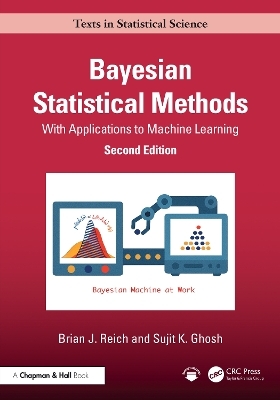
Bayesian Statistical Methods
Chapman & Hall/CRC (Verlag)
978-1-032-48632-1 (ISBN)
- Lieferbar (Termin unbekannt)
- Versandkostenfrei
- Auch auf Rechnung
- Artikel merken
Bayesian Statistical Methods: With Applications to Machine Learning provides data scientists with the foundational and computational tools needed to carry out a Bayesian analysis. Compared to others, this book is more focused on Bayesian methods applied routinely in practice, including multiple linear regression, mixed effects models and generalized linear models. This second edition includes a new chapter on Bayesian machine learning methods to handle large and complex datasets and several new applications to illustrate the benefits of the Bayesian approach in terms of uncertainty quantification.
Readers familiar with only introductory statistics will find this book accessible, as it includes many worked examples with complete R code, and comparisons are presented with analogous frequentist procedures. The book can be used as a one-semester course for advanced undergraduate and graduate students and can be used in courses comprising undergraduate statistics majors, as well as non-statistics graduate students from other disciplines such as engineering, ecology and psychology. In addition to thorough treatment of the basic concepts of Bayesian inferential methods, the book covers many general topics:
Advice on selecting prior distributions
Computational methods including Markov chain Monte Carlo (MCMC) sampling
Model-comparison and goodness-of-fit measures, including sensitivity to priors.
To illustrate the flexibility of the Bayesian approaches for complex data structures, the latter chapters provide case studies covering advanced topics:
Handling of missing and censored data
Priors for high-dimensional regression models
Machine learning models including Bayesian adaptive regression trees and deep learning
Computational techniques for large datasets
Frequentist properties of Bayesian methods.
The advanced topics are presented with sufficient conceptual depth that the reader will be able to carry out such analysis and argue the relative merits of Bayesian and classical methods. A repository of R code, motivating data sets and complete data analyses is made available on the book’s website.
Brian J. Reich, Gertrude M. Cox Distinguished Professor of Statistics at North Carolina State University, applies Bayesian statistical methods in a variety of fields including environmental epidemiology, engineering, weather and climate. He is a Fellow of the American Statistical Association, former Editor-in-Chief of the Journal of Agricultural, Biological, and Environmental Statistics and recipient of the LeRoy & Elva Martin Teaching Award at NC State University. Sujit K. Ghosh, Professor of Statistics at North Carolina State University, has worked in advanced research fields such as Bayesian inference, spatial statistics, survival analysis and shape-constrained inference, addressing complex inferential challenges in biomedical and environmental sciences, econometrics, and engineering. At NC State, he has been honored with the D.D. Mason Faculty Award and the Cavell Brownie Mentoring Award, reflecting his excellence in research, mentoring and teaching. His leadership includes impactful service as Program Director at NSF’s Division of Mathematical Sciences, Deputy Director at SAMSI and President of the IISA.
Preface 1 Basics of Bayesian inference 2 From prior information to posterior inference 3 Computational approaches 4 Linear models 5 Hypothesis testing 6 Model selection and diagnostics 7 Case studies using hierarchical modeling 8 Machine learning 9 Statistical properties of Bayesian methods Appendices Bibliography Index
| Erscheinungsdatum | 10.12.2025 |
|---|---|
| Reihe/Serie | Chapman & Hall/CRC Texts in Statistical Science |
| Zusatzinfo | 26 Tables, black and white; 113 Line drawings, black and white; 3 Halftones, black and white; 116 Illustrations, black and white |
| Sprache | englisch |
| Maße | 178 x 254 mm |
| Gewicht | 830 g |
| Themenwelt | Mathematik / Informatik ► Mathematik ► Statistik |
| Wirtschaft ► Volkswirtschaftslehre ► Ökonometrie | |
| ISBN-10 | 1-032-48632-5 / 1032486325 |
| ISBN-13 | 978-1-032-48632-1 / 9781032486321 |
| Zustand | Neuware |
| Informationen gemäß Produktsicherheitsverordnung (GPSR) | |
| Haben Sie eine Frage zum Produkt? |
aus dem Bereich