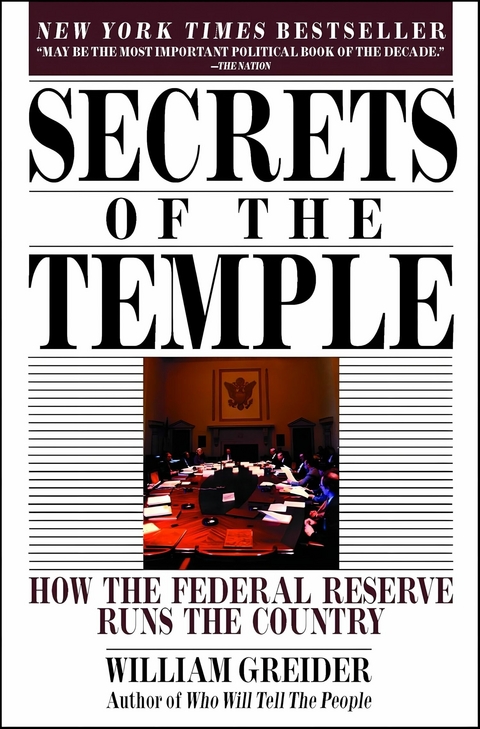
Secrets of the Temple (eBook)
363 Seiten
Publishdrive (Verlag)
978-0-00-101991-1 (ISBN)
William Greider's groundbreaking bestseller reveals how the mighty and mysterious Federal Reserve operates-and manipulates and the world's economy.
This ground-breaking best-seller reveals for the first time how the mighty and mysterious Federal Reserve operates-and how it manipulated and transformed both the American economy and the world's during the last eight crucial years. Based on extensive interviews with all the major players, Secrets of the Temple takes us inside the government institution that is in some ways more secretive than the CIA and more powerful than the President or Congress.
2. IN THE TEMPLE
When the Federal Reserve System’s new building on Constitution Avenue was completed in 1937, the clean, classical exterior of white marble looked much like the neighboring federal buildings going up in the New Deal era. The design conveyed “dignity and permanence,” as the architects intended, without the decorative tricks or monumental scale that made older government buildings in Washington seem pretentious or forbidding. An American eagle in white marble, perched over huge bronze doors, looked out at the green spaces of Washington’s Mall, just east of the Lincoln Memorial. The doorway led to a lobby displaying portraits of Woodrow Wilson, the Fed’s founding President, and Senator Carter Glass of Virginia, who shepherded the Federal Reserve Act through Congress in 1913. The lobby’s ceiling was decorated with a plaster relief of Greek coins surrounding the goddess Cybele, symbol of abundance and stability. The entrance was imposing but impractical. Except for rare ceremonial occasions, the bronze doors remained closed. Everyone, from clerks to governors, entered the Fed through the back door on the C Street side of the building.1
When the building was still new, Representative Wright Patman of Texas, last of the genuine Populists to serve in Congress, offered a mischievous suggestion. Patman was a brilliant eccentric, self-taught and stubbornly independent in his views, and he devoted nearly fifty years in Congress to methodically assaulting the Federal Reserve System and its privileged powers. This building, Patman observed at a House hearing in 1939, did not actually belong to the federal government. It belonged to the twelve Reserve Banks of the Federal Reserve System—and the twelve Reserve Banks were owned and controlled by private commercial banks, which held stock in the Reserve Banks as a condition of membership in the System. Therefore, the congressman reasoned, the Fed’s headquarters was not tax-exempt like other public buildings. It should be subject to local property taxes, like any other private enterprise.
Inspired by Patman’s remarks, the District of Columbia tax collector sent a bill for property taxes to the Federal Reserve’s Board of Governors. The Fed refused to pay. The board’s lawyers patiently tried to explain the complicated institution created by Woodrow Wilson’s legislative compromise, an institution that, they insisted, was a part of the government. The lawyers cited the original legislative history of 1913 and an Attorney General’s opinion issued the following year and subsequent federal court decisions, all of which confirmed this. The Federal Reserve was an “independent department” of government.
The D.C. tax collector was not convinced. After all, the Board of Governors had purchased the land from the federal government in 1935 for $750,000 and the Treasury Department had signed over the deed, relinquishing “all the right title and interest of the United States of America.” If the Fed was part of government, why would the federal government sell real estate to itself? In December 1941, four days before Pearl Harbor, the District of Columbia government published a notice of delinquent taxes and scheduled a public auction. It would sell the Federal Reserve’s marble temple to the highest bidder.
The auction was postponed several times and never occurred, but it took three years of legal wrangling before the Board of Governors could convince the local government that the Federal Reserve System, despite its peculiar structure, was indeed part of the federal government. In the end, each of the twelve Reserve Banks was compelled to execute a quitclaim deed, attesting that they did not own the building on Constitution Avenue, that the U.S. government owned it.2
Nevertheless, the Federal Reserve System enjoyed the ambiguity over its status and exploited it. Philip E. Coldwell, who served nearly thirty years in the System, as president of the Dallas Reserve Bank and on the Board of Governors, observed: “To some extent, the Federal Reserve considers itself government. Other times, when it serves, it considers itself not government.”
Wright Patman never relented. Twenty-five years later, on the floor of the House of Representatives, he declared: “A slight acquaintance with American constitutional theory and practice demonstrates that, constitutionally, the Federal Reserve is a pretty queer duck.” He was correct in that. The Federal Reserve System was an odd arrangement, a unique marriage of public supervision and private interests, deliberately set apart from the elected government, though still part of it. The Fed enjoyed privileges extended to no other agency in Washington —it raised its own revenue, drafted its own operating budget and submitted neither to Congress for approval. At the top were the seven governors of the Federal Reserve Board, appointed by the President to fourteen-year terms and confirmed by the Senate. But the seven governors shared power with the presidents of the twelve Reserve Banks, each serving the private banks in its region, from Boston to Atlanta, Dallas to San Francisco. The Reserve Bank presidents were not appointed in Washington, but were elected by each district’s board of directors. Six of the nine directors in each case were, in turn, elected themselves by the commercial banks, the “member banks” of the Federal Reserve System. When the Fed decided the core questions of regulating money supply, its debate and votes were conducted in a hybrid committee that combined the two levels, known as the Federal Open Market Committee. In FOMC decisions, the governors had seven votes and Reserve Bank presidents had five votes, rotated annually among the districts. Only the president of the New York Fed, more important than all the others, did not have to share; he voted at all meetings. Thus, critics complained, the nation’s money regulation was decided in part by representatives of private interests—the banks.3
To further complicate and darken the picture, the commercial banks held stock shares in each of the twelve Federal Reserve Banks, which misled many into assuming that the Federal Reserve System was “privately owned.” In fact, the stock shares were a vestigial feature of System membership that confused and excited Populist critics, but had virtually no practical meaning. The Federal Reserve System was government, including the twelve Federal Reserve Banks, not a private entity. Commercial bankers did enjoy preferred access and influence at the Fed, but the internal power relationship gave the Board of Governors, appointed by Washington, more authority than the presidents of the twelve Federal Reserve Banks. When a regional board of directors selected its new president, the chairman at the Fed’s home office could veto the choice.
The American arrangement was quite different from those of the central banks in most other industrial nations, where the appendage of regional reserve banks did not exist. The crucial difference, however, was that other central banks, even the prototypical Bank of England, were democratized in a way the Fed was not. They all operated on the same basic principles of finance, but other central bankers took their orders directly from elected politicians. When the Bank of England wished to raise interest rates, it could not move without approval from the Prime Minister’s Cabinet. The same subservient relationship applied in Japan, France and Italy. The one exception was the Bundesbank in West Germany, whose political independence resembled the Federal Reserve’s and for good reason. In the reconstruction following World War II, Germany’s new central bank was patterned on the American model.
Patman’s crusade failed. In a lifetime of tenacious lobbying for reform, the Texas congressman could never persuade a majority in Congress to change the Fed in any way. Year after year, as chairman of the House Banking Committee, Patman held meticulous hearings and introduced reform legislation to make the Fed more democratic and less subject to the influence of major banks. Shorten the terms of the governors so a single President would have more appointments and, thus, more influence. Remove the Reserve Bank presidents from the Federal Open Market Committee so that only public officials who were nominated by the Chief Executive and confirmed by Congress would decide monetary policy for the nation. Force the Fed to open its books for independent audits by Congress. Subject the Fed’s operating budgets to regular congressional scrutiny in the appropriations process, like any other federal agency. Above all, eliminate the privileged status of the private bankers. “A bunch of money hucksters,” Patman called them. The Fed, he said, constituted “a dictatorship on money matters by a bankers’ club.” None of his legislation was enacted.
Long after Patman died in the mid-1970s, others continued to raise his complaints. The same reform bills were introduced year after year in Congress, with both liberal and conservative sponsors. All failed to pass, with the single exception of the congressional audit of Fed books, authorized in 1978. Nearly every year, some group somewhere in America filed new lawsuits against the Fed, attacking its secrecy or challenging its legality. None of these lawsuits succeeded.
Neither the hot Populist rhetoric nor careful scholarly critiques made any difference. For all its peculiar features, the Federal Reserve System was remarkably stable among America’s political institutions. Over seventy years, its basic design probably changed less than any other important operating arm of the federal government, from the Pentagon to the Postal Service. Most major...
| Erscheint lt. Verlag | 18.8.2025 |
|---|---|
| Sprache | englisch |
| Themenwelt | Wirtschaft |
| ISBN-10 | 0-00-101991-0 / 0001019910 |
| ISBN-13 | 978-0-00-101991-1 / 9780001019911 |
| Informationen gemäß Produktsicherheitsverordnung (GPSR) | |
| Haben Sie eine Frage zum Produkt? |
 EPUB (Adobe DRM)
Größe: 1,6 MB
Kopierschutz: Adobe-DRM
Adobe-DRM ist ein Kopierschutz, der das eBook vor Mißbrauch schützen soll. Dabei wird das eBook bereits beim Download auf Ihre persönliche Adobe-ID autorisiert. Lesen können Sie das eBook dann nur auf den Geräten, welche ebenfalls auf Ihre Adobe-ID registriert sind.
Details zum Adobe-DRM
Dateiformat: EPUB (Electronic Publication)
EPUB ist ein offener Standard für eBooks und eignet sich besonders zur Darstellung von Belletristik und Sachbüchern. Der Fließtext wird dynamisch an die Display- und Schriftgröße angepasst. Auch für mobile Lesegeräte ist EPUB daher gut geeignet.
Systemvoraussetzungen:
PC/Mac: Mit einem PC oder Mac können Sie dieses eBook lesen. Sie benötigen eine
eReader: Dieses eBook kann mit (fast) allen eBook-Readern gelesen werden. Mit dem amazon-Kindle ist es aber nicht kompatibel.
Smartphone/Tablet: Egal ob Apple oder Android, dieses eBook können Sie lesen. Sie benötigen eine
Geräteliste und zusätzliche Hinweise
Buying eBooks from abroad
For tax law reasons we can sell eBooks just within Germany and Switzerland. Regrettably we cannot fulfill eBook-orders from other countries.
aus dem Bereich