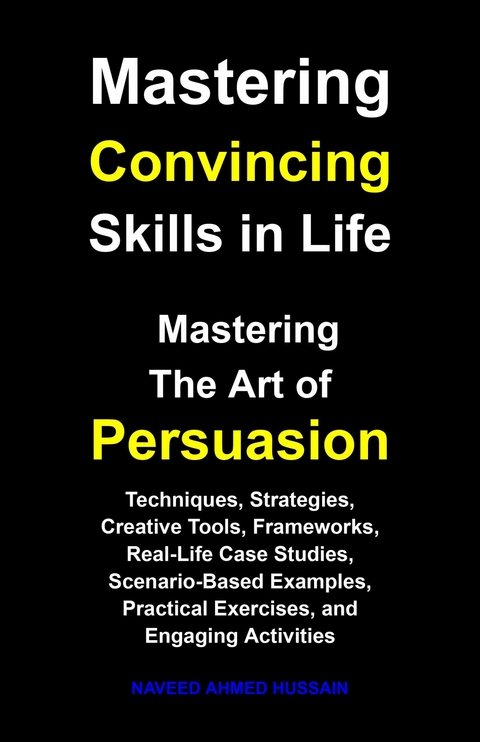
Mastering Convincing Skills in Life (eBook)
160 Seiten
Publishdrive (Verlag)
978-0-00-067441-8 (ISBN)
Welcome to Mastering Convincing Skills in Life, your essential guide to mastering the art of persuasion. Whether you're aiming to enhance your personal relationships, advance your career, or simply become a more effective communicator, this book provides you with the practical tools and strategies needed to influence others with confidence and integrity.
In our fast-paced world, the ability to persuade and influence is more crucial than ever. Every day, we encounter situations where effective communication can make a difference-whether you're negotiating a deal at work, convincing a friend to embrace a new idea, or simply making your voice heard in a group setting. Convincing Skills in Life is designed to help you navigate these moments with ease and effectiveness.
This book isn't just about winning arguments or getting people to agree with you. It's about understanding human behavior, building trust, and fostering meaningful connections. With a focus on ethical persuasion, you'll learn how to communicate your ideas clearly, listen empathetically, and respond to others in a way that resonates.
What You'll Learn:
Core Techniques: Discover the fundamentals of persuasion, including how to craft compelling messages, use non-verbal communication effectively, and structure your arguments logically.
Adaptability: Learn how to tailor your approach to different personalities and situations, ensuring that your message is heard and understood, no matter the context.
Ethical Influence: Explore the importance of honesty and transparency in persuasion, and how maintaining integrity can help build long-term relationships based on trust.
Practical Exercises: Engage in real-life case studies and scenario-based exercises that allow you to practice and refine your convincing skills in a variety of settings.
Whether you're a professional looking to influence others in the workplace, a leader aiming to inspire your team, or simply someone who wants to communicate more effectively in everyday life, Convincing Skills in Life offers the insights and techniques you need to succeed.
Start your journey today and unlock the power of persuasion. With the knowledge and tools you'll gain from this book, you'll be equipped to handle any situation with confidence, clarity, and conviction.
Get Your Copy Today
Don't wait to start your journey toward better Convincing Skills in Life. Get your copy of this book today and discover how mastering the art of persuasion can lead to greater success, stronger relationships, and a more fulfilling life. Let's embark on this journey together and make every conversation count!
Introduction
Welcome to the first chapter of "Convincing Skills in Life." Here, we lay the foundation for your journey toward mastering the art of persuasion. Understanding the fundamentals of convincing is crucial because it allows you to effectively communicate your ideas, build strong relationships, and influence outcomes in both personal and professional settings. This chapter will delve into the core concepts of convincing, the psychology behind persuasion, essential principles of influence, and the critical role of trust and credibility. By the end of this chapter, you'll have a solid understanding of what convincing skills entail and why they are indispensable in navigating life's myriad interactions.
Definition and Importance
What Are Convincing Skills?
Convincing skills, at their core, are the abilities to persuade others to see things from your perspective, adopt your ideas, or take a desired course of action. These skills encompass a range of techniques and strategies that involve clear communication, emotional intelligence, confidence, and the application of specific principles of influence. Convincing is not about coercion or manipulation but about presenting your case compellingly and ethically, fostering mutual understanding, and achieving consensus or cooperation.
Why Are They Essential in Personal and Professional Life?
Convincing skills are invaluable in both personal and professional contexts. Here’s why:
● Personal Life: In personal relationships, convincing skills help in resolving conflicts, making decisions, and encouraging loved ones to embrace new ideas or changes. Effective persuasion can enhance communication, deepen connections, and foster a more harmonious and supportive environment.
● Professional Life: In the workplace, the ability to persuade can be a game-changer. Whether you’re pitching a project, negotiating a deal, or leading a team, convincing skills enable you to articulate your vision, gain buy-in from stakeholders, and drive projects to successful completion. They are essential for leadership, collaboration, and career advancement.
The Psychology of Persuasion
Understanding Human Behavior and Decision-Making Processes
To persuade effectively, it’s crucial to understand how people make decisions. Human behavior and decision-making are influenced by a complex interplay of cognitive, emotional, and social factors. Here are some key insights:
● Cognitive Biases: People often rely on mental shortcuts or biases when making decisions. For example, the availability heuristic makes individuals overestimate the importance of information that is readily available to them. Understanding these biases can help you craft more persuasive messages.
● Emotion vs. Logic: While logical arguments are important, emotions play a significant role in decision-making. People are more likely to be persuaded when they feel an emotional connection to the message. Hence, appealing to both the heart and the mind is a powerful strategy.
The Role of Emotions in Convincing Others
Emotions are powerful drivers of human behavior. Here’s how they can be leveraged in persuasion:
● Empathy: Demonstrating empathy helps build rapport and trust. When people feel understood and valued, they are more open to being persuaded. Techniques like active listening and reflective responses can show empathy.
● Fear and Hope: Emotions like fear and hope can motivate action. Highlighting potential risks (fear) or benefits (hope) can be effective in convincing others to change their behavior or adopt new ideas. However, these emotions should be used ethically and not as tools of manipulation.
● Storytelling: Stories evoke emotions and make messages more relatable and memorable. Sharing personal anecdotes or case studies can illustrate your points vividly and engage your audience emotionally.
The Principles of Influence
Reciprocity, Commitment, Social Proof, Authority, Liking, and Scarcity
Dr. Robert Cialdini’s six principles of influence are foundational to understanding persuasion. Here’s a closer look at each principle:
- Reciprocity: People feel obliged to return favors. By offering something of value, you create a sense of indebtedness, making others more likely to agree with your requests.
- Commitment and Consistency: Once people commit to something, they are more likely to follow through to stay consistent with their self-image. Getting a small initial commitment can lead to larger agreements later.
- Social Proof: People look to others to determine appropriate behavior, especially in uncertain situations. Demonstrating that others support your idea can enhance its credibility.
- Authority: People respect and follow the lead of credible experts. Establishing your expertise and authority in a subject can significantly boost your persuasive power.
- Liking: People are more likely to be persuaded by those they like. Building rapport, finding common ground, and displaying genuine warmth and friendliness can make you more persuasive.
- Scarcity: Perceived scarcity increases value. Highlighting the uniqueness or limited availability of an opportunity can create a sense of urgency and prompt action.
How These Principles Apply to Everyday Situations
Let’s see how these principles can be applied in everyday situations:
● Reciprocity: In a professional setting, offering help or valuable information can make colleagues more inclined to support your proposals in return.
● Commitment and Consistency: If you’re trying to implement a new habit in your family, starting with a small, manageable change can lead to larger, more consistent behavior over time.
● Social Proof: When launching a new product, showcasing testimonials and endorsements from satisfied customers can enhance credibility and attract new buyers.
● Authority: Establishing your expertise through certifications, publications, or speaking engagements can make your professional opinions more persuasive.
● Liking: Building a positive relationship with coworkers by showing genuine interest in their lives and acknowledging their contributions can make them more receptive to your ideas.
● Scarcity: If you’re organizing an event, emphasizing limited seating or exclusive access can motivate people to register promptly.
Building Trust and Credibility
Establishing Rapport and Authenticity
Trust and credibility are the cornerstones of effective persuasion. Here’s how to build them:
● Authenticity: Be genuine in your interactions. People can sense insincerity, and it undermines trust. Share your true thoughts and feelings to connect authentically with others.
● Rapport: Establishing rapport involves creating a connection and a sense of mutual understanding. Techniques such as active listening, mirroring body language, and finding common interests can help build rapport.
The Importance of Integrity in Persuasion
Integrity is crucial for long-term success in persuasion. Here’s why:
● Consistency: Consistently acting in line with your values and promises builds your reputation as a trustworthy individual.
● Transparency: Being open and honest about your intentions and limitations fosters trust and respect.
● Ethics: Ethical persuasion respects the autonomy and dignity of others. It’s about influencing without manipulating, ensuring that the other party’s interests are considered.
Core Components of Convincing Skills
Communication
Effective communication is at the heart of convincing skills. Here are key components:
● Clarity: Be clear and concise in your messaging. Avoid jargon and complex language that can confuse your audience.
● Active Listening: Show that you are genuinely interested in what the other person is saying. This builds trust and allows you to tailor your message to their needs and concerns.
● Feedback: Seek and provide constructive feedback. It helps in refining your approach and building stronger connections.
Emotional Intelligence
Emotional intelligence (EI) enhances your ability to persuade by allowing you to navigate social interactions effectively. Key aspects include:
● Self-Awareness: Understanding your emotions and how they influence your behavior helps you remain calm and focused during persuasive interactions.
● Empathy: Recognizing and respecting others’ emotions builds rapport and makes your message more relatable.
● Social Skills: Strong interpersonal skills facilitate smoother interactions and help in managing conflicts constructively.
Confidence
Confidence in...
| Erscheint lt. Verlag | 26.11.2024 |
|---|---|
| Sprache | englisch |
| Themenwelt | Wirtschaft ► Betriebswirtschaft / Management ► Unternehmensführung / Management |
| ISBN-10 | 0-00-067441-9 / 0000674419 |
| ISBN-13 | 978-0-00-067441-8 / 9780000674418 |
| Informationen gemäß Produktsicherheitsverordnung (GPSR) | |
| Haben Sie eine Frage zum Produkt? |
 EPUB (Adobe DRM)
Größe: 159 KB
Kopierschutz: Adobe-DRM
Adobe-DRM ist ein Kopierschutz, der das eBook vor Mißbrauch schützen soll. Dabei wird das eBook bereits beim Download auf Ihre persönliche Adobe-ID autorisiert. Lesen können Sie das eBook dann nur auf den Geräten, welche ebenfalls auf Ihre Adobe-ID registriert sind.
Details zum Adobe-DRM
Dateiformat: EPUB (Electronic Publication)
EPUB ist ein offener Standard für eBooks und eignet sich besonders zur Darstellung von Belletristik und Sachbüchern. Der Fließtext wird dynamisch an die Display- und Schriftgröße angepasst. Auch für mobile Lesegeräte ist EPUB daher gut geeignet.
Systemvoraussetzungen:
PC/Mac: Mit einem PC oder Mac können Sie dieses eBook lesen. Sie benötigen eine
eReader: Dieses eBook kann mit (fast) allen eBook-Readern gelesen werden. Mit dem amazon-Kindle ist es aber nicht kompatibel.
Smartphone/Tablet: Egal ob Apple oder Android, dieses eBook können Sie lesen. Sie benötigen eine
Geräteliste und zusätzliche Hinweise
Buying eBooks from abroad
For tax law reasons we can sell eBooks just within Germany and Switzerland. Regrettably we cannot fulfill eBook-orders from other countries.
aus dem Bereich