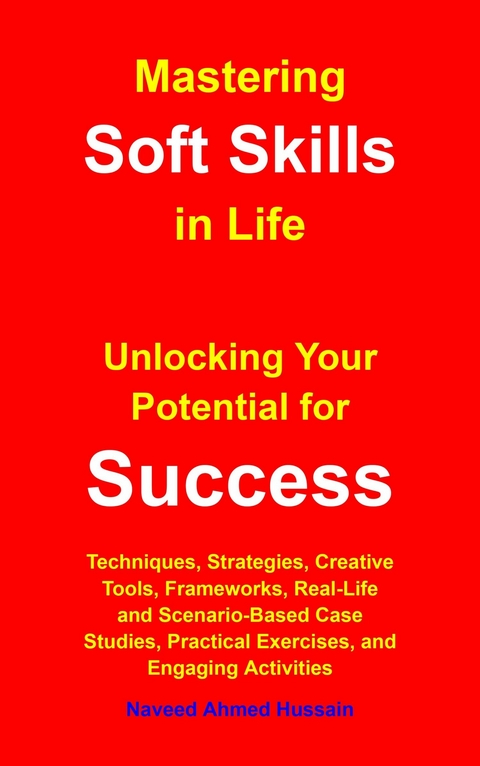
Mastering Soft Skills in Life (eBook)
172 Seiten
Publishdrive (Verlag)
978-0-00-067141-7 (ISBN)
Are you ready to transform your life with the power of soft skills? In a world where technical know-how is no longer enough, soft skills are what truly set you apart. These essential skills-like communication, adaptability, leadership, and emotional intelligence-are the keys to thriving personally and professionally. This book is your complete guide to mastering the soft skills you need to succeed in every aspect of your life.
What You'll Learn:
Effective Communication: Discover how to speak clearly, listen actively, and use body language to build stronger connections in both personal and professional settings.
Emotional Intelligence: Understand your own emotions and those of others to improve relationships, make better decisions, and lead with empathy.
Adaptability and Resilience: Learn how to embrace change, bounce back from setbacks, and stay flexible in the face of uncertainty.
Leadership and Influence: Develop the skills to lead by example, influence others positively, and inspire those around you-whether or not you have formal authority.
Time Management and Organization: Master the art of prioritizing, overcoming procrastination, and organizing your life to achieve balance and productivity.
Real-Life Stories and Hands-On Exercises
This book isn't just theory-it's packed with real-life case studies that show how soft skills can transform lives. You'll read inspiring stories of people who have used these skills to overcome obstacles and achieve their dreams. Plus, each chapter includes practical exercises to help you apply what you've learned right away, making it easy to develop these skills step by step.
Why This Book?
This is more than just a book-it's a toolkit for personal and professional growth. Whether you're a student, a professional, or someone looking to improve your everyday life, these skills will help you connect better with others, navigate challenges, and achieve your goals. With a friendly and motivational tone, this book makes learning feel like a conversation with a supportive friend who wants to see you succeed.
Start Your Journey Today
Ready to unlock your potential and take your life to the next level? Dive into this book and start building the soft skills that will help you thrive. Your journey to personal growth, confidence, and success begins now!
Get your copy today
Take the first step towards a more fulfilling life. Embrace the power of soft skills and watch how they can transform your world!
Chapter Introduction
Welcome to the journey of discovering one of the most crucial yet often overlooked aspects of personal and professional development: soft skills. In a world that increasingly values technical expertise, it’s easy to underestimate the importance of soft skills. However, these skills are the true enablers of success. They are the bridge between knowledge and action, between potential and achievement. This chapter will guide you through the foundational concepts of soft skills, exploring what they are, how they differ from hard skills, and why they are essential for both personal and professional success. By the end of this chapter, you will not only have a deep understanding of soft skills but also practical insights into how you can harness their power to achieve your goals.
1.1 What Are Soft Skills?
Soft skills, often referred to as interpersonal or people skills, are the attributes that enable you to interact effectively and harmoniously with others. Unlike hard skills, which are the technical abilities and knowledge required to perform specific tasks, soft skills are more about how you conduct yourself and how you manage relationships. They encompass a wide range of abilities, including communication, emotional intelligence, adaptability, problem-solving, teamwork, and leadership.
At their core, soft skills are about understanding and managing your emotions, as well as the emotions of those around you. They are the skills that help you navigate the complexities of human interactions, whether in a professional setting, at home, or in social situations. These skills are not only vital for building and maintaining relationships but also for effectively leading, collaborating, and influencing others.
For instance, communication, a key soft skill, goes beyond just speaking clearly or writing well. It involves listening actively, understanding non-verbal cues, and responding appropriately to the emotions and needs of others. Emotional intelligence, another critical soft skill, is about recognizing your own emotions and those of others, and using this awareness to manage interactions and relationships effectively.
Soft skills are inherently flexible and adaptable, which makes them incredibly valuable in today’s fast-paced, ever-changing world. They allow you to adjust your approach based on the situation and the people involved, making you more effective in your interactions and more resilient in the face of challenges.
1.2 The Difference Between Hard and Soft Skills
Understanding the distinction between hard and soft skills is crucial for recognizing the value each brings to your personal and professional life. Hard skills are the technical abilities and knowledge you acquire through education, training, or experience. These are the measurable competencies that can be taught and tested, such as coding, accounting, or graphic design. Hard skills are often the primary focus of traditional education and professional development programs, as they are directly related to specific job functions.
In contrast, soft skills are more abstract and less tangible. They are not easily measured or tested but are just as critical to success. While hard skills are what you do, soft skills are how you do it. For example, a software engineer may have the hard skills required to write code, but their ability to collaborate with a team, communicate ideas effectively, and manage stress under tight deadlines are the soft skills that will determine their overall success in the role.
Another key difference lies in the transferability of these skills. Hard skills are often specific to a particular job or industry, meaning they may not be directly applicable if you change careers. Soft skills, on the other hand, are universally applicable across all fields and industries. Whether you’re working in healthcare, finance, education, or any other sector, your ability to communicate, solve problems, and work well with others will always be valuable.
Moreover, while hard skills can often be outsourced or automated, soft skills remain uniquely human and irreplaceable. As technology continues to advance, the ability to connect with others on a human level, to inspire, to empathize, and to lead will become even more important. In many ways, soft skills are the differentiators that set you apart in a competitive job market.
1.3 The Role of Soft Skills in Personal and Professional Success
Soft skills play a pivotal role in both personal and professional success. They are the skills that help you navigate life’s challenges, build meaningful relationships, and achieve your goals. In the workplace, soft skills are often what differentiate a good employee from a great one. They are the skills that allow you to collaborate effectively with others, manage your time efficiently, and adapt to changing circumstances.
In your personal life, soft skills are equally important. They help you build and maintain healthy relationships, communicate effectively with loved ones, and manage stress and emotions. Whether you’re resolving a conflict with a friend, supporting a family member through a difficult time, or simply trying to balance the demands of work and home, soft skills are the key to success.
One of the most significant roles of soft skills is in leadership. Effective leaders are not just those who possess technical expertise, but those who can inspire, motivate, and guide others. Leadership requires a high degree of emotional intelligence, the ability to communicate clearly and persuasively, and the skill to make decisions under pressure. These are all soft skills that can be developed and honed over time.
In addition to leadership, soft skills are also critical in teamwork and collaboration. The ability to work well with others, to listen and consider different perspectives, and to contribute to a shared goal is essential in almost every professional setting. Teams that function well together are more productive, innovative, and successful, and this is largely due to the soft skills of the individuals within the team.
Soft skills also play a crucial role in problem-solving and decision-making. These skills enable you to analyze situations, consider various options, and make informed decisions that benefit both yourself and others. Whether you’re dealing with a complex project at work or a personal dilemma, the ability to think critically, remain calm under pressure, and make sound decisions is invaluable.
Finally, soft skills are essential for career growth and advancement. As you progress in your career, the importance of soft skills becomes increasingly apparent. While technical skills may get you in the door, it’s your soft skills that will help you climb the ladder. Employers are always looking for individuals who can not only perform their job functions but also lead, inspire, and contribute to the overall success of the organization.
1.4 Real-Life Case Study: The Impact of Soft Skills on Career Growth
Let’s consider the story of Maria, a marketing professional who started her career with a strong set of hard skills. Maria had a degree in marketing, knew the ins and outs of digital marketing tools, and was proficient in data analysis. However, despite her technical expertise, she struggled to advance in her career. Her feedback from colleagues and supervisors often pointed to challenges in communication, teamwork, and leadership.
Determined to overcome these barriers, Maria decided to focus on developing her soft skills. She started by improving her communication skills, learning how to convey her ideas clearly and listen actively to others. She also worked on her emotional intelligence, becoming more aware of her emotions and those of her colleagues. This helped her navigate office dynamics more effectively and build stronger relationships with her team.
Maria also took the initiative to enhance her leadership skills. She began volunteering to lead projects, where she practiced decision-making, delegation, and conflict resolution. Over time, her efforts paid off. Maria not only became a more effective team player but also emerged as a natural leader. Her colleagues began to seek her advice and look to her for guidance.
As Maria’s soft skills improved, so did her career prospects. She was soon promoted to a management position, where her ability to lead and inspire her team became her greatest asset. Her technical skills remained important, but it was her soft skills that truly set her apart and enabled her to excel in her new role.
Maria’s story illustrates the profound impact that soft skills can have on career growth. While hard skills may get you started, it’s your soft skills that will determine how far you can go. By investing in your soft skills, you not only enhance your professional capabilities but also open up new opportunities for advancement and success.
1.5 Practical Exercise: Identifying Your Key Soft Skills
Now that you have a deeper understanding of what soft skills are and why they matter, it’s time to identify your own key soft skills. This practical exercise will help you assess your current soft skills and identify areas where you can improve.
Step 1: Self-Assessment Start by reflecting on your recent experiences at work, at home, or in social settings. Consider situations where you interacted with others, faced challenges, or worked on a team. Think about how you handled these situations and what skills...
| Erscheint lt. Verlag | 18.11.2024 |
|---|---|
| Sprache | englisch |
| Themenwelt | Wirtschaft |
| ISBN-10 | 0-00-067141-X / 000067141X |
| ISBN-13 | 978-0-00-067141-7 / 9780000671417 |
| Informationen gemäß Produktsicherheitsverordnung (GPSR) | |
| Haben Sie eine Frage zum Produkt? |
 EPUB (Adobe DRM)
Größe: 169 KB
Kopierschutz: Adobe-DRM
Adobe-DRM ist ein Kopierschutz, der das eBook vor Mißbrauch schützen soll. Dabei wird das eBook bereits beim Download auf Ihre persönliche Adobe-ID autorisiert. Lesen können Sie das eBook dann nur auf den Geräten, welche ebenfalls auf Ihre Adobe-ID registriert sind.
Details zum Adobe-DRM
Dateiformat: EPUB (Electronic Publication)
EPUB ist ein offener Standard für eBooks und eignet sich besonders zur Darstellung von Belletristik und Sachbüchern. Der Fließtext wird dynamisch an die Display- und Schriftgröße angepasst. Auch für mobile Lesegeräte ist EPUB daher gut geeignet.
Systemvoraussetzungen:
PC/Mac: Mit einem PC oder Mac können Sie dieses eBook lesen. Sie benötigen eine
eReader: Dieses eBook kann mit (fast) allen eBook-Readern gelesen werden. Mit dem amazon-Kindle ist es aber nicht kompatibel.
Smartphone/Tablet: Egal ob Apple oder Android, dieses eBook können Sie lesen. Sie benötigen eine
Geräteliste und zusätzliche Hinweise
Buying eBooks from abroad
For tax law reasons we can sell eBooks just within Germany and Switzerland. Regrettably we cannot fulfill eBook-orders from other countries.
aus dem Bereich