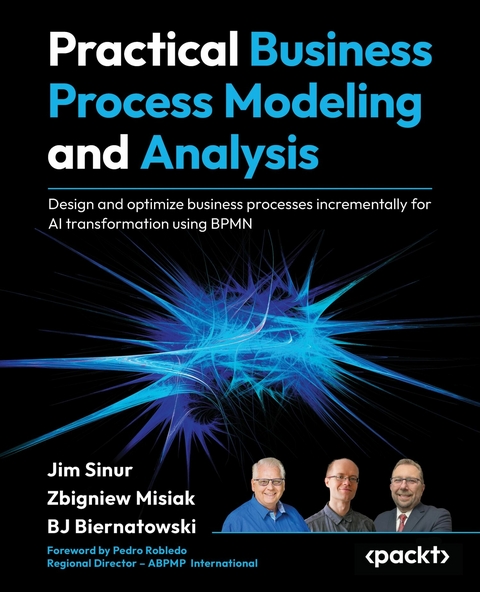
Practical Business Process Modeling and Analysis (eBook)
394 Seiten
Packt Publishing (Verlag)
978-1-80512-638-6 (ISBN)
Every business transformation begins with one question, 'How can we do this better?' Whether it's eliminating inefficiencies, optimizing business operations, or reimagining entire workflows with the help of AI, success depends on understanding and optimizing business processes. However, finding the right approach can be challenging with shifting market demands and evolving technologies.
In this book, three seasoned experts in BPM, automation, and AI-driven process optimization guide you through frameworks, techniques, and tools that drive digital transformation by helping you explore business process modelling, before and after process execution. You'll visualize complex workflows, establish scalable process architectures that drive digital transformation, and integrate automation for efficiency. With insights into BPMN, business value analysis, and field-tested consulting guidance, you'll see how process-led design and data-driven decisions can lead to smarter, more agile operations. Through real-world examples, you'll grasp how leading organizations have optimized their processes and how you can apply the same principles in your digital change program.
By the end of this book, you'll be able to identify, design, analyze, and transform business processes for measurable impact, as well as master the synergy of technology, process, and strategy to build systems that drive sustainable growth.
Learn practical techniques from leading AI and business process experts to streamline operations, drive digital transformation, and accelerate your career growthKey FeaturesNavigate common challenges in digital transformation to ensure seamless process adoption across teamsMaster BPMN, process modeling, and automation launch strategies to streamline workflows and boost efficiencyWork with practical frameworks to align business processes with strategic long-term growthPurchase of the print or Kindle book includes a free PDF eBookBook DescriptionEvery business transformation begins with one question, "e;How can we do this better?"e; Whether it's eliminating inefficiencies, optimizing business operations, or reimagining entire workflows with the help of AI, success depends on understanding and optimizing business processes. However, finding the right approach can be challenging with shifting market demands and evolving technologies. In this book, three seasoned experts in BPM, automation, and AI-driven process optimization guide you through frameworks, techniques, and tools that drive digital transformation by helping you explore business process modelling, before and after process execution. You'll visualize complex workflows, establish scalable process architectures that drive digital transformation, and integrate automation for efficiency. With insights into BPMN, business value analysis, and field-tested consulting guidance, you'll see how process-led design and data-driven decisions can lead to smarter, more agile operations. Through real-world examples, you ll grasp how leading organizations have optimized their processes and how you can apply the same principles in your digital change program. By the end of this book, you ll be able to identify, design, analyze, and transform business processes for measurable impact, as well as master the synergy of technology, process, and strategy to build systems that drive sustainable growth.What you will learnExplore the role of business process in digital transformationBuild scalable process architectures for long-term efficiency and adaptabilityFind out how to avoid common pitfalls in digital transformation and automation programsApply real-world strategies and frameworks to optimize operations effectivelyDiscover methods and tools to enhance business process analysis and decision-makingSee how the BPMN can be extended for scenarios like process simulation and risk managementMeasure and maximize business value from process transformation effortsWho this book is forThis book is ideal for business analysts, process improvement practitioners, project managers, consultants, operations managers, and IT leaders involved in process design, streamlining workflows, and integrating AI and automation. No prior experience with BPMN or automation is needed, though familiarity with business processes will be helpful.]]>
Preface
In a business landscape defined by relentless speed and digital complexity, the ability to model and analyze processes isn’t optional; it’s essential. Practical Business Process Modeling and Analysis distills the foundational knowledge every aspiring change agent needs to navigate transformation with confidence and clarity. Drawing on decades of global experience advising Fortune 500 companies, the authors provide practical insights that help you sidestep costly mistakes and bolster sponsor credibility while protecting your career trajectory.
With the pace of business change in 2025 accelerating beyond most organizations’ capacity to respond, leaders face a growing mismatch between strategic ambition and executional readiness. Economic pressures demand agility, human dynamics complicate transformation, and the rise of AI-powered low-code tools introduces opportunities and risks that can reshape entire business units. CFOs and CTOs are racing to digitize—but success depends on more than technology. It requires people who understand how to analyze, model, and evolve business processes in real time.
Yet, while businesses can easily source developers, Six Sigma experts, and project managers, few professionals possess the hybrid skill set needed to incubate and support long-term digital programs. Why? Because the ecosystem of process analysis tools evolved in silos, remained under-recognized by mainstream media, and was under-taught in business schools, with notable exceptions such as Widener University (Chester, Pennsylvania, USA), the Warsaw School of Economics (Warsaw, Poland), and UNIR (La Rioja, Spain). Even rigorous programs at the Technical University of Eindhoven (Eindhoven, Netherlands) and QUT (Brisbane, Australia) offer depth but rarely prepare professionals to contribute as agile change agents on day one.
This book was written to fill that gap.
We speak to business professionals—not as theorists, but as practitioners who understand that transformation lives in nuance, speed, and systems thinking. Whether you become a software vendor, join a consulting firm, enroll in an academic program, self-educate online, or convince your boss to invest in training, you’ll face trade-offs: vendor partiality, theoretical overload, or practical shallow dives. The truth is, there’s no perfect path into this domain—but there is a pragmatic one.
We offer a blended approach that synthesizes strategic insight with hands-on experience. You’ll learn how to deconstruct process artwork into executable logic, demystify modeling notations such as Business Process Model and Notation (BPMN), and communicate the benefits of visualization without corporate jargon. You’ll hear from global experts, including Jim Sinur, a leading voice in digital business, and see how shadow business architects are driving real change, often without formal credentials.
By the end of this book, you’ll understand the actual value of business and process architecture, have learned how to build transformation credibility, and have unlocked ways to contribute meaningfully to your company’s future. Whether you spend three days in a workshop in Boston, London, Hyderabad, or Warsaw or journey through these chapters, you’ll emerge ready to act.
Who this book is for
This book is for business professionals, decision-makers, and participants in a digital change initiative leading to the digitization of your company’s critical business processes. Basic skills with the Microsoft Office suite are required.
What this book covers
Chapter 1, Winning at Digital Transformation with Process Modeling, offers a strategic deep dive into process modeling as a cornerstone of digital transformation (DTX). It explores how modeling not only enhances process efficiency but also serves as a planning and auditing tool that evolves alongside emerging business needs. With insights from business process management (BPM) pioneer Jim Sinur, it guides readers through the types, benefits, and future trajectory of process modeling, especially its growing synergy with AI, analytics, and adaptive technologies. Overall, the chapter sets the stage for understanding how visual modeling supports intelligent, goal-driven, and resilient enterprise systems.
Chapter 2, Pillars of a Successful Digital Transformation, uncovers the strategic foundations of DTX, emphasizing that success hinges not on technology alone, but on adaptable processes, empowered teams, and a clear vision. Through candid reflection and practical frameworks, it introduces seven transformation pillars, from scalable COEs to change management, that align technology with business goals. By exploring diverse triggers for change and common pitfalls, it guides decision-makers in crafting resilient, purpose-driven strategies for long-term impact.
Chapter 3, The Wheel of BPM Driving Your Competitive Advantage, introduces the “wheel of BPM” as a strategic framework for launching and sustaining BPM transformations. It explores how BPM drives enterprise-wide digital change by empowering internal teams, aligning with strategic goals, and fostering a culture of continuous improvement. By examining inflection points, governance models, and real-world case studies, it equips readers with actionable guidance to build resilient, scalable, and people-centric transformation programs—anchored not in software alone, but in thoughtful planning, cross-functional collaboration, and long-term vision.
Chapter 4, Long-Term Trends and the Impact on Your Job, examines the profound impact of long-term DTX trends on careers, workplace dynamics, and learning strategies. As technology evolves exponentially, professionals must adapt through continuous learning and skill evolution. The author highlights BPM as a cornerstone for building resilient organizations, encouraging a vendor-independent approach that prioritizes agility and strategic alignment. Central to this transformation is a learning mindset. The chapter introduces a practical framework consisting of curiosity, exploration, feedback, and reflection. By weaving together strategic insight, technical foundations, and accessible learning paths, this chapter sets the tone for a more inclusive, adaptable, and intelligently automated workplace.
Chapter 5, Business Process 101, introduces BPM as a key driver of organizational value creation. It advocates for a holistic, ecosystem-based view of processes, beyond simple task sequences, to include governance, dependencies, and strategic alignment. Readers are guided through the essentials of process modeling: its scenarios, tools, and audiences. From basic frameworks such as SIPOC and IGOE to modeling states (as is versus to be) and use cases (improvement, automation, and documentation), the chapter empowers professionals to design effective, readable, and purposeful models. It also explores modeling roles, sources of process knowledge, and modeling tools from diagramming apps to enterprise-grade suites. Ultimately, the chapter lays the groundwork for process thinking, offering a practical, adaptable roadmap to visualize, communicate, and improve processes across modern organizations.
Chapter 6, Establishing Process Architecture, introduces the concept of process architecture as a strategic blueprint for understanding, managing, and improving organizational processes. It explains how interconnected processes form value chains and why a simple list or set of diagrams isn’t enough. By categorizing processes (management, core, and support) and establishing hierarchical models, organizations gain clarity on how work flows, who owns what, and how changes impact the broader system. It showcases both standardized approaches (such as APQC’s PCF) and custom-built architectures, emphasizing stakeholder alignment, strategy integration, and visual navigation. The chapter also highlights how enriched process attributes—goals, KPIs, IT systems, and risks—empower smarter decision-making for optimization, automation, and transformation. Ultimately, process architecture emerges as a critical foundation for achieving maturity in BPM and enabling agile, cross-functional collaboration across the enterprise.
Chapter 7, Process Modeling Notations, traces the evolution of process modeling notations, highlighting the strengths and limitations of various approaches: from early ASME flowcharts to complex frameworks such as IDEF, LOVEM, UML, and EPC. It positions BPMN as the convergence of decades of modeling innovations, offering a standardized visual language for diverse stakeholders. Readers learn how BPMN balances simplicity with expressive power, supports automation through XML-based data exchange, and integrates key elements such as tasks, events, gateways, pools, and data objects. By unpacking BPMN’s roots and its design philosophy, the chapter equips readers to interpret models with confidence, communicate across disciplines, and lay a foundation for intelligent process management in the digital age.
Chapter 8, BPMN – What You Need to Know, demystifies BPMN, making it accessible and...
| Erscheint lt. Verlag | 29.8.2025 |
|---|---|
| Vorwort | Pedro Robledo |
| Sprache | englisch |
| Themenwelt | Informatik ► Office Programme ► Outlook |
| Mathematik / Informatik ► Informatik ► Programmiersprachen / -werkzeuge | |
| Mathematik / Informatik ► Informatik ► Theorie / Studium | |
| Wirtschaft ► Betriebswirtschaft / Management ► Projektmanagement | |
| ISBN-10 | 1-80512-638-5 / 1805126385 |
| ISBN-13 | 978-1-80512-638-6 / 9781805126386 |
| Informationen gemäß Produktsicherheitsverordnung (GPSR) | |
| Haben Sie eine Frage zum Produkt? |
 EPUB (Ohne DRM)
Digital Rights Management: ohne DRM
Dieses eBook enthält kein DRM oder Kopierschutz. Eine Weitergabe an Dritte ist jedoch rechtlich nicht zulässig, weil Sie beim Kauf nur die Rechte an der persönlichen Nutzung erwerben.
Dateiformat: EPUB (Electronic Publication)
EPUB ist ein offener Standard für eBooks und eignet sich besonders zur Darstellung von Belletristik und Sachbüchern. Der Fließtext wird dynamisch an die Display- und Schriftgröße angepasst. Auch für mobile Lesegeräte ist EPUB daher gut geeignet.
Systemvoraussetzungen:
PC/Mac: Mit einem PC oder Mac können Sie dieses eBook lesen. Sie benötigen dafür die kostenlose Software Adobe Digital Editions.
eReader: Dieses eBook kann mit (fast) allen eBook-Readern gelesen werden. Mit dem amazon-Kindle ist es aber nicht kompatibel.
Smartphone/Tablet: Egal ob Apple oder Android, dieses eBook können Sie lesen. Sie benötigen dafür eine kostenlose App.
Geräteliste und zusätzliche Hinweise
Buying eBooks from abroad
For tax law reasons we can sell eBooks just within Germany and Switzerland. Regrettably we cannot fulfill eBook-orders from other countries.
aus dem Bereich