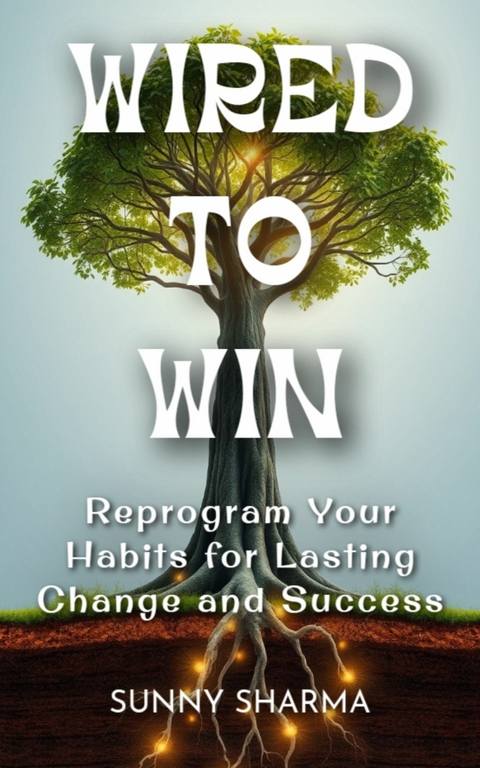
Wired to Win (eBook)
107 Seiten
Publishdrive (Verlag)
978-1-0671019-4-7 (ISBN)
Wired to Win: Reprogram Your Habits for Lasting Change and Success by Sunny Sharma is your manual for rewiring your daily life at the deepest level. Habits are not just actions-they're the silent architecture shaping your results, identity, and destiny. This book guides you step-by-step in building empowering habits and breaking destructive cycles that hold you back. Rooted in neuroscience, psychology, and timeless wisdom, the pages reveal how to overcome resistance, automate success, and create systems that align with your long-term vision. Chapters like 'The Habit Wiring Process,' 'Identity Over Willpower,' and 'Stacking Success Loops' walk you through a blueprint for behavioral transformation. Whether you're trying to improve health, productivity, mindset, or creativity, Wired to Win gives you the tools to make habits stick-permanently. If you're tired of starting over and ready to become someone who follows through effortlessly, it's time to upgrade your operating system. Change your habits, and you change your life-from the inside out.
Wired to Win: Reprogram Your Habits for Lasting Change and Success by Sunny Sharma is your manual for rewiring your daily life at the deepest level. Habits are not just actions-they're the silent architecture shaping your results, identity, and destiny. This book guides you step-by-step in building empowering habits and breaking destructive cycles that hold you back. Rooted in neuroscience, psychology, and timeless wisdom, the pages reveal how to overcome resistance, automate success, and create systems that align with your long-term vision. Chapters like "e;The Habit Wiring Process,"e; "e;Identity Over Willpower,"e; and "e;Stacking Success Loops"e; walk you through a blueprint for behavioral transformation. Whether you're trying to improve health, productivity, mindset, or creativity, Wired to Win gives you the tools to make habits stick-permanently. If you're tired of starting over and ready to become someone who follows through effortlessly, it's time to upgrade your operating system. Change your habits, and you change your life-from the inside out.
Chapter 1: The Architecture of Automatic Action
Imagine waking up every morning with a sense of purpose, effortlessly moving through your day with clarity and focus. Your decisions feel intentional, your actions aligned with your goals, and your energy is directed toward what truly matters. This isn’t a far-off dream or a rare stroke of luck—it’s the result of designing your life with the architecture of automatic action. At its core, this concept is about creating systems and habits that work for you, even when your willpower wanes or distractions arise. It’s about building a framework that allows you to operate at your best, not just occasionally, but consistently.
The architecture of automatic action is rooted in the idea that your environment, routines, and mindset can be intentionally crafted to support your aspirations. Think of it as building a house: if the foundation is solid and the design is thoughtful, the structure will stand strong, no matter the weather. Similarly, when you design your life with intention, you create a system that propels you forward, even when motivation is in short supply. This isn’t about rigid control or perfection—it’s about creating a flow that aligns with your natural rhythms and values.
What makes this approach so powerful is its simplicity. It’s not about overhauling your life overnight or relying on sheer discipline to push through challenges. Instead, it’s about making small, deliberate changes that compound over time. When you set up the right cues, routines, and rewards, your actions become automatic, freeing up mental energy for creativity, growth, and joy. The architecture of automatic action isn’t just a strategy—it’s a way of life. It’s about designing a life that feels effortless because it’s built on a foundation of intentionality and purpose. And the best part? You hold the blueprint.
1.1 The Power of Repetition: Building Neural Highways
Repetition is the architect of habit. Every time you repeat an action, you’re carving a deeper groove into your brain, transforming a winding dirt path into a smooth, effortless highway. Think of it like learning to drive: at first, every movement feels awkward—the clutch, the gear shift, the mirrors. But with practice, your hands and feet move automatically, as if guided by an invisible force. That’s the magic of repetition: it turns effort into ease.
Here’s how it works:
1. First repetition: You’re consciously aware of every step.
2. Tenth repetition: The process starts to feel familiar, but still requires focus.
3. Hundredth repetition: The action becomes second nature, almost automatic.
Consider the story of Michelangelo. He didn’t become a master sculptor overnight. It was the relentless repetition of chiseling stone, day after day, that allowed him to see the angel within the marble. Your habits are no different. Each repetition is a chisel stroke, shaping the masterpiece of your life.
1.2 The Role of Cues: Triggering Automatic Behavior
Every habit has a cue—a signal that sets the wheels of automatic action in motion. It could be as simple as the smell of coffee in the morning or the sound of your alarm clock. These cues act like invisible strings, pulling you into a familiar routine without conscious thought. The key is to design cues that align with your goals.
For example:
- Place your running shoes by the door to cue a morning jog.
- Set a phone reminder to cue a five-minute meditation session.
- Use a specific playlist to cue a focused work session.
Think of cues as the ignition switch of a car. Without them, the engine of habit won’t start. But with the right cues, your actions become as seamless as turning a key. The trick is to make your cues obvious, consistent, and aligned with your desired behavior. As the saying goes, “Environment is the invisible hand that shapes behavior.”
1.3 The Reward System: Reinforcing Positive Habits
Rewards are the glue that holds habits together. They’re the reason your brain says, “Let’s do that again.” Every time you complete a habit and receive a reward—whether it’s the endorphin rush after a workout or the satisfaction of checking off a to-do list—your brain releases dopamine, reinforcing the behavior. Over time, this creates a powerful feedback loop that makes the habit stick.
Here’s how to leverage rewards effectively:
1. Make them immediate: The closer the reward is to the action, the stronger the reinforcement.
2. Make them meaningful: Choose rewards that truly motivate you, whether it’s a piece of dark chocolate or a few minutes of relaxation.
3. Make them consistent: The more predictable the reward, the more ingrained the habit becomes.
Imagine training a dog: you reward it with a treat every time it sits on command. Soon, the dog starts sitting without being asked. Your brain works the same way. By rewarding yourself consistently, you’re training your mind to crave the habit. As B.F. Skinner once said, “The way positive reinforcement is carried out is more important than the amount.”
1.4 The Feedback Loop: Fine-Tuning Your Habits
Habits aren’t static; they’re dynamic systems that evolve over time. The feedback loop—cue, routine, reward—provides a framework for continuous improvement. By analyzing and adjusting each component, you can fine-tune your habits to perfection.
Start by asking yourself these questions:
- Is the cue clear and effective? If not, how can you make it more obvious?
- Is the routine aligned with my goals? If not, what adjustments can I make?
- Is the reward motivating and timely? If not, how can I make it more satisfying?
Take the example of a writer struggling to maintain a daily writing habit. At first, the cue (a morning alarm) worked, but over time, it lost its effectiveness. By changing the cue to a specific time and location—sitting at the desk with a cup of tea at 7 a.m.—the habit became automatic again. This is the power of the feedback loop: it allows you to identify what’s working, what’s not, and make the necessary tweaks.
Remember, habits are like plants. They need the right environment, consistent care, and occasional pruning to thrive. By mastering the feedback loop, you become the gardener of your own behavior, nurturing habits that grow stronger with each passing day. As Aristotle famously said, “We are what we repeatedly do. Excellence, then, is not an act, but a habit.”
1.5 The Blueprint of Habits: Designing Your Automatic Actions
Every habit begins with a blueprint—a mental sketch of what you want to achieve and how you’ll get there. Think of it like building a house: without a clear plan, the structure will crumble. To design your automatic actions, start by identifying the habits you want to cultivate. These could be as simple as drinking more water or as complex as mastering a new skill.
- Clarity is Key: Define your habit with precision. Instead of saying, “I want to exercise more,” specify, “I will run for 30 minutes every morning at 7 a.m.”
- Start Small: Break down your goal into manageable steps. If you aim to read more, begin with just 10 pages a day.
- Visualize Success: Picture yourself completing the habit effortlessly. This mental rehearsal primes your brain for action.
Remember, small, consistent steps lead to monumental change. Like a sculptor chiseling away at stone, each repetition shapes your future self.
1.6 The Power of Cues: Triggering Your Automatic Behavior
Habits don’t exist in a vacuum—they’re triggered by cues in your environment. These cues act as signals, telling your brain it’s time to act. To harness this power, align your habits with existing routines or external triggers.
1. Anchor Your Habits: Attach a new habit to something you already do. For example, if you want to practice gratitude, pair it with your morning coffee.
2. Design Your Environment: Make cues obvious and unavoidable. Place your running shoes by the door or keep a water bottle on your desk.
3. Leverage Technology: Use reminders, apps, or alarms to prompt action.
Think of cues as the spark that ignites the flame of action. By strategically placing these triggers, you create a seamless flow from intention to execution.
1.7 The Reward System: Reinforcing Your Automatic Actions
The final piece of the habit architecture is the reward—the positive reinforcement that makes your brain crave repetition. Without rewards, habits lose their appeal and fizzle out. To make your habits stick, ensure they’re intrinsically or extrinsically rewarding.
- Celebrate Small Wins: Acknowledge every success, no matter how minor. Finished your workout? Treat yourself to a healthy smoothie.
- Track Your Progress: Use a journal or app to monitor your consistency. Seeing your streak grow can be incredibly motivating.
- Focus on Intrinsic Joy: Find pleasure in the habit itself. Love the feeling of running? Let that be your reward.
As the saying goes, “What gets rewarded gets repeated.” By embedding rewards into your habits, you create a self-sustaining cycle of motivation and action. Together, these elements—blueprint, cues, and rewards—form the architecture of automatic action, paving the way for lasting change.
1.8 The Power of Habitual Systems
Imagine your life as a symphony,...
| Erscheint lt. Verlag | 6.8.2025 |
|---|---|
| Sprache | englisch |
| Themenwelt | Sachbuch/Ratgeber ► Beruf / Finanzen / Recht / Wirtschaft ► Bewerbung / Karriere |
| Wirtschaft | |
| Schlagworte | Behavioral transformation • habit mastery • habit stacking • Identity-Based Habits • lasting success • Neuroscience of Habits • personal growth habits |
| ISBN-10 | 1-0671019-4-2 / 1067101942 |
| ISBN-13 | 978-1-0671019-4-7 / 9781067101947 |
| Informationen gemäß Produktsicherheitsverordnung (GPSR) | |
| Haben Sie eine Frage zum Produkt? |
 EPUB (Adobe DRM)
Größe: 561 KB
Kopierschutz: Adobe-DRM
Adobe-DRM ist ein Kopierschutz, der das eBook vor Mißbrauch schützen soll. Dabei wird das eBook bereits beim Download auf Ihre persönliche Adobe-ID autorisiert. Lesen können Sie das eBook dann nur auf den Geräten, welche ebenfalls auf Ihre Adobe-ID registriert sind.
Details zum Adobe-DRM
Dateiformat: EPUB (Electronic Publication)
EPUB ist ein offener Standard für eBooks und eignet sich besonders zur Darstellung von Belletristik und Sachbüchern. Der Fließtext wird dynamisch an die Display- und Schriftgröße angepasst. Auch für mobile Lesegeräte ist EPUB daher gut geeignet.
Systemvoraussetzungen:
PC/Mac: Mit einem PC oder Mac können Sie dieses eBook lesen. Sie benötigen eine
eReader: Dieses eBook kann mit (fast) allen eBook-Readern gelesen werden. Mit dem amazon-Kindle ist es aber nicht kompatibel.
Smartphone/Tablet: Egal ob Apple oder Android, dieses eBook können Sie lesen. Sie benötigen eine
Geräteliste und zusätzliche Hinweise
Buying eBooks from abroad
For tax law reasons we can sell eBooks just within Germany and Switzerland. Regrettably we cannot fulfill eBook-orders from other countries.
EPUB (Ohne DRM)Digital Rights Management: ohne DRM
Dieses eBook enthält kein DRM oder Kopierschutz. Eine Weitergabe an Dritte ist jedoch rechtlich nicht zulässig, weil Sie beim Kauf nur die Rechte an der persönlichen Nutzung erwerben.
Dateiformat: EPUB (Electronic Publication)
EPUB ist ein offener Standard für eBooks und eignet sich besonders zur Darstellung von Belletristik und Sachbüchern. Der Fließtext wird dynamisch an die Display- und Schriftgröße angepasst. Auch für mobile Lesegeräte ist EPUB daher gut geeignet.
Systemvoraussetzungen:
PC/Mac: Mit einem PC oder Mac können Sie dieses eBook lesen. Sie benötigen dafür die kostenlose Software Adobe Digital Editions.
eReader: Dieses eBook kann mit (fast) allen eBook-Readern gelesen werden. Mit dem amazon-Kindle ist es aber nicht kompatibel.
Smartphone/Tablet: Egal ob Apple oder Android, dieses eBook können Sie lesen. Sie benötigen dafür eine kostenlose App.
Geräteliste und zusätzliche Hinweise
Buying eBooks from abroad
For tax law reasons we can sell eBooks just within Germany and Switzerland. Regrettably we cannot fulfill eBook-orders from other countries.
aus dem Bereich