


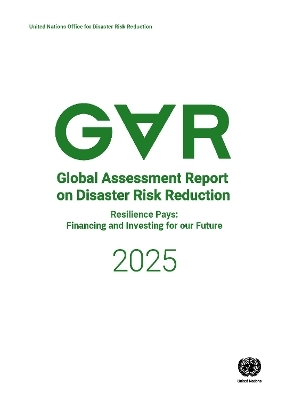
Global Assessment Report on Disaster Risk Reduction 2025
Resilience Pays: Financing and Investing for Our Future
Seiten
2025
United Nations (Verlag)
978-92-1-154256-1 (ISBN)
United Nations (Verlag)
978-92-1-154256-1 (ISBN)
Smart investments can disrupt the cycle of disasters, debt and humanitarian need as economic losses soar. Rising hazards from severe risks, unsafe urbanization and outdated policies call for embedding risk reduction in core decisions, turning resilience into a foundation for long-term stability and growth.
The Global Assessment Report (GAR) 2025: Resilience Pays: Financing and Investing for our Future highlights how smarter investment can reset the destructive cycle of disasters, debt, insurability and humanitarian need that threatens a climate-changed world. Disaster risk is increasing as more frequent and intense hazard events, unsafe urbanization and ineffective development put more people and assets in harm’s way. Disasters are having profound macroeconomic impacts, with direct losses estimated at $202 billion. When indirect and ecosystem costs are taken into account, escalating disaster costs now surpass $2.3 trillion annually. There is an urgent need to transform how disaster risk is addressed amid a rapidly changing climate. Risk is no longer a peripheral issue but a systemic challenge that affects financial stability, sustainability, and equity. By embedding risk reduction into core policy and investment decisions, it is possible to break the recurring cycle of shocks, losses and debt. With the right choices, resilience can become a foundation for long-term prosperity, enabling societies not only to withstand disasters but to thrive despite them.
The Global Assessment Report (GAR) 2025: Resilience Pays: Financing and Investing for our Future highlights how smarter investment can reset the destructive cycle of disasters, debt, insurability and humanitarian need that threatens a climate-changed world. Disaster risk is increasing as more frequent and intense hazard events, unsafe urbanization and ineffective development put more people and assets in harm’s way. Disasters are having profound macroeconomic impacts, with direct losses estimated at $202 billion. When indirect and ecosystem costs are taken into account, escalating disaster costs now surpass $2.3 trillion annually. There is an urgent need to transform how disaster risk is addressed amid a rapidly changing climate. Risk is no longer a peripheral issue but a systemic challenge that affects financial stability, sustainability, and equity. By embedding risk reduction into core policy and investment decisions, it is possible to break the recurring cycle of shocks, losses and debt. With the right choices, resilience can become a foundation for long-term prosperity, enabling societies not only to withstand disasters but to thrive despite them.
| Erscheinungsdatum | 02.09.2025 |
|---|---|
| Reihe/Serie | Global Assessment Report on Disaster Risk Reduction (GAR) |
| Verlagsort | New York |
| Sprache | englisch |
| Maße | 170 x 240 mm |
| Gewicht | 960 g |
| Themenwelt | Sozialwissenschaften ► Politik / Verwaltung ► Europäische / Internationale Politik |
| Sozialwissenschaften ► Soziologie | |
| Wirtschaft ► Betriebswirtschaft / Management ► Allgemeines / Lexika | |
| ISBN-10 | 92-1-154256-1 / 9211542561 |
| ISBN-13 | 978-92-1-154256-1 / 9789211542561 |
| Zustand | Neuware |
| Informationen gemäß Produktsicherheitsverordnung (GPSR) | |
| Haben Sie eine Frage zum Produkt? |
Mehr entdecken
aus dem Bereich


aus dem Bereich
Amerikas Strategie der Vorherrschaft und der Kampf um Eurasien
Buch | Softcover (2024)
NOMEN Verlag
CHF 27,95
kurze Geschichte einer langen Beziehung
Buch | Hardcover (2025)
Suhrkamp (Verlag)
CHF 36,40
erfolgreiche Interessenvertretung durch Prozesskompetenz im komplexen …
Buch | Hardcover (2023)
Wiley-VCH (Verlag)
CHF 58,75


