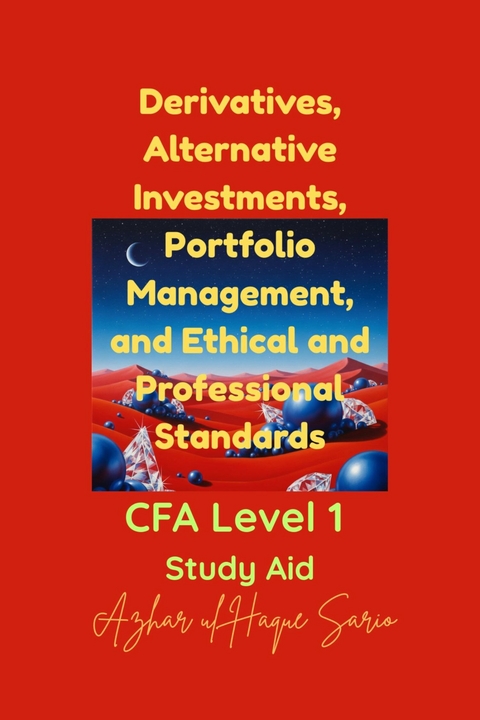
Derivatives, Alternative Investments, Portfolio Management, and Ethical and Professional Standards (eBook)
204 Seiten
Azhar Sario Hungary (Verlag)
978-3-384-67238-4 (ISBN)
Ace the final subjects of your CFA Level 1 exam with this essential study guide!
This book is your focused guide to mastering four key areas of the CFA curriculum. We start with Derivatives. You will learn about derivative instruments and their markets. We explore forward commitments and contingent claims. You'll understand the benefits and risks of these tools. We cover the core concepts of arbitrage and replication. The book details the pricing and valuation of forwards, futures, swaps, and options. You will also learn about option replication using put-call parity and valuing derivatives with a binomial model. Next, we dive into Alternative Investments. This section introduces their unique features and structures. You'll learn how to analyze their performance and returns. We cover investments in private equity and debt. The guide explores real estate, infrastructure, and natural resources. It also provides a clear overview of hedge funds and an introduction to the world of digital assets. The third subject is Portfolio Management. Here, we break down portfolio risk and return in two detailed parts. You will get an overview of the entire portfolio management process. We teach the basics of portfolio planning and construction. You'll also explore the behavioral biases that affect individual investors and get a solid introduction to risk management. Finally, we cover Ethical and Professional Standards. This section explains the importance of ethics and trust in finance. It provides a thorough review of the Code of Ethics and Standards of Professional Conduct. You will find detailed guidance for all seven standards, an introduction to the Global Investment Performance Standards (GIPS), and practical ethics applications to solidify your understanding.
What makes this study aid different? We know you have dense textbooks and official materials. This book isn't designed to replace them; it's designed to make them easier to understand. We cut through the academic jargon and complex language. We present the core, examinable concepts in a clear, concise, and conversational way. Think of this as your expert study partner, simplifying difficult topics so you can learn more efficiently. While other books might overwhelm you with information, our guide focuses on reinforcing your knowledge and building your confidence for exam day. We get straight to the point, helping you connect the dots between different concepts and prepare for the kind of questions you'll actually face. It's the perfect tool for your final review, helping you solidify what you've learned and pinpoint any areas that need more attention.
Disclaimer: The author and this publication are not affiliated with, endorsed by, or sponsored by the CFA Institute. CFA Institute does not endorse, promote, or warrant the accuracy or quality of the products or services offered by the author. CFA® and Chartered Financial Analyst® are trademarks owned by the CFA Institute. This study aid is an independent product created for educational purposes under the principle of nominative fair use.
Portfolio Risk and Return: Part I
1. Your Financial Construction Crew: Meet the Asset Classes
Imagine you’re not just investing money; you’re building something magnificent, a fortress of financial well-being. To do that, you need more than a single tool—you need a whole crew, each with a specialized job. These are your asset classes.
Stocks: The Demolition & Framing Crew. This is your high-energy, high-risk team. When you hire stocks, you’re buying a piece of the action, becoming a part-owner in a project. Their goal is explosive growth, tearing down old limits and framing up massive new structures. They have the potential to build your fortune higher and faster than anyone else. But they’re volatile. Sometimes they swing a sledgehammer with wild abandon, and things can get shaky. They are the engine of growth, but you wouldn’t want them building the whole house alone.
Bonds: The Master Plumber & Electrician. When you bring in bonds, you’re not hiring an owner—you’re the one loaning them the money to get the job done. In return, they promise to pay you back, with steady, predictable payments along the way, like a slow, satisfying drip of income. They are the masters of stability, the systems running behind the walls that keep the lights on and the water flowing. They won’t build you a skyscraper overnight, but they are the dependable force that keeps your project from collapsing when the stock crew gets a little too reckless.
Real Estate: The Foundation & Landscape. This is the solid ground your fortress is built upon. It’s tangible—a piece of land, a rental property, a commercial building. You can walk on it, touch it, and collect rent like harvesting a garden. Real estate is your hedge against the financial storms of inflation, a solid anchor. But it’s not without its challenges. It’s deeply rooted and can’t be moved or sold in an instant (it's "illiquid"). It requires tending, management, and significant capital to lay the first brick.
Cash: The On-Site Supervisor. This is your ready-for-anything resource. Cash and its equivalents (like money market funds) are your command center. It’s the safest member of your crew, offering instant flexibility and total preservation of your capital. Its purpose isn’t to build, but to direct. It’s the money you keep on hand to pay for unexpected repairs, seize a sudden opportunity, or simply give the rest of the crew a break while you wait for a storm to pass. It offers the lowest return, but its value is in its readiness.
2. Your Financial Gut Feeling: The Power of Risk Aversion
Deep down, we are all wired to be cautious. We instinctively flinch from a hot stove and look both ways before crossing the street. In the world of finance, this instinct is called risk aversion. It’s the quiet voice in your head that whispers, "Are you sure about this?"
Imagine a choice: I hand you a crisp, guaranteed $100 bill. Or, we flip a coin. Heads, you get $200; tails, you get nothing. The math says both bets are worth the same on average, but your gut probably clenches at the thought of walking away with empty pockets. A risk-averse person—which is most of us—takes the sure thing. We don’t just value the potential reward; we deeply feel the potential pain of loss.
This isn’t about avoiding risk entirely. It’s about demanding to be paid for the anxiety. This is the "risk premium"—the extra spoonful of sugar you need to swallow the bitter pill of uncertainty. It's the reason a wild, unpredictable stock has to promise a much higher potential return than a boringly stable bond. Without that promise of a premium, you’d just keep your money tucked away in the financial equivalent of your mattress.
This feeling is your personal investment compass. A young professional with a 40-year career ahead is like an adventurer at the start of a long journey; they can afford a few wrong turns and bumpy roads for the chance of discovering treasure. Their compass points toward growth. A retiree, however, is on the final leg of their journey. Their priority is not discovering new lands, but preserving the treasures they’ve already gathered. Their compass points toward safety. Risk aversion is the magnetic north of your financial soul, guiding you to a portfolio that lets you sleep at night.
3. The Summit Attempt: Finding Your Perfect Portfolio
Choosing the right portfolio is like planning the perfect mountain expedition. It’s a deeply personal journey where your ambition meets the reality of the mountain.
First, you have the Capital Allocation Line (CAL). Think of this as the single best, most efficient trail up the mountain. It starts at "base camp"—the risk-free rate, where you get a small, guaranteed return with zero climbing risk. From there, the trail leads up toward the summit of a single, expertly chosen "risky portfolio." The steepness of this trail is called the Sharpe Ratio; a steeper path means you’re gaining a lot of altitude (return) for every step of effort (risk). It's the best bang for your buck on the entire mountain. You can stay at base camp (100% risk-free), hike to the summit (100% risky portfolio), or even use ropes and gear (borrowing money) to climb past the summit. Every possible combination lies on this one perfect trail.
But which point on the trail is right for you? That depends on your indifference curves. These are like contour lines mapping your personal "comfort zone." A seasoned, fearless mountaineer has wide comfort zones; they don't mind a bit of altitude sickness (risk) if it means a better view (return). A more cautious hiker has very tight comfort zones; even a small increase in altitude requires a huge leap in scenic beauty to feel worth it.
Your optimal portfolio is that magical spot on the mountain where your personal comfort zone just kisses the best available trail. It is the highest, most breathtaking viewpoint you can reach without feeling sick or scared. It is the perfect harmony between the mountain’s opportunity and your spirit’s tolerance for adventure.
4. Reading an Asset's Personality: Mean, Variance, & Covariance
To build a team, you need to understand the personalities of the players. In finance, we use a few key stats to do just that.
The Mean (Its Average Mood): This is simply an asset's average performance over time. Think of it as its default personality. If a stock has a mean return of 8%, that's its typical, day-in-day-out mood. It's our best guess for how it will behave in the future.
The Variance (Its "Moodiness"): This tells you if an asset has a steady, predictable personality or if it's prone to wild mood swings. A low-variance asset, like a bond, is the stoic, reliable friend who is always the same. A high-variance asset, like a tech startup stock, is the brilliant but erratic artist—one day euphoric, the next day in despair. Variance is the measure of an asset’s volatility; it’s the mathematical term for risk.
The Covariance (Its Social Life): This is the most fascinating trait. It tells us how an asset behaves around others.
A positive covariance means two assets are best friends who move with the crowd. When the market is happy, they’re both happy.
A negative covariance means you have a contrarian in your group. When everyone else zigs, this asset zags. It’s the friend who brings an umbrella to the beach—and is a genius when it suddenly rains.
This "social behavior" is the secret to building a truly resilient portfolio.
5. The Magic of Teamwork: Portfolio Standard Deviation
Now, let's put the team together. The risk of your entire portfolio isn't just the average "moodiness" of its members. It's about how they interact. The true measure of your portfolio's risk is its standard deviation, and it holds a beautiful secret.
Think of your portfolio as a dance troupe. The standard deviation of each individual asset is like the raw talent of each dancer. You could have a team of superstars, but if they all do their own thing at the same time, the result is chaos—a high-risk performance.
The formula for portfolio standard deviation includes a secret ingredient: the covariance, or the choreography between the dancers. If your dancers move in harmony—if one steps back while another leaps forward—they create a smooth, breathtaking performance. The overall risk (the chance of them tripping over each other) is dramatically reduced.
This is why a portfolio's standard deviation is almost always less than the simple average of its individual parts. The choreography—the way the assets move in relation to one another—creates a whole that is safer and more stable than the sum of its parts. This isn't just a nice idea; it's a mathematical truth. It's the magic of diversification in action.
6. The Seesaw Principle: The Power of Imperfect Harmony
This is the beautiful paradox at the heart of smart investing. The key to safety isn't finding perfectly safe assets; it's finding assets that are imperfectly matched. This relationship is measured by correlation, which runs from -1.0 to +1.0.
Correlation of +1.0 (The Perfect Echo): The assets are identical twins. They move in perfect...
| Erscheint lt. Verlag | 3.8.2025 |
|---|---|
| Sprache | englisch |
| Themenwelt | Wirtschaft ► Betriebswirtschaft / Management |
| Schlagworte | Alternative Investments • CFA ethics review • CFA Level 1 Study Guide • Chartered Financial Analyst • Derivatives pricing and valuation • GIPS standards • investment portfolio management |
| ISBN-10 | 3-384-67238-0 / 3384672380 |
| ISBN-13 | 978-3-384-67238-4 / 9783384672384 |
| Informationen gemäß Produktsicherheitsverordnung (GPSR) | |
| Haben Sie eine Frage zum Produkt? |
 EPUB (Ohne DRM)
Digital Rights Management: ohne DRM
Dieses eBook enthält kein DRM oder Kopierschutz. Eine Weitergabe an Dritte ist jedoch rechtlich nicht zulässig, weil Sie beim Kauf nur die Rechte an der persönlichen Nutzung erwerben.
Dateiformat: EPUB (Electronic Publication)
EPUB ist ein offener Standard für eBooks und eignet sich besonders zur Darstellung von Belletristik und Sachbüchern. Der Fließtext wird dynamisch an die Display- und Schriftgröße angepasst. Auch für mobile Lesegeräte ist EPUB daher gut geeignet.
Systemvoraussetzungen:
PC/Mac: Mit einem PC oder Mac können Sie dieses eBook lesen. Sie benötigen dafür die kostenlose Software Adobe Digital Editions.
eReader: Dieses eBook kann mit (fast) allen eBook-Readern gelesen werden. Mit dem amazon-Kindle ist es aber nicht kompatibel.
Smartphone/Tablet: Egal ob Apple oder Android, dieses eBook können Sie lesen. Sie benötigen dafür eine kostenlose App.
Geräteliste und zusätzliche Hinweise
Buying eBooks from abroad
For tax law reasons we can sell eBooks just within Germany and Switzerland. Regrettably we cannot fulfill eBook-orders from other countries.
aus dem Bereich