Secure Energy Optimization (eBook)
497 Seiten
Wiley-Scrivener (Verlag)
978-1-394-27183-2 (ISBN)
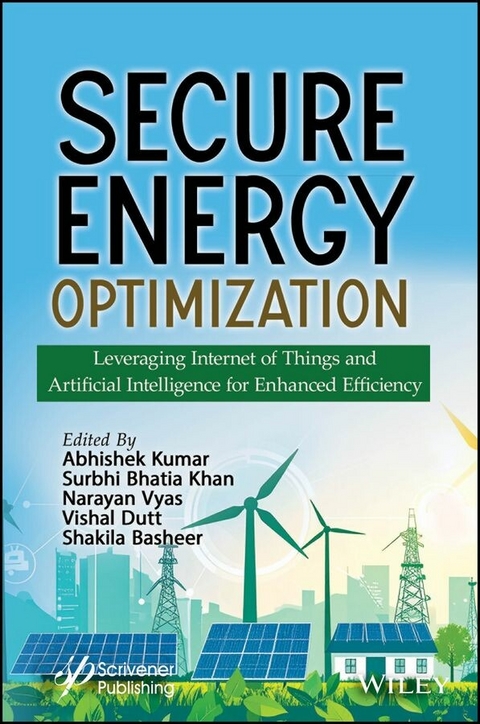
Secure Energy Optimization: Leveraging Internet of Things and Artificial Intelligence for Enhanced Efficiency is essential for anyone looking to navigate the transformative landscape of energy management, as it expertly combines the principles of IoT and AI with real-world case studies to provide actionable insights for achieving sustainable and efficient energy optimization.
Energy is rapidly changing, with an emphasis on sustainable and efficient energy use. In this context, the combination of Internet of Things (IoT) and Artificial Intelligence (AI) technologies has emerged as a potent technique for optimising energy use, improving efficiency, and enhancing overall energy security. Secure Energy Optimization: Leveraging Internet of Things and Artificial Intelligence for Enhanced Efficiency provides a comprehensive review of how IoT and AI can be used to accomplish safe energy optimisation. Readers will gain an understanding of the underlying principles of IoT and AI, as well as their applications in energy efficiency and the problems and hazards related to their adoption. They will investigate the successful integration of IoT and AI technologies in energy management systems, smart grids, and renewable energy sources using real-world case studies and examples. By bringing together theoretical notions, cutting-edge research, and practical examples, this book bridges the gap between theory and implementation.
Abhishek Kumar, PhD is an assistant professor and the Research and Development Coordinator at Chitkara University with over 11 years of experience. He has over 100 publications in peer-reviewed national and international journals, books, and conferences. His research includes artificial intelligence, renewable energy, image processing, computer vision, data mining, and machine Learning.
Surbhi Bhatia Khan, PhD is a lecturer in the Department of Data Science in the School of Science, Engineering, and Environment at the University of Salford with over 11 years of teaching experience. She has published over 100 papers in reputed journals, 12 international patents, and 12 books. Her areas of interest include information systems, sentiment analysis, machine learning, databases, and data science.
Narayan Vyas is a principal research consultant at AVN Innovations, where he is actively involved in research and development. He has published many articles in reputed, peer-reviewed national and international journals and conferences. His research areas include the Internet of Things, machine learning, deep learning, computer vision, and bioinformatics.
Vishal Dutt is a technical trainer in the Department of Computer Science and Engineering at Chandigarh University with over seven years of teaching experience. He has over 50 publications in reputed, peer-reviewed national and international journals, conferences, and book chapters, in addition to two books. His research interests include data science, data mining, machine learning, and deep learning.
Shakila Basheer, PhD is an assistant professor in the Department of Information Systems in the College of Computer and Information Science at Princess Nourah Bint Abdulrahman University with over ten years of teaching experience. She has published over 90 technical papers in international journals, conferences, and book chapters. Her research focus includes data mining, image processing, and fuzzy logic.
Secure Energy Optimization: Leveraging Internet of Things and Artificial Intelligence for Enhanced Efficiency is essential for anyone looking to navigate the transformative landscape of energy management, as it expertly combines the principles of IoT and AI with real-world case studies to provide actionable insights for achieving sustainable and efficient energy optimization. Energy is rapidly changing, with an emphasis on sustainable and efficient energy use. In this context, the combination of Internet of Things (IoT) and Artificial Intelligence (AI) technologies has emerged as a potent technique for optimising energy use, improving efficiency, and enhancing overall energy security. Secure Energy Optimization: Leveraging Internet of Things and Artificial Intelligence for Enhanced Efficiency provides a comprehensive review of how IoT and AI can be used to accomplish safe energy optimisation. Readers will gain an understanding of the underlying principles of IoT and AI, as well as their applications in energy efficiency and the problems and hazards related to their adoption. They will investigate the successful integration of IoT and AI technologies in energy management systems, smart grids, and renewable energy sources using real-world case studies and examples. By bringing together theoretical notions, cutting-edge research, and practical examples, this book bridges the gap between theory and implementation.
| Erscheint lt. Verlag | 1.8.2025 |
|---|---|
| Sprache | englisch |
| Themenwelt | Wirtschaft ► Volkswirtschaftslehre |
| Schlagworte | Analysis • Artificial Intelligence Algorithms • demand response • Dynamic Pricing • energy data • energy efficiency • energy optimization • Energy Security • Energy Storage Optimization • fault detection • IoT and AI in Energy • IoT Sensors • Real-time Monitoring • renewable energy integration • Secure Energy Management • Sustainable energy |
| ISBN-10 | 1-394-27183-2 / 1394271832 |
| ISBN-13 | 978-1-394-27183-2 / 9781394271832 |
| Informationen gemäß Produktsicherheitsverordnung (GPSR) | |
| Haben Sie eine Frage zum Produkt? |
 PDF (Adobe DRM)
Kopierschutz: Adobe-DRM
Adobe-DRM ist ein Kopierschutz, der das eBook vor Mißbrauch schützen soll. Dabei wird das eBook bereits beim Download auf Ihre persönliche Adobe-ID autorisiert. Lesen können Sie das eBook dann nur auf den Geräten, welche ebenfalls auf Ihre Adobe-ID registriert sind.
Details zum Adobe-DRM
Dateiformat: PDF (Portable Document Format)
Mit einem festen Seitenlayout eignet sich die PDF besonders für Fachbücher mit Spalten, Tabellen und Abbildungen. Eine PDF kann auf fast allen Geräten angezeigt werden, ist aber für kleine Displays (Smartphone, eReader) nur eingeschränkt geeignet.
Systemvoraussetzungen:
PC/Mac: Mit einem PC oder Mac können Sie dieses eBook lesen. Sie benötigen eine
eReader: Dieses eBook kann mit (fast) allen eBook-Readern gelesen werden. Mit dem amazon-Kindle ist es aber nicht kompatibel.
Smartphone/Tablet: Egal ob Apple oder Android, dieses eBook können Sie lesen. Sie benötigen eine
Geräteliste und zusätzliche Hinweise
Buying eBooks from abroad
For tax law reasons we can sell eBooks just within Germany and Switzerland. Regrettably we cannot fulfill eBook-orders from other countries.
aus dem Bereich