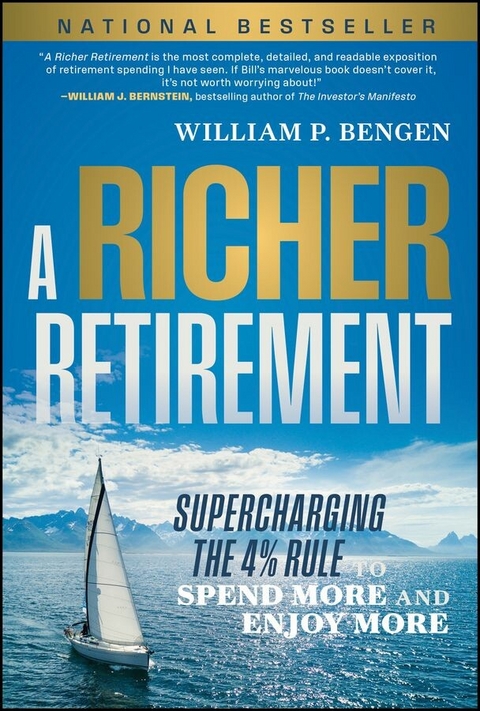
A Richer Retirement (eBook)
290 Seiten
Wiley (Verlag)
978-1-394-34318-8 (ISBN)
Know exactly how much you can safely spend each year after you retire without outliving your nest egg
In A Richer Retirement: Supercharging the 4% Rule to Spend More and Enjoy More, entrepreneur, researcher, and financial planner, William P. Bengen, delivers a straightforward, soup-to-nuts guide for maximizing your withdrawals from your investment accounts during your retirement. The author explains how you can draw heavily on your retirement accounts without spending yourself into premature poverty.
This book is a comprehensive roadmap to constructing your personal retirement withdrawal plan. You'll learn how to compute a low-risk maximum withdrawal rate so that you can enjoy your retirement savings to the utmost. You'll also discover guidance on why and how to adjust your withdrawals during retirement to help make sure that your accounts last your entire life.
You'll also find:
- The eight elements of a comprehensive personal retirement withdrawal plan
- Techniques for selecting your withdrawal rate based on the eight elements, inflation, and stock market valuation
- A template for your withdrawal plan that will help you recognize if you're overspending (or underspending!) and exactly how to address that issue
Perfect for well-informed laypeople entering, nearing, or in retirement, A Richer Retirement is a can't-miss retirement playbook for everyone who wants to make the most of their retirement savings without outliving their nest egg. It's also an essential read for financial professionals who serve clients in or close to retirement.
WILLIAM P. BENGEN is a financial researcher and former Certified Financial Planner licensee. He's an expert in the sustainability of withdrawals from stock and bond portfolios and is frequently quoted in major financial publications. He's a recipient of the NAPFA's Robert J. Underwood Distinguished Service Award.
NATIONAL BESTSELLERKnow exactly how much you can safely spend each year after you retire without outliving your nest egg In A Richer Retirement: Supercharging the 4% Rule to Spend More and Enjoy More, entrepreneur, researcher, and financial planner, William P. Bengen, delivers a straightforward, soup-to-nuts guide for maximizing your withdrawals from your investment accounts during your retirement. The author explains how you can draw heavily on your retirement accounts without spending yourself into premature poverty. This book is a comprehensive roadmap to constructing your personal retirement withdrawal plan. You'll learn how to compute a low-risk maximum withdrawal rate so that you can enjoy your retirement savings to the utmost. You'll also discover guidance on why and how to adjust your withdrawals during retirement to help make sure that your accounts last your entire life. You'll also find: The eight elements of a comprehensive personal retirement withdrawal plan Techniques for selecting your withdrawal rate based on the eight elements, inflation, and stock market valuation A template for your withdrawal plan that will help you recognize if you're overspending (or underspending!) and exactly how to address that issue Perfect for well-informed laypeople entering, nearing, or in retirement, A Richer Retirement is a can't-miss retirement playbook for everyone who wants to make the most of their retirement savings without outliving their nest egg. It's also an essential read for financial professionals who serve clients in or close to retirement.
CHAPTER 1
THE PROBLEM: OUTLIVING YOUR RETIREMENT SAVINGS
Long‐range planning for income from retirement savings is beset with many uncertainties. To begin with, we don't know how long we'll live in retirement. Will it be 20 years? Thirty years? Or will we survive to the ripe old age of 105, as did dear‐departed Aunt Matilda?
Furthermore, financial markets are inherently volatile and unpredictable. We don't know what returns to expect from investments such as stocks and bonds in years to come. The future path of inflation is also indeterminate. Will the stock market crash, or will it soar? Will we return to the painful inflation of the 1970s, which mauled the portfolios of retirees, or will the Federal Reserve triumph in its battle to beat it back? As we'll see in later chapters, these are vital considerations for your withdrawal plan.
Long ago, I learned the futility of forecasting any of these factors. I prefer the attitude of one of my favorite authors, Mark Twain, who slyly observed, “Prediction is difficult – particularly when it involves the future.” Thus, in the early 1990s, when I tackled the urgent need to guide my clients on retirement withdrawals, I decided to turn toward the past for answers.
1.1 PORTFOLIO LONGEVITY, BEAR MARKETS, AND INFLATION
My research relies heavily on charts to illustrate my findings. You'll find this book loaded to the brim with charts! An updated version of the first chart I ever produced, in 1993, appears in Figure 1.1.
This chart presents, for each of hundreds of historical retirees, the length of time their portfolio lasted (its “longevity”), assuming an initial withdrawal rate of 6%. The 6% rate was chosen arbitrarily. At the time, I had no idea what constituted a reasonable withdrawal rate.
Some clarifications are needed before we engage in observations about this chart.
First, this chart contains data for clients who retired on the first day of each quarter beginning 1 January 1926, and ending 1 January 2013, a total of 349 individuals.
Figure 1.1 Number of years portfolio lasted @ 6% initial withdrawal rate. Tax‐advantaged account, cost‐of‐living adjustment (COLA) scheme, seven asset classes, capped at 50 years, fixed 55%/40%/5% stocks/bonds/cash.
The findings in this book are based on actual data through 31 December 2022. Analysis of retiree portfolios with less than 10 years of actual data can produce unreliable results, so for this chart I excluded individuals who retired after 1 January 2013.
Second, I capped the “longevity” of each portfolio at a maximum of 50 years. There are, of course, a few exceptionally long‐lived individuals who will be retired for longer, and many of the “Financial Independence, Retire Early (FIRE)” folks (who aspire to retire at age 35 or younger) may exceed this limitation. However, 50 years is long enough for the great majority of retirees.
Third, those who retired on or after 1 January 1974 lack a full 50 years of actual data. For years with missing data (beginning 1 January 2023), I have inserted long‐term averages of investment returns and inflation statistics. This “data gap” is not of great concern, as the longevity of most retirement portfolios is determined in their first decade. This doesn't imply that developments of the last 20 years of retirement are without impact; it's just that earlier events have their effects compounded for longer, and thus those effects are magnified.
Next, we need to specify some of the assumptions made in the preparation of the chart:
- A “tax‐advantaged” account (such as an IRA or Roth IRA).
- The portfolio “rebalanced” (returned to its original allocation) once annually.
- Portfolio allocated as follows: 55% in stocks, 40% in bonds, and 5% in cash.
- Withdrawals made using the “COLA” scheme, which works as follows: The first‐year withdrawal equals 6% of the portfolio's starting value. In subsequent years, withdrawals are increased by the prior year's inflation, much as Social Security functions.
Now that we have the preliminaries out of the way, let's take a closer look at Figure 1.1. One is immediately struck by how many portfolios, even at a seemingly high withdrawal rate of 6%, lasted for at least 50 years. More than a third of the retirees fall into this category. Many of these probably lasted considerably longer, but the chart is arbitrarily capped at 50 years. A “6% rule” would have worked for these retirees, and possibly even a higher withdrawal rate!
It's also evident that, in contrast, many retirees ran out of money well short of 50 years, including several who failed to make it to 20 years. These “failed portfolios” seemed to occur in clusters. What's the reason for that?
To answer that question, consider Table 1.1, which lists major bear markets in US Large‐Company Stocks since 1926. A bear market is an extended period during which stock prices decline significantly. They are often associated with a recession in the economy. Furthermore, to be considered a bona fide major bear market, investors need to develop a negative psychology, often including a conviction that they “will never buy another stock as long as they live.” By these standards, the 33% COVID‐related decline in early 2020 does not qualify as a major bear market, as investors did not have enough time to develop FOLM (Fear of Losing Money). In fact, they barely had enough time to swallow their Paxlovid tablets before it was over.
Table 1.1 Characteristics of major bear markets in US large‐company stocks (LCS) since 1926
| Period | Duration (months) | Total return LCS | Change in inflation | Total return ITGB* |
|---|
| September 1929–June 1932 | 34 | −89.2% | −27.8% | +17.6% |
| March 1937–March 1938 | 13 | −50.0% | + 0.0% | +3.1% |
| January 1973–December 1974 | 24 | −48.2% | +22.1% | +10.6% |
| September 2000–September 2002 | 25 | −49.1% | +4.8% | +9.7% |
| October 2007–March 2009 | 17 | −56.8% | +1.8% | +15.0% |
* ITGB = Intermediate‐Term US Government Bonds
Perhaps unsurprisingly, most of the dips in Figure 1.1 coincide with the major bear markets listed in Table 1.1. It's fair to conclude that a major bear market early in retirement tends to significantly reduce portfolio longevity. Concomitantly, a major bull market early in retirement (such as during the 1980s) can have the felicitous effect of extending a portfolio's life.
There are further lessons to be learned here. Note that the bar corresponding to the October 1947 retiree is notably short (22 years) but is not associated with any major bear market. However, from July 1946 through June 1948, a period of two years, inflation raged at high levels. This clearly indicates that inflation is a critical factor in making retirement portfolios last.
In Table 1.1, the deepest bear market occurred during the Depression, with a loss exceeding 89%. However, according to Figure 1.1, a more severe reduction in portfolio longevity happened a few years prior to the 1973–1974 bear market, which registered a much smaller loss in stock prices (−49.8%). Why didn't the Depression bear market have a more onerous effect on portfolio longevity?
The answer is that the Depression was a time of double‐digit deflation (declining consumer prices), which reduced withdrawals for several consecutive years. The 1973–1974 bear market occurred during a period of high inflation (rising consumer prices), so that retirement portfolios were subjected to a double whammy of declining portfolio values and rapidly accelerating withdrawals (to better understand this dual effect, see the “balloon analogy” in Section 1.5). There have been other periods as well, when a moderate decline in stocks accompanied by a short burst of high inflation damaged retirement portfolios. In other words, inflation must be considered on a par with stock bear markets as a determinant of the success of a withdrawal plan.
Finally, the last column in Table 1.1 displays the returns earned by US Government Bonds during stock bear markets. The positive returns earned by bonds made them a useful “diversifier” to offset some of the losses in stocks. We shall see further evidence of this effect when we discuss optimum asset allocations for retirement portfolios.
1.2 MY RESEARCH METHODOLOGY
A few words about my research methods seem appropriate. From the beginning, I've used a...
| Erscheint lt. Verlag | 30.7.2025 |
|---|---|
| Sprache | englisch |
| Themenwelt | Sachbuch/Ratgeber ► Beruf / Finanzen / Recht / Wirtschaft ► Geld / Bank / Börse |
| Wirtschaft ► Betriebswirtschaft / Management | |
| Schlagworte | 4% rule spending • how much can I spend in retirement? • how much should I save for retirement? • retirement book • retirement planning • retirement saving plan • retirement spending • retirement spending plan • spending in retirement • the four percent rule |
| ISBN-10 | 1-394-34318-3 / 1394343183 |
| ISBN-13 | 978-1-394-34318-8 / 9781394343188 |
| Informationen gemäß Produktsicherheitsverordnung (GPSR) | |
| Haben Sie eine Frage zum Produkt? |
 EPUB (Adobe DRM)
Kopierschutz: Adobe-DRM
Adobe-DRM ist ein Kopierschutz, der das eBook vor Mißbrauch schützen soll. Dabei wird das eBook bereits beim Download auf Ihre persönliche Adobe-ID autorisiert. Lesen können Sie das eBook dann nur auf den Geräten, welche ebenfalls auf Ihre Adobe-ID registriert sind.
Details zum Adobe-DRM
Dateiformat: EPUB (Electronic Publication)
EPUB ist ein offener Standard für eBooks und eignet sich besonders zur Darstellung von Belletristik und Sachbüchern. Der Fließtext wird dynamisch an die Display- und Schriftgröße angepasst. Auch für mobile Lesegeräte ist EPUB daher gut geeignet.
Systemvoraussetzungen:
PC/Mac: Mit einem PC oder Mac können Sie dieses eBook lesen. Sie benötigen eine
eReader: Dieses eBook kann mit (fast) allen eBook-Readern gelesen werden. Mit dem amazon-Kindle ist es aber nicht kompatibel.
Smartphone/Tablet: Egal ob Apple oder Android, dieses eBook können Sie lesen. Sie benötigen eine
Geräteliste und zusätzliche Hinweise
Buying eBooks from abroad
For tax law reasons we can sell eBooks just within Germany and Switzerland. Regrettably we cannot fulfill eBook-orders from other countries.
aus dem Bereich