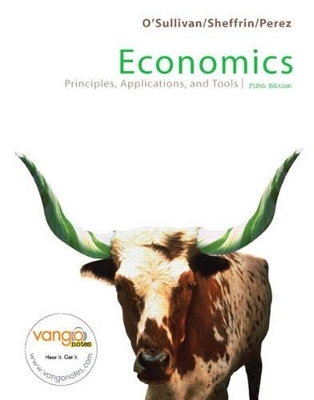
Economics:principles, Applications, and Tools with My EconLab in CourseCompass plus e-book
Pearson Prentice Hall
978-1-4058-7334-5 (ISBN)
- Titel ist leider vergriffen;
keine Neuauflage - Artikel merken
O'Sullivan/Sheffrin/Perez 5e uses questions to drive student interest, then applications to illustrate concepts, and then tools to practice economic concepts. Students come into their first Economics course thinking they will better understand the economy around them; the choices our government, international governments, businesses, and individuals make. Unfortunately, many don't get answers to those questions when they complete the course. O/S/P uses chapter opening questions, applications that explain and tie to those questions throughout the chapter, and chapter ending tools to help students actively internalize economics.
Arthur O'Sullivan is a professor of economics at Lewis and Clark College in Portland, Oregon. After receiving his B.S. in economics at the University of Oregon, he spent two years in the Peace Corps, working with city planners in the Philippines. He received his Ph.D. in economics from Princeton University in 1981 and has taught at the University of California, Davis, and Oregon State University, winning several teaching awards at both schools. He recently accepted an endowed professorship at Lewis and Clark College, where he teaches microeconomics and urban economics. He is the author of the best-selling textbook, Urban Economics, currently in its sixth edition. Professor O'Sullivan's research explores economic issues concerning urban land use, environmental protection, and public policy. His articles have appeared in many economics journals, including theJournal of Urban Economics, Journal of Environmental Economics and Management, National Tax Journal, Journal of Public Economics, andJournal of Law and Economics. Professor O'Sullivan lives with his family in Lake Oswego, Oregon. For recreation, he enjoys hiking, boogie-boarding, paragliding, and squash. Steven M. Sheffrin is dean of the division of social sciences and professor of economics at the University of California, Davis. He has been a visiting professor at Princeton University, Oxford University, and the London School of Economics and has served as a financial economist with the Office of Tax Analysis of the United States Department of Treasury. He has been on the faculty of the University of California, Davis, since 1976 and has served as the chairman of the department of economics. He received his B.A. from Wesleyan University and his Ph.D. in economics from the Massachusetts Institute of Technology. Professor Sheffrin is the author of 10 other books and monographs and over 100 articles in the fields of macroeconomics, public finance, and international economics. His most recent books include Rational Expectations (second edition) and Property Taxes and Tax Revolts: The Legacy of Proposition 13 (with Arthur O'Sullivan and Terri Sexton). Professor Sheffrin has taught macroeconomics at all levels, from large introduction to principles classes (enrollments of 400) to graduate classes for doctoral students. He is the recipient of the Thomas Mayer Distinguished Teaching Award in economics. He lives with his wife Anjali (also an economist) in Davis, California, and has two daughters who have studied economics. In addition to a passion for current affairs and travel, he plays a tough game of tennis. Stephen Perez is chair of the economics department at California State University, Sacramento. After receiving his B.A. in economics at the University of California, San Diego, he received his Ph.D. in economics from the University of California, Davis, in 1994. He taught economics at Virginia Commonwealth University and Washington State University before coming to California State University, Sacramento, in 2001. He teaches macroeconomics at all levels as well as econometrics, sports economics, labor economics, and mathematics for economists. Professor Perez's research explores most macroeconomic topics. In particular, he is interested in evaluating the ability of econometric techniques to discover the truth, issues of causality in macroeconomics, and sports economics. His articles have appeared in many economics journals, including the Journal of Monetary Economics, Econometrics Journal, Economics Letters, Journal of Economic Methodology, Public Finance and Management, Journal of Economics and Business, Oxford Bulletin of Economics and Statistics, Journal of Money, Credit, and Banking, Applied Economics, and Journal of Macroeconomics.
PART 1: Introduction and Key Principles Ch 1: Introduction: What is Economics? Appendix: Using Graphs & Percentages Ch 2: Key Principles of Economics Ch 3: Exchange and Markets Ch 4: Demand, Supply, and Market Equilibrium Part 2: The Basic Concepts in Macroeconomics Ch 5: Measuring a Nation's Production and Income Ch 6: Unemployment and Inflation Part 3: The Economy in the Long Run Ch 7: The Economy at Full Employment Ch 8: Why Do Economies Grow? Appendix: A Model of Capital Deepening Part 4: Economic Fluctuations and Fiscal Policy Ch 9: AD/AS Ch 10: Fiscal Policy Ch 11: The Income Expenditure Model Appendix: Formulas for Equilibrium Income & the Multiplier Ch 12: Investment and Financial Markets Part 5: Money, Banking, and Monetary Policy Ch 13: Money and the Banking System Appendix: Formula for Deposit Creation Ch 14: The Federal Reserve and Monetary Policy Part 6: Inflation, Unemployment, and Economic Policy Ch 15: Modern Macroeconomics: From the Short Run to the Long Run. Ch 16: The Dynamics of Inflation and Unemployment Ch 17:Macroeconomic Policy Debates Part 7: The International Economy Ch 18: International Trade and Public Policy Ch 19: The World of International Finance Part 8: A Closer Look at Demand and Supply Ch 20: Elasticity: A Measure of Responsiveness Ch 21: Market Efficiency and Government Intervention Ch 22: Consumer Choice with Utility Theory Appendix: Consumer Choice with Indifference Curves Part 9: Market Structures and Pricing Ch 23: Production Technology and Cost Ch 24: Perfect Competition: Short Run and Long Run Ch 25: Monopoly and Price Discrimination Ch 26: Market Entry and Monopolistic Competition Ch 27: Oligopoly and Strategic Behavior Ch 28: Controlling Market Power: Antitrust and Regulation Part 10: Externalities and Information Ch 29: Imperfect Information and Disappearing Markets Ch 30: Public Goods, Taxes, and Public Choice Ch 31: External Costs and Environmental Policy Part 11: The Labor Market and Income Distribution Ch 32: The Labor Market, Income, and Poverty Ch 33: Unions, Monopsony, and Imperfect Information
| Erscheint lt. Verlag | 31.5.2007 |
|---|---|
| Sprache | englisch |
| Maße | 224 x 284 mm |
| Gewicht | 1904 g |
| Themenwelt | Wirtschaft ► Volkswirtschaftslehre |
| ISBN-10 | 1-4058-7334-5 / 1405873345 |
| ISBN-13 | 978-1-4058-7334-5 / 9781405873345 |
| Zustand | Neuware |
| Informationen gemäß Produktsicherheitsverordnung (GPSR) | |
| Haben Sie eine Frage zum Produkt? |
aus dem Bereich