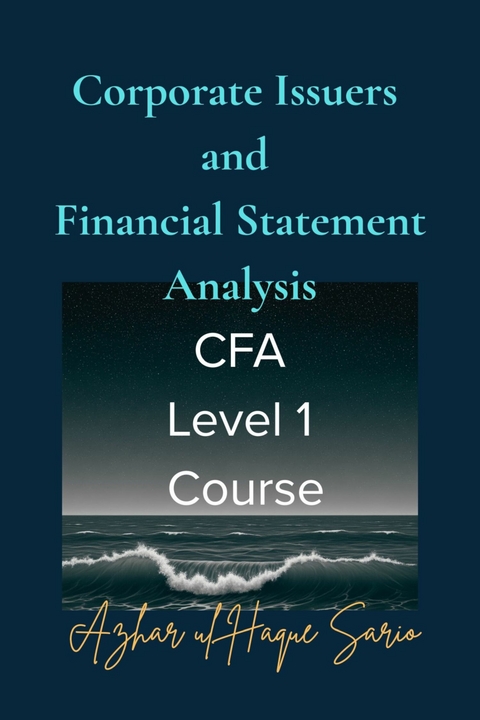
Corporate Issuers and Financial Statement Analysis (eBook)
256 Seiten
Azhar Sario Hungary (Verlag)
978-3-384-66831-8 (ISBN)
Ready to master two of the most critical topics for the CFA Level 1 exam in one focused guide?
This book is your complete resource for Corporate Issuers and Financial Statement Analysis. It covers two major subjects in a logical flow. First, we explore the world of Corporate Issuers. You will learn all about business structures. We explain different organizational forms. You'll understand corporate features and ownership. We identify investors and other key stakeholders. The book dives deep into corporate governance. You will learn about managing working capital and liquidity. We show how companies make capital investment decisions. You'll see how capital is allocated. We will help you grasp complex capital structures. We also break down various business models. Then, the book transitions to Financial Statement Analysis. It starts with a clear and simple introduction. You will learn to properly analyze an income statement. We teach you to dissect a company's balance sheet. You will master the statement of cash flows. We have dedicated chapters for tough topics. These include inventories and long-term assets. We also cover long-term liabilities, equity, and income taxes. You'll learn to spot high-quality financial reporting. We arm you with essential financial analysis techniques. Finally, we provide a gentle introduction to financial statement modeling to tie it all together.
So, what makes this guide your best choice for success? Many exam prep books are incredibly dense and academic. They can feel overwhelming and disconnected from the real world. We built this book to be different. Our approach is conversational and direct, breaking down complex ideas into simple, easy-to-understand concepts, as if a personal tutor were guiding you. We focus exclusively on these two interrelated topics, creating a seamless learning path between understanding a company's internal decisions and analyzing its external financial reports. Instead of just defining terms, we show you the 'why' behind them. You won't just learn what a capital structure is; you'll see exactly how it impacts the numbers you analyze on the financial statements. This integrated method, which links corporate actions to financial outcomes within one cohesive volume, provides a practical, real-world understanding that other, more fragmented materials often fail to deliver. It's designed to build your confidence and practical skills, not just help you memorize facts.
Disclaimer: This book is an independent publication. It has not been authorized, sponsored, or otherwise approved by the CFA Institute. CFA® and Chartered Financial Analyst® are registered trademarks owned by the CFA Institute. The use of these trademarks is for identification purposes only under the nominative fair use doctrine and does not imply any affiliation with or endorsement by the CFA Institute.
Analyzing Income Statements
Beneath the polished surface of every financial report lies a story. It's a tale of ambition, strategy, success, and sometimes, struggle. But who gets to decide how and when that story is told? The answer, surprisingly, lies in a practice that sounds deceptively dull: revenue recognition.
Think of it not as accounting, but as the art of financial storytelling. It’s the set of narrative rules that governs when a company can officially declare, "We earned this." It’s the difference between a story that reflects reality and one that’s pure fiction. And just like a great novel, it has a structure, a plot, and characters whose fates hang in the balance.
The global standard for this art form, known as ASC 606 and IFRS 15, is essentially a five-act play for telling your company’s revenue story honestly.
The Five-Act Play of a Promise Kept
Every time a company makes a sale, it’s staging a small play. Here's how the script unfolds:
Act I: The Handshake (Identify the Contract)
Every story needs a beginning. This is it. It’s the moment a company and a customer agree to do business. But it's more than a casual nod. For the story to be real, the deal must be a firm commitment. Both sides know their roles, the price is set, and it's clear the company will actually get paid. Without this solid opening scene, the rest of the story can't even begin. It’s the foundational promise upon which everything is built.
Act II: Unpack the Promises (Identify the Performance Obligations)
A great story is rarely about one single event. It has subplots. This act is about looking inside the contract and finding all the individual promises the company has made. Selling a new phone system isn't one promise; it’s three: the hardware itself, the installation service, and the 12 months of tech support. Each of these is a distinct subplot, a separate story arc that will conclude on its own timeline. The art here is unbundling these promises to tell a more accurate, detailed story of value delivery.
Act III: Settle on the Price (Determine the Transaction Price)
What are the stakes of our story? The transaction price is the bounty the hero (the company) expects to claim. But life is full of plot twists. What if there's a bonus for finishing a project early? Or a penalty for being late? This "variable consideration" has to be estimated. The storyteller must decide: are we telling a tale of "most likely" success, or one that averages out all possible outcomes? This is where judgment enters the narrative, shaping the potential climax of the story.
Act IV: Slice the Pie (Allocate the Price to the Promises)
Our story has a total prize, and it has several subplots. Now, we have to decide how much of that prize belongs to each subplot. If a phone and a one-year service plan are sold together for $1,200, it's not fair to say the story is all about the phone. We must slice that $1,200 pie and give a piece to the phone (the first subplot) and a piece to the service plan (the second subplot), based on what each would cost alone. This ensures each part of the story gets the credit it deserves, when it deserves it.
Act V: Take a Bow (Recognize Revenue When a Promise is Kept)
This is the grand finale of each subplot. It's the moment the company gets to turn to its audience—investors, analysts, the world—and announce, "We did it." When does this happen?
A Moment in Time: Sometimes the curtain falls in a single, dramatic moment. When you buy a coffee, the story begins and ends right there. The coffee shop takes its bow the second you walk away with your latte. Control has been transferred.
Over Time: Other stories are an epic saga. A subscription to a streaming service isn't a single event; it's a story that unfolds month by month. The company takes a small bow every month, recognizing a piece of the revenue as it provides the ongoing service. The story is the continuous access, not a one-time product.
The Story's Genre Matters
Just as there are different genres of literature, there are different ways this five-act play unfolds across industries.
The Epic (Long-Term Construction): Building a skyscraper is a multi-year epic. You don’t wait until the final brick is laid to tell the story. Revenue is recognized chapter by chapter, based on the progress made, giving readers a real-time account of the monumental effort.
The Living Novel (Software-as-a-Service): A SaaS subscription is a story that never truly ends. The company delivers value every single day, and so the revenue story is told not as a single sale, but as a continuous, recurring stream of monthly installments.
The Anthology (Retail): A retail store tells thousands of short stories every day. Each sale is a complete narrative. But there are twists: a customer returning an item is like wanting to rewrite the ending. A gift card is a story waiting to be told.
The Cameo (Principal vs. Agent): Is the company the star of the show or just a supporting actor? An airline (the principal) sells you a ticket and tells the full story of that fare as its revenue. A travel website (the agent) that booked the flight only gets to tell the story of its commission. Getting this role wrong is the difference between claiming you directed the movie and admitting you just sold the popcorn.
Reading Between the Lines: Why the Analyst is the Critic
As a financial analyst, your job is to be the literary critic. You can't just take the story at face value. You must ask:
Is the Story Real? (Profit vs. Cash Flow): A company can tell a thrilling tale of record revenues, but if the cash register is empty, is it a true story or a fantasy? The gap between the reported profit (the narrative) and the actual cash flow (the reality) reveals the quality of the storytelling. A growing pile of "deferred revenue" isn't a liability to fear; it's the foreshadowing of blockbuster sequels already paid for by the audience.
Is the Author Trustworthy? (Earnings Quality): Is the company using cheap narrative tricks? Rushing to recognize revenue before the story is finished makes the current chapter look exciting but leaves future chapters empty. An astute critic spots this "aggressive storytelling" and knows it’s not sustainable.
How Does This Compare to Other Books? (Comparability): The five-act structure is universal, but every author has a unique style. To compare two companies, you have to read the "author's notes" in the back of the book—the financial footnotes. This is where they explain their specific storytelling choices. Only then can you judge if one book is truly better than another.
In the end, revenue recognition is the soul of financial reporting. It breathes life into the numbers, giving them context, timing, and meaning. To overlook its artful structure is to read only the cover of a company's book—missing the plot, the characters, and the true narrative of its journey.
The Gardener's Ledger: When a Cost Becomes a Cost
Let's get out of the stuffy boardroom and into a garden. This is where the real story of business begins—with effort and the hope of a reward. The core idea you’re asking about, "expense recognition," isn't just accounting jargon; it’s about telling an honest story of that effort. It’s about answering one simple question: "Did we really make a profit this season?" It’s not about the cash in your pocket; it’s about the truth of the harvest.
Here’s how our gardener thinks about it.
1. The Tale of the Tomato Seed (The Matching Principle)
Our gardener buys a packet of special heirloom tomato seeds in February. Cold, hard cash is gone. But is that a cost of doing business for February? Not really. The effort hasn't paid off yet. Those seeds sit in a shed, full of potential.
In August, the gardener sells a beautiful, ripe tomato from one of those plants. Cha-ching! Revenue is earned. Now, the cost of that seed wakes up. It marches onto the books and stands right next to the revenue from the tomato sale. It’s a perfect match, a cause and its effect. The cost of the seed is only truly "spent" in the story of the business when the fruit it produced is sold. To do it any other way—to count the cost in a snowy February and the income in a sunny August—would be to tell a disjointed and misleading story about the garden's success.
2. The Wheelbarrow's Long Journey (Systematic Allocation)
The gardener buys a sturdy new wheelbarrow. It costs $150 and is expected to last for five good years, helping to grow tomatoes, zucchini, and pumpkins.
How do you pin the cost of this wheelbarrow to a single tomato? You can't. It would be insane to try. The wheelbarrow is a long-term partner in the garden. So, the gardener uses simple wisdom: they decide the wheelbarrow gives about $30 of its "life" to the garden each year ($150 / 5 years). This $30 is the "wheelbarrow expense" for the season. It's a rational, systematic way to honor the tool's contribution over its entire working life, rather than pretending the garden took a massive $150 hit the moment it was purchased. This is the...
| Erscheint lt. Verlag | 29.7.2025 |
|---|---|
| Sprache | englisch |
| Themenwelt | Wirtschaft ► Betriebswirtschaft / Management ► Finanzierung |
| Schlagworte | CFA Level 1 Study Guide • CFA USA Level 1 2025 exam • Chartered Financial Analyst prep • corporate finance essentials • Financial Statement Analysis • how to read financial statements • investment analysis fundamentals |
| ISBN-10 | 3-384-66831-6 / 3384668316 |
| ISBN-13 | 978-3-384-66831-8 / 9783384668318 |
| Informationen gemäß Produktsicherheitsverordnung (GPSR) | |
| Haben Sie eine Frage zum Produkt? |
 EPUB (Ohne DRM)
Digital Rights Management: ohne DRM
Dieses eBook enthält kein DRM oder Kopierschutz. Eine Weitergabe an Dritte ist jedoch rechtlich nicht zulässig, weil Sie beim Kauf nur die Rechte an der persönlichen Nutzung erwerben.
Dateiformat: EPUB (Electronic Publication)
EPUB ist ein offener Standard für eBooks und eignet sich besonders zur Darstellung von Belletristik und Sachbüchern. Der Fließtext wird dynamisch an die Display- und Schriftgröße angepasst. Auch für mobile Lesegeräte ist EPUB daher gut geeignet.
Systemvoraussetzungen:
PC/Mac: Mit einem PC oder Mac können Sie dieses eBook lesen. Sie benötigen dafür die kostenlose Software Adobe Digital Editions.
eReader: Dieses eBook kann mit (fast) allen eBook-Readern gelesen werden. Mit dem amazon-Kindle ist es aber nicht kompatibel.
Smartphone/Tablet: Egal ob Apple oder Android, dieses eBook können Sie lesen. Sie benötigen dafür eine kostenlose App.
Geräteliste und zusätzliche Hinweise
Buying eBooks from abroad
For tax law reasons we can sell eBooks just within Germany and Switzerland. Regrettably we cannot fulfill eBook-orders from other countries.
aus dem Bereich