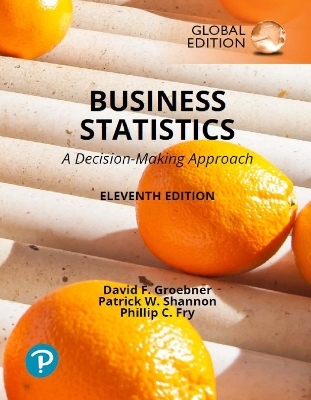
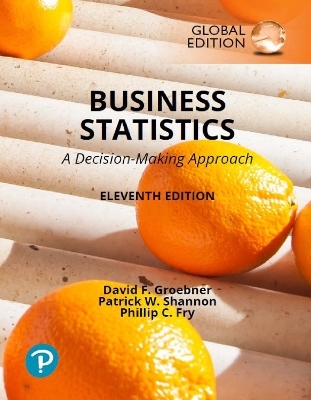
MyLab Statistics with Pearson eText (24 Months) for Statistics for Managers Using Microsoft Excel
Pearson (Hersteller)
978-0-13-666196-2 (ISBN)
- Titel nicht im Sortiment
- Artikel merken
The gold standard in learning Microsoft Excel for business statistics
Statistics for Managers Using Microsoft® Excel®, 9th Edition helps students develop the knowledge of Excel needed in future careers. The authors present statistics in the context of specific business fields, and now include a full chapter on business analytics. Guided by principles set forth by ASA's Guidelines for Assessment and Instruction (GAISE) reports and the authors' diverse teaching experiences, the text continues to innovate and improve the way this course is taught to students. Current data throughout gives students valuable practice analyzing the types of data they will see in their professions, and the authors' friendly writing style includes tips and learning aids throughout.
The book also integrates PHStat, a statistical add-in that bolsters the functions of Excel. Extensive instructor and student resources are provided, including two online-only chapters, as well as the Digital Cases referenced in the text.
Personalize learning with MyLab Statistics
By combining trusted author content with digital tools and a flexible platform, MyLab Statistics personalizes the learning experience and improves results for each student. With MyLab Statistics and StatCrunch® integrated web-based statistical software, students learn the skills they need to interact with data in the real world.
About our authors David M. Levine is Professor Emeritus of Statistics and Computer Information Systems at Baruch College (City University of New York). He received B.B.A. and M.B.A. degrees in statistics from City College of New York and a Ph.D. from New York University in industrial engineering and operations research. He is nationally recognized as a leading innovator in statistics education and is the co-author of 14 books, including such best-selling statistics textbooks as Statistics for Managers Using Microsoft Excel, Basic Business Statistics: Concepts and Applications, Business Statistics: A First Course, and Applied Statistics for Engineers and Scientists Using Microsoft Excel and Minitab. He also is the co-author of Even You Can Learn Statistics: A Guide for Everyone Who Has Ever Been Afraid of Statistics, currently in its 2nd edition; Six Sigma for Green Belts and Champions and Design for Six Sigma for Green Belts and Champions, and the author of Statistics for Six Sigma Green Belts, all published by Pearson imprint FT Press; and Quality Management, 3rd Edition with McGraw-Hill/Irwin. He is also the author of Video Review of Statistics and Video Review of Probability, both published by Video Aided Instruction, and the statistics module of the MBA primer published by Cengage Learning. He has published articles in various journals, including Psychometrika, The American Statistician, Communications in Statistics, Decision Sciences Journal of Innovative Education, Multivariate Behavioral Research, Journal of Systems Management, Quality Progress, and The American Anthropologist, and he has given numerous talks at the Decision Sciences Institute (DSI), American Statistical Association (ASA), and Making Statistics More Effective in Schools and Business (MSMESB) conferences. Levine also has received several awards for outstanding teaching and curriculum development from Baruch College. David F. Stephan is an independent instructional technologist. He was an Instructor/Lecturer of Computer Information Systems at Baruch College (City University of New York) for over 20 years, and served as an Assistant to the Provost and to the Dean of the School of Business & Public Administration for computing. He pioneered the use of computer classrooms for business teaching, devised interdisciplinary multimedia tools, and created techniques for teaching computer applications in a business context. He also conducted the first large-scale controlled experiment to show the benefit of teaching Microsoft Excel in a business case context to undergraduate students. An avid developer, he created multimedia courseware while serving as the Assistant Director of a Fund for the Improvement of Postsecondary Education (FIPSE) project at Baruch College. Stephan is also the originator of PHStat, the Pearson Education statistical add-in for Microsoft Excel and a co-author of Even You Can Learn Statistics: A Guide for Everyone Who Has Ever Been Afraid of Statistics, and Practical Statistics by Example Using Microsoft Excel and Minitab. He is currently developing ways to extend the instructional materials that he and his co-authors develop to mobile and cloud computing platforms as well as develop social-media facilitated means to support learning in introductory business statistics courses. David Stephan received a B.A. in geology from Franklin and Marshall College and a M.S. in computer methodology from Baruch College (City University of New York). Kathryn A. Szabat is Associate Professor and Chair of Business Systems and Analytics at LaSalle University. She teaches undergraduate and graduate courses in business statistics and operations management. She also teaches as Visiting Professor at the Ecole Superieure de Commerce et de Management (ESCEM) in France. Szabat's research has been published in International Journal of Applied Decision Sciences, Accounting Education, Journal of Applied Business and Economics, Journal of Healthcare Management, and Journal of Management Studies. Scholarly chapters have appeared in Managing Adaptability, Intervention, and People in Enterprise Information Systems; Managing, Trade, Economies and International Business; Encyclopedia of Statistics in Behavioral Science; and Statistical Methods in Longitudinal Research. She has provided statistical advice to numerous business, non-business, and academic communities. Her more recent involvement has been in the areas of education, medicine, and nonprofit capacity building. Szabat received a B.S. in mathematics from State University of New York at Albany and M.S. and Ph.D. degrees in statistics, with a cognate in operations research, from the Wharton School of the University of Pennsylvania.
F. First Things First
FTF.1 Think Differently About Statistics
FTF.2 Business Analytics: The Changing Face of Statistics
FTF.3 Starting Point for Learning Statistics
FTF.4 Starting Point for Using Software
FTF.5 Starting Point for Using Microsoft Excel
1. Defining and Collecting Data
1.1 Defining Variables
1.2 Collecting Data
1.3 Types of Sampling Methods
1.4 Data Cleaning
1.5 Other Data Preprocessing Tasks
1.6 Types of Survey Errors
2. Organizing and Visualizing Variables
2.1 Organizing Categorical Variables
2.2 Organizing Numerical Variables
2.3 Visualizing Categorical Variables
2.4 Visualizing Numerical Variables
2.5 Visualizing Two Numerical Variables
2.6 Organizing a Mix of Variables
2.7 Visualizing a Mix of Variables
2.8 Filtering and Querying Data
2.9 Pitfalls in Organizing and Visualizing Variables
3. Numerical Descriptive Measures
3.1 Measures of Central Tendency
3.2 Measures of Variation and Shape
3.3 Exploring Numerical Variables
3.4 Numerical Descriptive Measures for a Population
3.5 The Covariance and the Coefficient of Correlation
3.6 Descriptive Statistics: Pitfalls and Ethical Issues
4. Basic Probability
4.1 Basic Probability Concepts
4.2 Conditional Probability
4.3 Ethical Issues and Probability
4.4 Bayes' Theorem
4.5 Counting Rules
5. Discrete Probability Distributions
5.1 The Probability Distribution for a Discrete Variable
5.2 Binomial Distribution
5.3 Poisson Distribution
5.4 Covariance of a Probability Distribution and Its Application in Finance
5.5 Hypergeometric Distribution
6. The Normal Distribution and Other Continuous Distributions
6.1 Continuous Probability Distributions
6.2 The Normal Distribution
6.3 Evaluating Normality
6.4 The Uniform Distribution
6.5 The Exponential Distribution
6.6 The Normal Approximation to the Binomial Distribution
7. Sampling Distributions
7.1 Sampling Distributions
7.2 Sampling Distribution of the Mean
7.3 Sampling Distribution of the Proportion
7.4 Sampling from Finite Populations
8. Confidence Interval Estimation
8.1 Confidence Interval Estimate for the Mean (σ Known)
8.2 Confidence Interval Estimate for the Mean (σ Unknown)
8.3 Confidence Interval Estimate for the Proportion
8.4 Determining Sample Size
8.5 Confidence Interval Estimation and Ethical Issues
8.6 Application of Confidence Interval Estimation in Auditing
8.7 Estimation and Sample Size Determination for Finite Populations
8.8 Bootstrapping
9. Fundamentals of Hypothesis Testing: One-Sample Tests
9.1 Fundamentals of Hypothesis Testing
9.2 t Test of Hypothesis for the Mean (σ Unknown)
9.3 One-Tail Tests
9.4 Z Test of Hypothesis for the Proportion
9.5 Potential Hypothesis-Testing Pitfalls and Ethical Issues
9.6 Power of the Test
10. Two-Sample Tests
10.1 Comparing the Means of Two Independent Populations
10.2 Comparing the Means of Two Related Populations
10.3 Comparing the Proportions of Two Independent Populations
10.4 F Test for the Ratio of Two Variances
10.5 Effect Size
11. Analysis of Variance
11.1 One-Way ANOVA
11.2 Two-Way ANOVA
11.3 The Randomized Block Design
11.4 Fixed Effects, Random Effects, and Mixed Effects Models
12. Chi-Square and Nonparametric Tests
12.1 Chi-Square Test for the Difference Between Two Proportions
12.2 Chi-Square Test for Differences Among More Than Two Proportions
12.3 Chi-Square Test of Independence
12.4 Wilcoxon Rank Sum Test for Two Independent Populations
12.5 Kruskal-Wallis Rank Test for the One-Way ANOVA
12.6 McNemar Test for the Difference Between Two Proportions (Related Samples)
12.7 Chi-Square Test for the Variance or Standard Deviation
12.8 Wilcoxon Signed Ranks Test for Two Related Populations
13. Simple Linear Regression
13.1 Simple Linear Regression Models
13.2 Determining the Simple Linear Regression Equation
13.3 Measures of Variation
13.4 Assumptions of Regression
13.5 Residual Analysis
13.6 Measuring Autocorrelation: The Durbin-Watson Statistic
13.7 Inferences About the Slope and Correlation Coefficient
13.8 Estimation of Mean Values and Prediction of Individual Values
13.9 Potential Pitfalls in Regression
14. Introduction to Multiple Regression
14.1 Developing a Multiple Regression Model
14.2 Evaluating Multiple Regression Models
14.3 Multiple Regression Residual Analysis
14.4 Inferences About the Population Regression Coefficients
14.5 Testing Portions of the Multiple Regression Model
14.6 Using Dummy Variables and Interaction Terms
14.7 Logistic Regression
14.8 Cross-Validation
15. Multiple Regression Model Building
15.1 The Quadratic Regression Model
15.2 Using Transformations in Regression Models
15.3 Collinearity
15.4 Model Building
15.5 Pitfalls in Multiple Regression and Ethical Issues
16. Time-Series Forecasting
16.1 Time-Series Component Factors
16.2 Smoothing an Annual Time Series
16.3 Least-Squares Trend Fitting and Forecasting
16.4 Autoregressive Modeling for Trend Fitting and Forecasting
16.5 Choosing an Appropriate Forecasting Model
16.6 Time-Series Forecasting of Seasonal Data
16.7 Index Numbers
17. Business Analytics
17.1 Business Analytics Overview
17.2 Descriptive Analytics
17.3 Decision Trees
17.4 Clustering
17.5 Association Analysis
17.6 Text Analytics
17.7 Prescriptive Analytics
18. Getting Ready to Analyze Data in the Future
18.1 Analyzing Numerical Variables
18.2 Analyzing Categorical Variables
19. Statistical Applications in Quality Management (online)
19.1 The Theory of Control Charts
19.2 Control Chart for the Proportion: The p Chart
19.3 The Red Bead Experiment: Understanding Process Variability
19.4 Control Chart for an Area of Opportunity: The c Chart
19.5 Control Charts for the Range and the Mean
19.6 Process Capability
19.7 Total Quality Management
19.8 Six Sigma
20. Decision Making
20.1 Payoff Tables and Decision Trees
20.2 Criteria for Decision Making
20.3 Decision Making with Sample Information
20.4 Utility
Appendices
| Erscheint lt. Verlag | 8.6.2020 |
|---|---|
| Sprache | englisch |
| Themenwelt | Wirtschaft ► Volkswirtschaftslehre ► Ökonometrie |
| ISBN-10 | 0-13-666196-3 / 0136661963 |
| ISBN-13 | 978-0-13-666196-2 / 9780136661962 |
| Zustand | Neuware |
| Informationen gemäß Produktsicherheitsverordnung (GPSR) | |
| Haben Sie eine Frage zum Produkt? |
aus dem Bereich