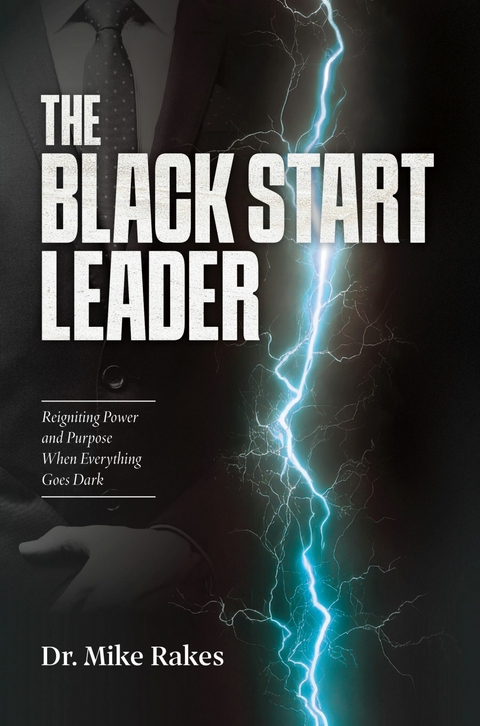
Black Start Leader (eBook)
160 Seiten
Bookbaby (Verlag)
979-8-3178-1194-5 (ISBN)
Dr. Mike Rakes is a power thinker, soul shepherd, and cultural architect. He is a seasoned C-suite executive, strategic turnaround leader, and higher education innovator with a track record of revitalizing institutions through visionary leadership and disciplined execution. With two terminal degrees, one in business and one in religion, Dr. Rakes brings a rare blend of executive acumen and values-based leadership to every challenge. With deep roots in both corporate governance and nonprofit transformation, Dr. Rakes is a sought-after executive coach, consultant, and board advisor for organizations navigating disruption, growth, and mission-critical transitions. He has chaired university boards, served on international governance teams focused on institutional transformation, and led global scholar forums addressing leadership, culture, and societal impact. As the current President of Evangel University, Dr. Rakes has ushered in a new era of momentum-marked by historic philanthropic and alumni support, a resurgence in enrollment, and bold investments in the university's future.
Power is not merely about authority or titles; it's about generating energy, transforming potential into action, and transmitting influence across an organization to create real, lasting change. This book will show you how to use your personal influence, language, and political acumen to create real, lasting change in organizations. Through these pages, readers will explore the distinction between leadership and management and why that matters, the role of communication in creating new realities, and the importance of navigating organizational politics. Discover how power, like a well-functioning grid, can illuminate new pathways to attain missional success and infuse limitless energy to power your organization for greater impact. By comparing organizations to power grids vast, interconnected systems that require careful calibration learn how the leaders in an organization play the role of energy generators which produce the energy that fuels progress, or transformers which channel and adapt energy into specific needs. But without strategic oversight, these systems can falter, leaving organizations in the dark or overloaded with inefficiencies. At its core, leadership is about power; if your organization is going to move, grow, or serve, its power and energy will come from someone. This book shows you how that someone can be you.
CHAPTER 1 Blackouts Require Black Starts
It was just another November evening—until it wasn’t.
New York City thrummed with its usual rhythm as the workday came to a close, a symphony of chaos and order. Office workers spilled out of skyscrapers, their loud chatter blending with the metallic screech of subways below. Yellow taxis darted through crowded streets, their horns punctuating the five o’clock hour. Everything ran with unbroken predictability, the city’s invisible power grid making life effortless—until it didn’t.
The first flicker came like a nervous twitch in the city’s veins. Lights dimmed briefly above and below the streets, then surged back to life. People paused then shrugged it off—New Yorkers were used to glitches. But when the second flicker stretched into thirteen hours, nerves frayed and businesses grounded to a halt as the full weight of the blackout sank in.
It was 1965. Earlier that year, Jack Nicklaus secured his second Masters title, and Mickey Mantle made history with the first home run under a roof at the newly opened Houston Astrodome. But 1965 would be remembered for instilling a deep fear in society—when, in an instant, normal life vanished, and the electrical system that sustained it went dark.
Thirty million people across eight US states and parts of Ontario, Canada, were suddenly without power and plunged into darkness, leaving ordinary citizens gripped by uncertainty.1 It all began with a slight power fluctuation in a small relay box near Ontario—an out-of-sequence switch near Niagara Falls that triggered a cascading failure across the electrical grid. One by one, power plants shut down, each failure rippling outward, pulling the next system into collapse. One overloaded circuit caused a disruption and loss of synchronization that spread system-wide like falling dominos, leaving entire regions without power.
For thirteen hours, the blackout held the modern world hostage. Millions were stunned by the sudden darkness, as critical flaws in the nation’s power grid were laid bare. Plant managers scrambled to restart the system, but every attempt failed. There was no playbook—no precedent—for what had unfolded.
Elevators froze mid-floor, trapping workers in steel cages. Subways ground to a halt in pitch-black tunnels, leaving 800,000 passengers clinging to handrails, cut off from the world above. In the northeast countryside and in Canada, farmhouses surrounded by corn and wheat also went dark. Within five minutes, the entire electrical grid had collapsed in a surging failure, leaving no way to restart the grid.
This event was more than an inconvenience—it was a revelation. The smallest problem in the power system can be brought to a shutdown, unless a person intervenes. The blackout led to substantial reforms in grid coordination and prompted the creation of the North American Electric Reliability Corporation (NERC), which focused on improving grid reliability and recovering from blackouts.
Here was the crux of this unprecedented challenge. In past blackouts, power had been restored by drawing energy from still-functioning grids, one system finding power by jumpstarting from another. But this time, with no power available anywhere, the usual recovery methods were useless. The grid was entirely dark, exposing a critical vulnerability. It took the most brilliant folks thirteen long hours to restore power.
What the crisis revealed was a little-known but vital concept in the world of energy: the black start. When the entire grid goes dark, you can’t rely on neighboring systems to restore power—they’re down too. A black start is the rare, high-stakes process of reigniting the system from zero, without external support. It requires a small, self-sufficient power source—often a hydroelectric plant or specially configured generator—that can awaken a substation, which then brings another online, cascading until the entire grid hums with life again.
The same is true of leadership. In moments of crisis—when the system fails, morale crumbles, and the usual sources of momentum are offline—you can’t depend on external energy to revive the organization. You need a leader with black start capacity: someone who carries the internal voltage to generate power from nothing. These are the leaders who don’t wait for perfect conditions or permission to act. They initiate. They spark change when everything else is unresponsive. Without them, teams flounder. Missions stall. But with them, renewal becomes possible—not because the environment is ready, but because they are.
We’ve all seen it. At first, it’s subtle—a slight misalignment between teams, bursts of wasted energy from internal conflicts, and disengaged employees retreating into silos. These small power drains seem manageable at first, but left unchecked, they compound. Day after day, energy seeps away. Morale erodes. Momentum stalls. And soon, an organization that once thrived is stagnant and dysfunctional. When this happens, only a leader using their personal power can bring it back to life.
Polaroid had lost its vision as a company—initially powered by its thoughts and innovations, it was now in the dark. Once an industry pioneer, Polaroid had revolutionized photography with its instant film cameras. The joy of snapping a picture and watching it develop in seconds felt like magic, and for decades, the company was at the forefront of modernization. But as the world moved toward digital photography in the 1990s, Polaroid hesitated. The very thinking and bold decisions that made them great became their downfall.2
While companies like Sony and Canon embraced the digital revolution, Polaroid clung to its legacy, convinced the world would always want physical photos. They had the chance to pivot. They had the technology. But their leadership failed—not only to identify the energy drains but to reimagine the future before it was too late. By 2001, Polaroid declared bankruptcy—a company that once illuminated imaginations, now fading into a dark irrelevance.
But, if Polaroid’s failure was tragic, Kodak’s was even more shocking. Unlike Polaroid, Kodak didn’t just have access to digital photography—it invented it. In 1975, a Kodak engineer named Steven Sasson developed the first digital camera. The company had a head start that should have secured its dominance for decades.
Instead, Kodak’s leadership dismissed the potential of digital imaging, fearing it would cannibalize their film business. They bet on their existing infrastructure, ignoring the shift happening before their eyes.3 Customers adapted to digital faster than Kodak did, and by the time the company attempted to catch up, it was too late. In 2012, Kodak, once synonymous with photography, filed for bankruptcy. They had seen the future but organizationally did not have enough power in their system to keep it all going—Kodak went dark for good.
Not all corporate blackouts happen because of technological ignorance—some stem from sheer arrogance. In the 1970s, Firestone was a giant in the tire industry, dominating alongside Goodyear. But then came a disruption: radial tire technology. Unlike traditional bias-ply tires, radials offered better durability, fuel efficiency, and overall performance.
Firestone executives dismissed the shift as a fad, convinced that American drivers wouldn’t abandon traditional tires. They continued producing outdated designs while competitors—especially Michelin—embraced radials and captured the market. By the time Firestone realized their mistake, they were in freefall. Factories shut down, financial losses piled up, and the company’s reputation suffered irreversible damage. Eventually, Firestone was acquired by Bridgestone in 1988.
Blackouts happen not just on electrical grids but in boardrooms, factories, churches, and classrooms. Companies like Polaroid, Kodak, and Firestone didn’t collapse overnight; they slowly lost alignment, clarity, and momentum until their internal systems went dark. I’ve streamlined these examples for clarity, but behind each failure was the same core issue: when the lights began to flicker, no one was ready with a black start. What they needed wasn’t just a new strategy—it was a leader with the capacity to generate power from within—a leader who could reconnect the organization to its core mission, restore flow, and reignite belief. Any system—a Fortune 500 company, a local church, or a family business—can experience a blackout. But recovery always begins the same way: with someone who carries the spark.
The blackout of 1965 didn’t just disrupt daily life—it exposed a dangerous truth: the power grid had no reliable way to restart itself after a total collapse. The entire electric power industry was caught unprepared. The grid remained paralyzed for hours without independent startup capabilities or a coordinated recovery plan. It was a national vulnerability hiding in plain sight. That failure forced a reckoning.
In response, industry leaders took decisive actions. By 1968, they had established the North American Electric Reliability Council—now known as NERC—to enforce a new era of standards, accountability, and coordinated response. At the top of their priorities was a groundbreaking concept: black start capability. Every utility would be required to identify and maintain self-starting power sources. Restoration would no longer be ad hoc or reactive—it would be...
| Erscheint lt. Verlag | 23.7.2025 |
|---|---|
| Sprache | englisch |
| Themenwelt | Wirtschaft ► Betriebswirtschaft / Management ► Unternehmensführung / Management |
| ISBN-13 | 979-8-3178-1194-5 / 9798317811945 |
| Informationen gemäß Produktsicherheitsverordnung (GPSR) | |
| Haben Sie eine Frage zum Produkt? |
 EPUB (Ohne DRM)
Größe: 974 KB
Digital Rights Management: ohne DRM
Dieses eBook enthält kein DRM oder Kopierschutz. Eine Weitergabe an Dritte ist jedoch rechtlich nicht zulässig, weil Sie beim Kauf nur die Rechte an der persönlichen Nutzung erwerben.
Dateiformat: EPUB (Electronic Publication)
EPUB ist ein offener Standard für eBooks und eignet sich besonders zur Darstellung von Belletristik und Sachbüchern. Der Fließtext wird dynamisch an die Display- und Schriftgröße angepasst. Auch für mobile Lesegeräte ist EPUB daher gut geeignet.
Systemvoraussetzungen:
PC/Mac: Mit einem PC oder Mac können Sie dieses eBook lesen. Sie benötigen dafür die kostenlose Software Adobe Digital Editions.
eReader: Dieses eBook kann mit (fast) allen eBook-Readern gelesen werden. Mit dem amazon-Kindle ist es aber nicht kompatibel.
Smartphone/Tablet: Egal ob Apple oder Android, dieses eBook können Sie lesen. Sie benötigen dafür eine kostenlose App.
Geräteliste und zusätzliche Hinweise
Buying eBooks from abroad
For tax law reasons we can sell eBooks just within Germany and Switzerland. Regrettably we cannot fulfill eBook-orders from other countries.
aus dem Bereich