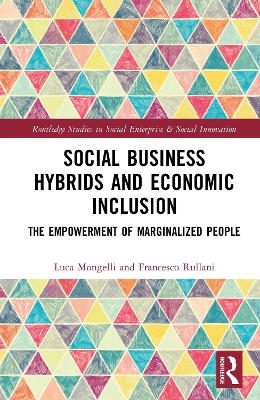
Social Business Hybrids and Economic Inclusion
Routledge (Verlag)
978-1-041-13267-7 (ISBN)
This book addresses marginalization as a form of disempowerment – social, economic, and political exclusion that prevents people from realizing their potential. In response, it explores how organizations can foster empowerment, focusing on Social Business Hybrids (SBHs), which use market-based strategies to activate the economic capabilities of marginalized people. However, such empowerment only succeeds under specific conditions, especially in relation to the environments – or "loci" – where SBHs operate.
The book aims to understand both the transformative actions SBHs undertake and the contexts in which these actions occur. Drawing from the Capabilities Approach (Sen, Nussbaum, Kabeer) and Community Psychology (Rappaport), the authors develop a framework integrating two key concepts: The empowering role of organizations and an ecological perspective that considers the relevance of social spaces.
They identify two main types of SBH actions: "creation empowerment" and "access empowerment", and two types of empowerment spaces: "safe spaces" and "open spaces for reconnection". These dimensions come together in the proposed SBH Empowering Matrix, which outlines four strategies – safe creation, open creation, safe access, and open access. Each is illustrated through a dedicated case study, providing practical insights into how SBHs can unlock the potential of marginalized people.
Luca Mongelli is an Assistant Professor at L'Aquila University and Scientific Coordinator of the Markets, Culture and Ethics (MCE) Research Centre at the Pontifical University of the Holy Cross in Rome, Italy. Francesco Rullani is Full Professor and Scientific Director of the Impact Unit of the Yunus Social Business Centre Venice at Venice School of Management, Ca' Foscari University, Italy.
Introduction Part 1. Human Development, Empowerment and Organizations 1. From deprivation to human development 2. Founding the concept of empowerment: the Capability Approach 3. Enriching the concept of empowerment: from Community Psychology to Management, towards Empowering Organizations 4. Social Business Hybrids as Empowering Organizations Part 2. A reference model and four empirical cases 5. The Safe Creation model: the case of MadeInCarcere 6. The Open Creation model: the case of Ridaje 7. The Open Access model: the case of Pedius 8. The Safe Access model: the case of Dynamo Part 3. Discussion and conclusions 9. Takeaways from the cases and the empowerment models 10. Connecting the wires: spaces, value creation and the matrix of Empowering SBHs
| Erscheinungsdatum | 11.12.2025 |
|---|---|
| Reihe/Serie | Routledge Studies in Social Enterprise & Social Innovation |
| Zusatzinfo | 3 Tables, black and white; 38 Line drawings, black and white; 38 Illustrations, black and white |
| Verlagsort | London |
| Sprache | englisch |
| Maße | 152 x 229 mm |
| Gewicht | 600 g |
| Themenwelt | Wirtschaft ► Betriebswirtschaft / Management ► Marketing / Vertrieb |
| Wirtschaft ► Betriebswirtschaft / Management ► Planung / Organisation | |
| Wirtschaft ► Betriebswirtschaft / Management ► Unternehmensführung / Management | |
| ISBN-10 | 1-041-13267-0 / 1041132670 |
| ISBN-13 | 978-1-041-13267-7 / 9781041132677 |
| Zustand | Neuware |
| Informationen gemäß Produktsicherheitsverordnung (GPSR) | |
| Haben Sie eine Frage zum Produkt? |
aus dem Bereich