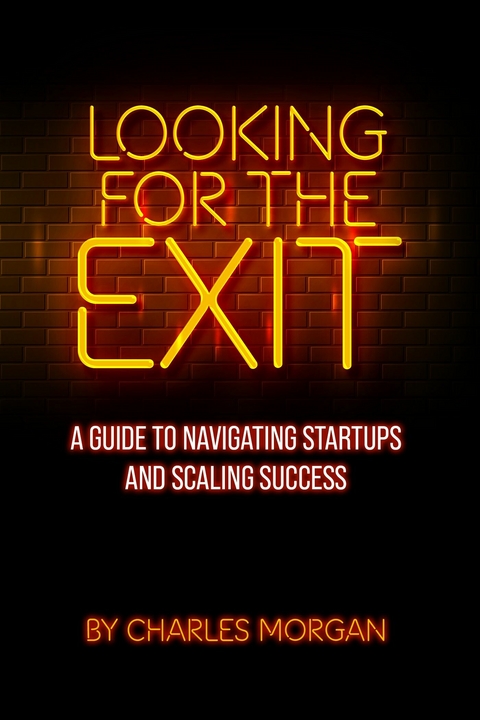
Looking For The Exit (eBook)
184 Seiten
Bookbaby (Verlag)
979-8-3178-0932-4 (ISBN)
Charles 'Fellowman' Morgan is an entrepreneur, storyteller, and founder with a deep commitment to building tools that expand economic mobility and equity. Raised in rural East Texas, Charles understands firsthand the challenges that come with being overlooked by traditional systems-and he's made it his mission to rewrite that narrative. As the founder of TrealScore, an insurtech startup using AI and alternative data to make insurance affordable and more transparent, Charles is at the forefront of innovation for underserved communities. He also hosts the podcast Looking For The Exit, where he interviews underrepresented founders and investors about the path to building and exiting venture-backed startups. With a background in chemical engineering and an MBA from Prairie View A&M University, Charles has led multiple startups and is currently immersed in the venture capital ecosystem-advising, investing, and advocating for a more inclusive future. Looking For The Exit is both a roadmap and a rallying cry-part playbook, part strategic guide-designed to help underestimated founders navigate the startup journey.
This book is for the founder who had to figure it out without a blueprint. Looking for the Exit is a bold guide for underrepresented entrepreneurs building businesses inside a system that wasn't built for them. If you've ever been underestimated in a pitch meeting, told your market was too niche, or had to bootstrap longer than your peers, this book meets you with strategy, not sympathy. From funding and scaling to exits and legacy, it offers real-world tools, founder stories, and frameworks built for the barriers and breakthroughs that others often ignore. Whether you're raising your first round or planning your next move, this is your roadmap to building with power, purpose, and long-term value. It's also for those working to strengthen the entrepreneurial ecosystem - business school students, VCs, angels, and allies who want to invest more equitably, support more effectively, and understand what the journey really looks like. Build what lasts. On your terms.
Chapter 1 The Structural Landscape – Why the Playing Field Isn’t Level
“You have to know the maze before you navigate it.”
Understanding the Terrain
The startup world loves the myth of meritocracy. If you have a great idea, work hard enough, and pitch it well, success is within reach – or so the story goes. But most founders know better. If you’ve tried to build something without a financial cushion, warm introductions, or early access to capital and networks, you’ve probably felt the difference between myth and reality. The barriers are real. The playing field is not level. And for far too many, the climb is steeper – not because of a lack of drive or ideas, but because of long-standing systems that shape access unevenly.
Access in the startup world has never been neutral. It’s shaped by economic, social, and historical patterns that determine who gets seen, who gets funded, and who gets left out. This chapter maps those patterns so you can recognize them early, navigate them faster, and make better strategic decisions in a system that wasn’t built with everyone in mind.
While we’ll highlight how race has shaped access for many founders, the patterns apply more broadly. You’ll likely recognize the dynamics if you’re building without financial safety nets, deep networks, or institutional backing, whether from a redlined neighborhood, a rural town, or a working-class family. The challenges show up differently, but the friction is familiar.
Structural Advantage: The Startup Head Start
Some founders enter the game with momentum already behind them. They start with access to capital via inheritance, family loans, or well-off networks. They’ve grown up surrounded by people who’ve built and scaled businesses. They know the language of the pitch room, have friends who’ve raised Series A rounds, and move through networks where early capital is already circulating.
That head start isn’t about character or capability. It’s about structure. Systems of wealth, education, and proximity to capital and power reproduce themselves. When one founder must earn trust, and another inherits it, the outcome isn’t merit – it’s momentum rooted in legacy.
Understanding structural advantage isn’t about blame. It’s about clarity – recognizing the tailwinds that help some founders accelerate while others face more resistance. Investors and institutions often treat familiar credentials, networks, or backgrounds as proxies for potential, and in doing so, they may overlook capable founders who don’t fit the usual profile.
The Historical Blueprint: Barriers by Design
Barriers to entrepreneurship in Black and Brown communities didn’t emerge by accident. They materialized through policies and practices that favored some groups while systematically excluding others. These deeply rooted structural inequities continue to shape the entrepreneurial landscape today.
Redlining and Its Long-Term Impact
One of the most damaging policies was redlining, codified in the 1930s as part of federal housing practices. This policy systematically denied mortgages and loans to Black and Brown communities, often labeling these neighborhoods as “hazardous” or “high risk” based solely on racial demographics. As a result, homeownership - the primary vehicle for wealth building in the United States – was kept out of reach for many families of color.
Over time, redlining didn’t just affect property ownership; it created lasting economic divides. According to a 2023 study by the National Community Reinvestment Coalition, formerly redlined areas still suffer from lower property values and limited access to capital compared to predominantly white neighborhoods. This means that, even decades later, aspiring entrepreneurs from these communities often lack the foundational wealth that could serve as startup capital.
Generational Wealth Gaps
The legacy of redlining and other exclusionary policies has contributed to deep, persistent wealth gaps, especially along racial lines. In 2022, white households had a median net worth of $284,310, compared to $44,890 for Black households and $61,600 for Latinx households. But racial disparities aren’t the only factor. Founders from low-wealth backgrounds - regardless of race – often enter entrepreneurship without the financial cushion that others can draw on.
Without family capital or inherited assets, it’s much harder to bootstrap, take early risks, or recover from setbacks. According to a 2021 Federal Reserve report, Black and Latinx founders are still more likely than their white peers to rely on credit cards or personal savings to fund their startups, putting them at greater financial risk. However, this gap is felt by many first-time founders with limited runway, especially those from working-class or underbanked communities.
Exclusion from High-Growth Sectors
Beyond wealth gaps, structural exclusion from high-growth industries, such as technology and finance, has further restricted access to entrepreneurial opportunities. Historically, Black and Brown professionals were underrepresented in sectors that generate significant wealth and innovation. For example, as of 2022, only 3% of venture capital partners in the United States identified as Black or Latinx. This lack of representation means fewer investors who understand the unique challenges minority founders face, leading to potential bias in funding decisions.
Moreover, the tech industry itself remains predominantly white, with companies like Google and Facebook reporting that Black employees made up less than 5% of their U.S. workforce as recently as 2023. This underrepresentation at the funding and operational levels creates a double barrier: limited mentorship from industry leaders and fewer connections to the networks that often facilitate investment.
A Systemic Challenge
Financial System Barriers: A Structural Legacy
In theory, the traditional banking system should serve as a critical funding path, especially for founders who don’t have access to venture capital. In practice, it often acts as another barrier. Whether due to outdated policies, biased risk models, or systemic underinvestment, many entrepreneurs struggle to access fair financing, especially those from historically marginalized or economically disadvantaged communities.
Discriminatory Lending and Unequal Access
Black entrepreneurs continue to face well-documented disparities in loan approvals. According to the Federal Reserve’s 2023 Small Business Credit Survey, Black-owned businesses are nearly twice as likely to be denied loans as white-owned businesses, even when controlling for revenue and credit scores. That gap reflects a legacy of racial bias in lending practices that still shows up in bank policies, algorithms, and underwriting decisions.
But again, race isn’t the only axis of exclusion. White founders from low-wealth backgrounds, especially those in rural areas or formerly disinvested industrial towns, often encounter similar hurdles. Lack of collateral, limited credit history, and zip code-based risk scoring make it harder to qualify, even when the business is solid and the demand is proven.
The issue isn’t always a lack of financial viability. It’s how viability gets measured, and which signals the system is built to trust.
The Long Tail of Redlining and Community Disinvestment
Redlining may have been outlawed decades ago, but its effects still shape the financial landscape. Banks continue to classify some neighborhoods, particularly those once redlined, as “high risk,” regardless of present-day performance. According to a 2022 Brookings Institution study, homes in formerly redlined neighborhoods are still valued 23% lower on average than comparable properties in non-redlined areas.
For founders in these areas – Black, Brown, or white – that means fewer opportunities to use real estate as collateral, fewer local lenders willing to take a chance, and more difficulty raising capital in their communities.
When traditional financing is out of reach, many turn to personal credit cards or high-interest alternatives, increasing financial strain and limiting long-term scalability. The risk doesn’t stem from the business itself – it comes from being left out of the capital infrastructure that helps companies to grow.
Bias in Credit Scoring and Modern Risk Models
Even when founders come to the table with strong financials, they often face outdated or biased credit assessments. A 2022 report from the National Bureau of Economic Research found that Black and Latinx business owners were 60% more likely to be asked for additional documentation than their white peers.
That added scrutiny, combined with automated scoring models that reward homeownership, longstanding credit history, or inherited financial stability, creates a compounding disadvantage. Entrepreneurs without generational wealth or deep financial records are often seen as “riskier” on paper, even if their business model is sound and their cash flow is strong.
This doesn’t just affect founders of color. It affects anyone building from a financial position that the system wasn’t designed to accommodate. The result is a credit gap that reinforces structural inequality, rather than reflecting actual business...
| Erscheint lt. Verlag | 18.8.2025 |
|---|---|
| Sprache | englisch |
| Themenwelt | Wirtschaft ► Betriebswirtschaft / Management |
| ISBN-13 | 979-8-3178-0932-4 / 9798317809324 |
| Informationen gemäß Produktsicherheitsverordnung (GPSR) | |
| Haben Sie eine Frage zum Produkt? |
 EPUB (Ohne DRM)
Größe: 2,3 MB
Digital Rights Management: ohne DRM
Dieses eBook enthält kein DRM oder Kopierschutz. Eine Weitergabe an Dritte ist jedoch rechtlich nicht zulässig, weil Sie beim Kauf nur die Rechte an der persönlichen Nutzung erwerben.
Dateiformat: EPUB (Electronic Publication)
EPUB ist ein offener Standard für eBooks und eignet sich besonders zur Darstellung von Belletristik und Sachbüchern. Der Fließtext wird dynamisch an die Display- und Schriftgröße angepasst. Auch für mobile Lesegeräte ist EPUB daher gut geeignet.
Systemvoraussetzungen:
PC/Mac: Mit einem PC oder Mac können Sie dieses eBook lesen. Sie benötigen dafür die kostenlose Software Adobe Digital Editions.
eReader: Dieses eBook kann mit (fast) allen eBook-Readern gelesen werden. Mit dem amazon-Kindle ist es aber nicht kompatibel.
Smartphone/Tablet: Egal ob Apple oder Android, dieses eBook können Sie lesen. Sie benötigen dafür eine kostenlose App.
Geräteliste und zusätzliche Hinweise
Buying eBooks from abroad
For tax law reasons we can sell eBooks just within Germany and Switzerland. Regrettably we cannot fulfill eBook-orders from other countries.
aus dem Bereich