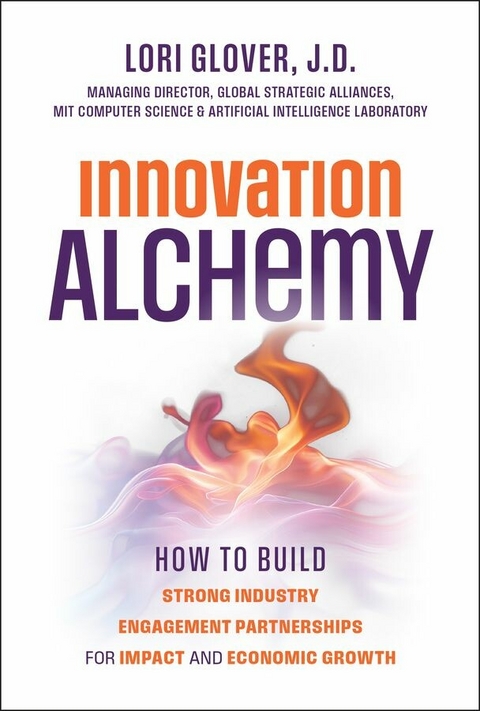
Innovation Alchemy (eBook)
360 Seiten
Wiley (Verlag)
978-1-394-30725-8 (ISBN)
An incisive and comprehensive new playbook for symbiotic partnerships
In Innovation Alchemy: Building Strong Industry Engagement Partnerships for Impact and Economic Growth, leader of Global Partnerships and Alliances at MIT's Computer Science and Artificial Intelligence Lab, Lori Glover, delivers a compelling exploration of how to create mutually beneficial partnerships and collaborations in and between industry, academia, and beyond. You'll learn how to navigate, structure, and deliver win-win programs and take full advantage of research, faculty connections, new tech, student connections, professional development, capstones, course connections, technology transfer, and start-ups.
Avoiding a 'one-size-fits-all' approach, this book clarifies the foundations of solid partnerships and collaborations. It explains the author's 10 Steps to successful partnerships, including:
- How to understand the fundamentals and define your strategy
- Knowing your stakeholders and mapping their connection points
- Understanding possible paths of engagement, plan creation, and team building
Innovation Alchemy offers checklists and tools to help you construct your own partnership plan and a complete roadmap for putting one into practice. It's an essential read for academic and industry leaders interested in unlocking the many benefits that flow from collaborations packed with case studies, leader interviews, toolkits, and additional resources.
LORI GLOVER, J.D., is Managing Director of Global Strategic Alliances for the MIT Computer Science & Artificial Intelligence Laboratory. She is responsible for corporate and organizational engagement with the lab through the CSAIL Alliance Program, research initiatives, the Visiting Industry Researcher program, start-ups and technology ecosystem, professional development programs, and talent recruitment.
An incisive and comprehensive new playbook for symbiotic partnerships In Innovation Alchemy: Building Strong Industry Engagement Partnerships for Impact and Economic Growth, leader of Global Partnerships and Alliances at MIT's Computer Science and Artificial Intelligence Lab, Lori Glover, delivers a compelling exploration of how to create mutually beneficial partnerships and collaborations in and between industry, academia, and beyond. You'll learn how to navigate, structure, and deliver win-win programs and take full advantage of research, faculty connections, new tech, student connections, professional development, capstones, course connections, technology transfer, and start-ups. Avoiding a one-size-fits-all approach, this book clarifies the foundations of solid partnerships and collaborations. It explains the author's 10 Steps to successful partnerships, including: How to understand the fundamentals and define your strategy Knowing your stakeholders and mapping their connection points Understanding possible paths of engagement, plan creation, and team building Innovation Alchemy offers checklists and tools to help you construct your own partnership plan and a complete roadmap for putting one into practice. It's an essential read for academic and industry leaders interested in unlocking the many benefits that flow from collaborations packed with case studies, leader interviews, toolkits, and additional resources.
Introduction
This book is designed to help frame approaches to innovation engagement partnerships between the academic sector and the industrial sector. Some parts speak to industry, others to academia. Academic institutions, companies, nonprofits, start‐ups, accelerators, research labs, and community organizations involved in innovation can leverage this book to help create mutually beneficial partnerships and collaborations. These partnerships are symbiotic in that each partner has something the other needs but can't provide on their own. A common example of a symbiotic relationship in this context is the workforce. Companies need skilled workers, and those workers are educated and trained by colleges and universities as well as professional associations, trade groups, and others. The skills and knowledge delivered to the learner in the academic setting translates to the talent needed by companies to make a commercial impact.
The terminology in the book falls into two main classifications of “industry” and “academia” but applies to the alignment of all the units in the innovation ecosystem. Similar to the periodic table of elements in chemistry classes, the following illustration plugs the organizations in the innovation ecosystem into the table in place of the chemical elements. The white and light grey squares are more aligned with industry or commercialization/impact, while the darker grey squares are more aligned with academic/research/creation. This is the periodic table of innovation elements containing the various organizations needed for Innovation Alchemy.
All of these organizations are part of what I call the innovation supply chain, which we explore in Part 1. Connecting industry and academia is the fuel for the innovation supply chain. There really is no one size fits all, but understanding the foundations is essential. This book will explore key issues to be aware of, critical considerations in form and function of planned partnerships, and best practices for success. There are also worksheets, forms, and planners to help you get started (a functional toolkit!), regardless from which organization you are approaching collaboration plans.
The basis of mutual benefit is essential. Innovation engagement partnerships are built on value. They are built to benefit the institutions involved and foster innovation that will impact the broader community. Academia and nonprofit research centers don't sell a product. Instead, they can offer vision further up the innovation curve without the constraints of daily corporate operations. For industry or commercial organizations, there is value in connecting with the talent, new ideas, new technology awareness, and start‐ups from the academic elements. It has been well established that in today's world, one must, according to Peter Drucker, “innovate or die,” and not all innovation can come from within. New ideas, fresh perspectives, and challenges from outside the box help companies stay on top of the ever‐changing landscape (technological, policy, talent, etc.) and connected to those nascent developments that can cause the next seismic shift in their industry sector.
Similarly, for academia, partnership opportunities with industry offer employment pathways for students, research partnerships on impactful challenges, support for mission‐critical programming, and a customer base for newly spun‐off start‐ups. Academic institutions need to understand industry's challenges to best prepare the next generation workforce to help industry thrive and to help solve pressing problems for which no commercial solution exists today.
Years of budget cuts and a shrinking federal investment in research has increased academia's need for student support, research funding, and programming assistance. Additionally, many institutions are facing “the cliff,”1 a projected 15% decline in college students from 2025 to 2029. This will impact the talent supply and the creation of new innovations as well. Consequently, many more academic institutions are trying to figure out pathways to connect with industry for new educational opportunities to help industry upskill the workforce they have, funding for research, and a commercialization pathway for new technologies. However, innovation is happening at lightning speed. Companies can't realistically invest in every research sector that could impact their business. Focusing on the core internally and developing ties with external institutions working on new innovations is an approach that leverages resources and can deliver broad value. As technology and new business ideas move from the university or research center to the marketplace, industry plays a key role as customers, funders, and partners to help start‐ups grow and strengthen the greater economic region.
If your company is large or small or your academic organization is a community college, undergraduate, graduate, medical or nonprofit institution, you have the ability to create strong, impactful, and mutually beneficial partnerships. The key to building strong collaborations is to not only understand the value proposition and impact opportunity, but also to align well on needs and deliverables. This book can help start, or refine, the process of building the engagement structure.
Several excellent professional organizations exist to expand knowledge in these areas as well as help you develop a professional network of people, in both industry and academia, who work in this space:
- University Industry Innovation Network (UIIN)
- University Industry Demonstration Partnership (UIDP)
- National Association of Corporate Relations Officers (NACRO)
- National Association of Colleges and Employers (NACE)
- University Professional and Continuing Education Association (UPCEAA)
- Association of University Technology Managers (AUTM)
- American Association of Engineering Education College and Industry Partnership Division (ASEE CIPD)
Industry and academia need each other more now than ever before. Times are changing rapidly. New technologies burst onto the scene and explode the status quo. The need for a skilled workforce that can adapt and move a company forward is increasingly essential. Connecting with research to envision entirely new markets and possibilities, as well as with the start‐ups bringing the latest from research labs to the commercial marketplace, ushers in continued innovation and possibilities. Every economy can benefit from strong engagement partnerships for new technologies, preparing the next generation of workers and building strong economic centers. These collaborations are vital to a thriving economy and positive societal impact that can benefit people around the globe with helpful new products, new economic pathways through education and jobs, and flourishing innovation systems for better living and environmental impact.
This book examines the 10 steps to successful innovation engagement partnerships for both the industry and academic organizations in the Periodic Table of Innovation Elements. In short, they are as follows:
- Understand the fundamentals.
- Define your partnership strategy/frame ROI.
- Know your stakeholders.
- Map your connection points.
- Understand possible paths of engagement.
- Create your plan.
- Build your team(s) for success.
- Execute the plan.
- Track your successes/learn from mistakes.
- Innovate.
In this book, the 10 steps are divided into four parts:
- PART 1 provides the necessary background to understand perspectives from different institutions and includes step 1 to understand the fundamentals.
- PART 2 examines the key factors to help you frame your engagement including steps 2–5.
- PART 3 helps scope a vision and a roadmap for creating your own innovation engagement partnership framework and includes steps 6–10.
- PART 4 is the toolkit. It includes materials I have developed over the years building different engagement partnerships. The worksheets and checklists are to help you in planning. There are also tip sheets on best practices and lessons learned to help you in building and establishing an impactful innovation engagement partnership.
Together we can build thriving ecosystems that move revolutionary breakthroughs, and skilled talent, out of labs and into the commercial marketplace for impact and economic growth.
Focus Features
Additionally, there are focus features and case studies from industry, academia, and others on different forms of engagement partnerships in practice. There are also interviews with people who are at the heart of some of the most important features of successful innovation collaborations.
Side Note
This book focuses mainly on the building of engagement programs through a US‐focused lens. It does not, however, address the role that the US government and its agencies have in assisting industry‐academic partnerships. There are other forms of partnerships and engagements that include various models where government can be a successful component such as the National Science Foundation's Industry‐University Cooperative Research Centers (IUCRCs), but that topic is beyond the scope of this book. Additionally, with a US focus, the book does not address models that may exist in other countries that...
| Erscheint lt. Verlag | 14.7.2025 |
|---|---|
| Sprache | englisch |
| Themenwelt | Sachbuch/Ratgeber ► Beruf / Finanzen / Recht / Wirtschaft ► Bewerbung / Karriere |
| Wirtschaft ► Betriebswirtschaft / Management | |
| Schlagworte | corporate engagement programs • IAP • iap checklist • iap roadmap • IAPS • iap toolkit • industry-academic collaborations • Industry-Academic Partnerships • research collaborations with industry • Research Partnerships • us corporate engagement program |
| ISBN-10 | 1-394-30725-X / 139430725X |
| ISBN-13 | 978-1-394-30725-8 / 9781394307258 |
| Informationen gemäß Produktsicherheitsverordnung (GPSR) | |
| Haben Sie eine Frage zum Produkt? |
 EPUB (Adobe DRM)
Kopierschutz: Adobe-DRM
Adobe-DRM ist ein Kopierschutz, der das eBook vor Mißbrauch schützen soll. Dabei wird das eBook bereits beim Download auf Ihre persönliche Adobe-ID autorisiert. Lesen können Sie das eBook dann nur auf den Geräten, welche ebenfalls auf Ihre Adobe-ID registriert sind.
Details zum Adobe-DRM
Dateiformat: EPUB (Electronic Publication)
EPUB ist ein offener Standard für eBooks und eignet sich besonders zur Darstellung von Belletristik und Sachbüchern. Der Fließtext wird dynamisch an die Display- und Schriftgröße angepasst. Auch für mobile Lesegeräte ist EPUB daher gut geeignet.
Systemvoraussetzungen:
PC/Mac: Mit einem PC oder Mac können Sie dieses eBook lesen. Sie benötigen eine
eReader: Dieses eBook kann mit (fast) allen eBook-Readern gelesen werden. Mit dem amazon-Kindle ist es aber nicht kompatibel.
Smartphone/Tablet: Egal ob Apple oder Android, dieses eBook können Sie lesen. Sie benötigen eine
Geräteliste und zusätzliche Hinweise
Buying eBooks from abroad
For tax law reasons we can sell eBooks just within Germany and Switzerland. Regrettably we cannot fulfill eBook-orders from other countries.
aus dem Bereich