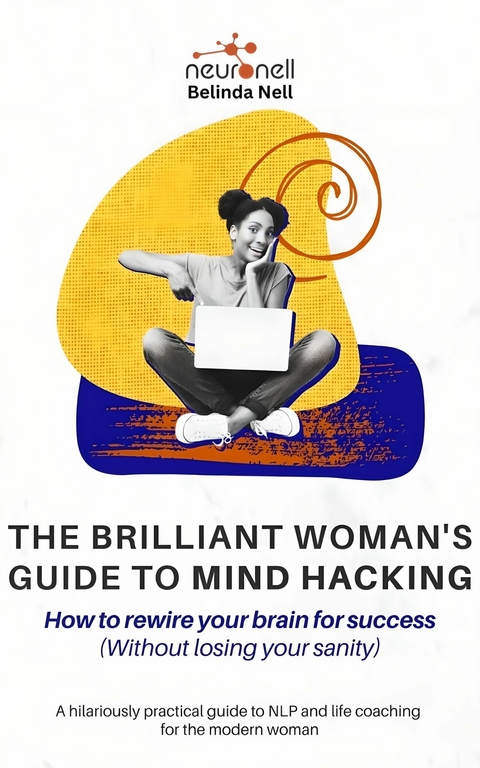
The Brilliant Woman's Guide to Mind Hacking (eBook)
195 Seiten
Publishdrive (Verlag)
978-0-00-095818-1 (ISBN)
Finally, a self-help book that doesn't assume you've got your life sorted by age twelve or that you've never stood in your knickers at 2 AM eating cereal whilst questioning your existence.
This refreshingly honest guide combines proven Neurolinguistic Programming techniques with real-world wisdom for women who understand that life is gloriously messy. Written by internationally certified life coach and NLP practitioner Belinda, this book is for every brilliant woman who's ever felt like she's swimming upstream whilst everyone else found the secret escalator.
Discover how to parent your overprotective brain, transform your inner critic into your biggest supporter, and master the art of talking to yourself without looking mental. Learn why your mind catastrophises everything (spoiler: it's not your fault), how to build genuine rapport with anyone, and practical techniques to hack your brain's outdated programming.
Perfect for professional women in sales, marketing, and business who want to break through mental barriers without pretending they don't sometimes hide in the loo for five minutes of peace. This isn't about manifesting unicorns or tasting rainbows - it's about updating your mental software with techniques that actually work.
Key topics include:
Understanding your primitive brain and why it loves drama more than Netflix
Transforming limiting beliefs and self-sabotaging patterns
Building unshakeable confidence and authentic communication skills
Practical NLP techniques for everyday challenges
Real-world strategies for managing overwhelm and perfectionism
Based on decades of corporate experience and extensive study of leading minds including Tony Robbins, Dale Carnegie, and NLP pioneers Virginia Satir and Connirae Andreas, this book delivers transformation without the spiritual bypassing.
Grab a cuppa and let's get your brilliant mind working for you instead of against you.
5
Chapter 2: The Art of Talking to Yourself Without Looking Mental
“Be yourself; everyone else is already taken.” - Oscar Wilde (who clearly understood the importance of good internal dialogue)
You talk to yourself often. You have approximately 60,000 thoughts per day, most of which are on repeat like a mental playlist you can’t skip.
The question isn’t whether you have internal dialogue (you do), but whether that dialogue is your biggest supporter or your harshest critic.
The Internal Commentary Nobody Talks About
As you’re reading this, there’s a voice in your head commenting on everything. It might be saying things like:
- “This is interesting.”
- “I should be doing the washing up instead.”
- “I wonder if this works.”
- “I hope no one can see me reading a self-help book.”
That voice? That’s your internal dialogue, and it’s been running a constant commentary on your life since you were old enough to think in words. The problem is that most of us have never consciously chosen what that voice says.
Meet Your Internal Narrator
Your internal voice was programmed mainly by:
- Your parents’ voices (“Hurry up!” “Be careful!” “What will people think?”)
- Your teachers (“Try harder!” “That’s not good enough!”)
- Society’s messages (“You should be…” “Real women don’t…”)
- Your own experiences (“I can’t do this,” “I’m not good at…”)
The Uncomfortable Truth: Most of us speak to ourselves in ways we would never talk to our worst enemy, let alone our best friend.
The Science of Self-Talk
Dr. John Demartini’s research shows that our internal dialogue directly impacts our neurology. When you tell yourself, “I’m rubbish at this,” your brain starts looking for evidence to support that belief. It’s not being mean - it’s being efficient.
Your brain’s job is to prove you right, whatever you believe. If you think you’re incompetent, it will highlight every mistake. If you feel you’re capable, you’ll notice your successes.
NLP Insight: The language patterns we use internally create our external reality. Change the language, change the experience.
Types of Internal Voices (And How to Manage Them)
The Critic
What it sounds like: “You’re going to mess this up.” “Everyone else is better than you.” “You should have done that differently.”
Where it comes from: Usually a misguided attempt to protect you from failure or rejection.
How to manage it: Thank the critic for trying to help, then ask: “What would be more helpful to think right now?”
The Catastrophiser
What it sounds like: “What if everything goes wrong?” “This is a disaster!” “I can’t handle this!”
Where it comes from: Your brain’s primitive threat-detection system.
How to manage it: “Thank you, brain, for planning for contingencies. What’s most likely to happen?”
The Comparer
What it sounds like: “She’s got it all figured out.” “I should be further along by now.” “Everyone else makes this look easy.”
Where it comes from: Social conditioning and evolutionary tribal instincts.
How to manage it: “Comparison is the thief of joy. What’s going well in my own life?”
The Perfectionist
What it sounds like: “This isn’t good enough.” “I need to do more.” “It has to be perfect.”
Where it comes from: Fear of criticism or rejection.
How to manage it: “Done is better than perfect. What’s good enough for now?”
The Voice You Want: Your Inner Wise Woman
Imagine having an internal voice that sounds like the wisest, kindest, most supportive woman you know. Someone who:
- Believes in your capabilities
- Offers gentle guidance without judgment
- Reminds you of your strengths during difficult times
- Helps you see situations clearly without drama
The Good News is that you can cultivate this voice. It’s not about positive thinking or fake affirmations - it’s about conscious, kind, realistic self-talk.
Rewriting Your Internal Script
The STOP Technique
When you notice unhelpful self-talk:
- Stop what you’re doing
- Take a breath
- Observe what you’re telling yourself
- Pivot to something more helpful
The Best Friend Test
Ask yourself: “Would I say this to my best friend in the same situation?” If not, rephrase it with the same kindness you’d show her.
The Evidence Detective
When your inner critic pipes up, become a detective:
- “Is this thought factual or interpretive?”
- “What evidence supports this? What evidence contradicts it?”
- “What would be a more balanced perspective?”
Practical Self-Talk Makeovers
Instead of: “I’m terrible at presentations.”
Try: “I’m learning to be more confident at presentations.”
Instead of: “I should have everything figured out by now.”
Try: “I’m learning and growing at my own pace.”
Instead of: “I can’t do anything right.”
Try: “I made a mistake, and that’s how I learn.”
Instead of: “Everyone else has it easier.”
Try: “Everyone faces challenges; I only see part of their story.”
The Power of Questions vs. Statements
Tony Robbins discovered that questions direct focus more powerfully than statements. Your brain can argue with statements, but it automatically searches for answers to questions.
Empowering Questions to Ask Yourself:
- “What can I learn from this?”
- “How can I make this easier?”
- “What would I attempt if I knew I couldn’t fail?”
- “What’s going well that I haven’t acknowledged?”
- “How can I be kind to myself right now?”
Disempowering Questions to Avoid:
- “Why does this always happen to me?”
- “What’s wrong with me?”
- “Why can’t I get anything right?”
- “Why is everyone else so much better at this?”
The Three Voices Technique
NLP pioneer Virginia Satir taught about accessing different internal voices for various situations:
The Nurturer: Kind, supportive, understanding. “You’re doing your best in a challenging situation.”
The Protector: Wise, boundaried, assertive. “This doesn’t feel right. Trust your instincts.”
The Problem-Solver: Logical, practical, solution-focused. “What are three possible ways to handle this?”
Practice accessing these voices consciously, rather than defaulting to the critic.
Creating Your Personal Mantras
Mantras aren’t about pretending everything is perfect - they’re about programming helpful thoughts into your mental playlist.
The Brilliant Woman’s Mantras:
For Overwhelm: “I can only do what I can do, and that’s enough.”
For Comparison: “My only competition is who I was yesterday.”
For Perfectionism: “Progress, not perfection, is the goal.”
For Fear: “I am braver than I believe and more capable than I know.”
For Self-Doubt: “I trust myself to figure this out as I go.”
The Evening Review Practice
Before bed, instead of replaying everything you did “wrong,” ask:
- What went well today?
- What did I learn?
- How did I show up as my best self?
- What am I grateful for?
- What’s one thing I’m looking forward to tomorrow?
This programmes your unconscious mind to notice positives and possibilities rather than problems.
Changing the Voice’s Tone and Volume
Here’s a fun NLP technique: when you notice critical self-talk, imagine:
- Making the voice sound like Mickey...
| Erscheint lt. Verlag | 3.7.2025 |
|---|---|
| Sprache | englisch |
| Themenwelt | Wirtschaft |
| ISBN-10 | 0-00-095818-2 / 0000958182 |
| ISBN-13 | 978-0-00-095818-1 / 9780000958181 |
| Informationen gemäß Produktsicherheitsverordnung (GPSR) | |
| Haben Sie eine Frage zum Produkt? |
 EPUB (Adobe DRM)
Größe: 1,4 MB
Kopierschutz: Adobe-DRM
Adobe-DRM ist ein Kopierschutz, der das eBook vor Mißbrauch schützen soll. Dabei wird das eBook bereits beim Download auf Ihre persönliche Adobe-ID autorisiert. Lesen können Sie das eBook dann nur auf den Geräten, welche ebenfalls auf Ihre Adobe-ID registriert sind.
Details zum Adobe-DRM
Dateiformat: EPUB (Electronic Publication)
EPUB ist ein offener Standard für eBooks und eignet sich besonders zur Darstellung von Belletristik und Sachbüchern. Der Fließtext wird dynamisch an die Display- und Schriftgröße angepasst. Auch für mobile Lesegeräte ist EPUB daher gut geeignet.
Systemvoraussetzungen:
PC/Mac: Mit einem PC oder Mac können Sie dieses eBook lesen. Sie benötigen eine
eReader: Dieses eBook kann mit (fast) allen eBook-Readern gelesen werden. Mit dem amazon-Kindle ist es aber nicht kompatibel.
Smartphone/Tablet: Egal ob Apple oder Android, dieses eBook können Sie lesen. Sie benötigen eine
Geräteliste und zusätzliche Hinweise
Buying eBooks from abroad
For tax law reasons we can sell eBooks just within Germany and Switzerland. Regrettably we cannot fulfill eBook-orders from other countries.
aus dem Bereich