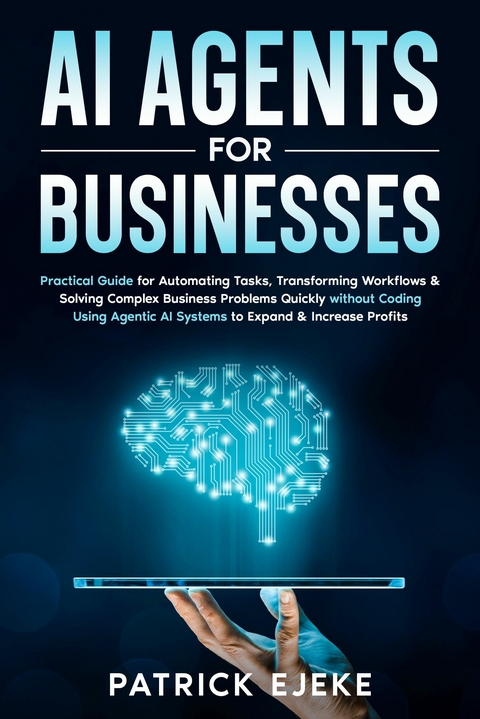
AI Agents for Businesses (eBook)
197 Seiten
Publishdrive (Verlag)
978-0-00-096020-7 (ISBN)
UNLOCK THE POWER OF AI AGENTS FOR YOUR BUSINESS
Transform Your Operations, Boost Efficiency, and Increase Profits
Discover the game-changing potential of AI agents in revolutionizing your business operations. 'AI AGENTS FOR BUSINESSES' is your ultimate guide to harnessing the power of agentic AI systems, without requiring any coding expertise.
This is YOUR ROADMAP to expand your business and increase profits by leveraging LLM-powered autonomous systems to automate tasks, solve complex problems, and stay ahead in the AI revolution in your business.
What You'll Learn
- Breakdown technical jargon: You will understand all there is to know about AI Agents with an approachable style that makes advanced subjects clear even for novices.
- Automate Repetitive Tasks: Streamline your workflow by automating mundane tasks, freeing up time for strategic decision-making and improve efficiency.
- Transform Workflows: Leverage AI agents to optimize business processes, enhance productivity, and drive growth.
- Solve Complex Problems: Utilize AI-driven solutions to tackle intricate business challenges and stay ahead of the competition.
-Expanded AI Agent Use Cases: Discover cutting-edge application examples ranging from multi-agent cooperation to artificial intelligence-powered solutions in several sectors.
- Expand and Increase Profits: Unlock new revenue streams and boost profitability with the strategic application of AI agents.
This book is your road map to success regardless of your level of entrepreneurship, tech passion, or professional seeking to leverage artificial intelligence. Even Online Marketers, Agencies and Social Media Influencers that are keen on building their Personal Brands can and should take advantage the information in this book to grow.
Key Benefits
- No Coding Required: Easily implement AI solutions without extensive technical expertise.
- Practical Guidance: Follow step-by-step instructions and real-world examples to integrate AI agents into your business.
- Actionable Insights: Gain valuable knowledge on how to drive business growth, improve efficiency, and increase profits.
Get Ready to Revolutionize Your Business!!
Don't miss out on the opportunity to transform your business with AI agents. Order your copy of 'AI AGENTS FOR BUSINESSES' today and start unlocking the full potential of your organization.
CLICK THE BUY NOW BUTTON and Start Achieving Your Business Goals!
CHAPTER ONE
The Rise of AI Agents in Business
For the past ten years artificial intelligence (AI) progressively migrated from science fiction into business operations which now form the foundation of routine operations. Artificial intelligence achieves high marks through its capabilities of automating customer service operations and supply chain optimization. The following stage in this evolutionary process will emerge as a new generation of intelligent tools which we call AI agents. These programs do not function through pre-written scripts or perform repetitive tasks. These artificial agents demonstrate adaptive abilities while maintaining context-awareness and can perform decision-making functions while learning from data and conducting interactions with human beings as well as systems during dynamic conditions.
AI agents represent a specific type of AI technology which defines their characteristics. A software entity which perceives its environment through sensors then reasons about it and autonomously takes actions to reach its defined goals makes up an AI agent. Digital coworkers are how you should view these agents because they execute tasks spanning from scheduling meetings to document preparation and managing data analysis and strategic suggestion generation. AI agents surpass traditional automation tools through the combination of machine learning and natural language processing because these capabilities enable adaptation without human supervision to produce better outcomes.
The development of AI agents becomes possible because multiple key factors unite. Intelligent systems benefit from the abundance of structured along with unstructured data that has emerged to develop their learning capabilities. Businesses store enormous data sets that stem from interactions with customers and operations and sales activities and additional domains. The large processing ability of AI agents reveals hidden insights that people cannot detect while they take instant action on this information.
Improved processing capabilities together with cloud services make it possible for companies to implement and grow their intelligent system operations. Hardware investments and multiple specialized teams who used to occupy this technology space now have access to simplified AI solutions through APIs and user-friendly platforms. The democratization of AI technology allows organizations of all sizes to try and deploy AI agents no matter their size or technological capabilities.
Businesses must now turn to flexible scalable solutions because the workplace environment transformed under pandemic pressure to require digital transformation at an expedited pace. The implementation of AI agents provides businesses with an opportunity to preserve operational efficiency while decreasing operational costs and improving decision-making abilities which lets human workers focus on more complex responsibilities.
AI agents have already started assuming essential positions in various business operations. Virtual assistants operate as scheduling managers and customer inquiry administrators. Intelligent data analysts utilize their expertise to identify irregularities that they then use to generate proposed optimization approaches. AI agents serving the marketing field provide three essential services which include personalized content creation and campaign administration as well as customer interaction analytics. The HR department uses these tools to simplify recruitment procedures along with employee onboarding and support systems. The described cases demonstrate how organizations increasingly adopt automated intelligent collaboration as their standard approach.
The introduction of AI agents represents than technological advancement because it creates a new approach to work processes. The new paradigm questions established work definitions by making leaders evaluate which duties should stay with humans while machines handle other tasks. The transformation process will require time to complete and it will present various obstacles on the way. Intelligent automation presents substantial business opportunities to those organizations which make the commitment to explore adaptive automation solutions through strategic investments.
AI agents in their current development stage are not content with altering individual assignments because they actively redefine workflows and executive procedures and organizational business frameworks. Early adoption of this shift by companies will result in leadership positions in the intelligent enterprise era.
Historical Context: From Simple Automation to Intelligent Agents
The advancement from basic automation to intelligent agents represents a progressive historical development that resulted from technological milestones and changing business operations as well as a determination to make machines operate alongside humans. Understanding the current impact of AI agents in business operations requires a review of our historical development.
The Age of Simple Automation
The initial applications of automation existed as mechanical systems. During the Industrial Revolution machines took over manual work operations from factories. The machines operated without independent thought while performing their predetermined mechanical routines. Machines alongside computers performed repetitive tasks through programmatic automation in the middle of the twentieth century after humans wrote their instructions.
The business world witnessed the emergence of early payroll processors and inventory management software and assembly line robotics as new systems during this period. The equipment helped enhance productivity yet lacked flexibility in operation. Such systems operated without the capability to respond to changes in environment or input. The basic programming design did not include the ability to understand or respond to changes —their only function was execution.
The Birth of Business Software and RPA
During the 1980s through the 1990s enterprise software experienced unprecedented growth within the business sector. Enterprise resource planning (ERP) and customer relationship management (CRM) systems gradually spread between organizations of all sizes. Business platforms used automation to handle various operations but needed continuous human intervention because they processed structured information.
In the early 2000s the world witnessed a major development in Robotic Process Automation (RPA). The application of RPA technology allowed companies to automate digital tasks which followed established rules for repetitive operations including data copying and transaction processing and email distribution. RPA technology reproduced screen-based human tasks yet it operated exclusively within predefined logical parameters. RPA bots operated only within the boundaries of their predefined programming instructions.
The Rise of Artificial Intelligence
Artificial Intelligence became the turning point when it emerged as a new technology. Industrial progress in computing and data accessibility with machine learning algorithms triggered the development of systems which surpassed traditional hardcoded logic. Traditional automation methods did not enable machines to perform intellectual tasks such as data analysis because AI administrators possessed the ability to analyze data and recognize patterns as well as suggest predictions.
The first applications of AI served specific goals such as fraud prevention and recommendation system development along with demand prediction. The systems demanded extraordinary large datasets alongside complex specialized models. Companies gained their initial ability to use machines as intellectual assets that could perform analytical tasks through these systems.
Enter the Intelligent Agent
AI technology development produced the intelligent agent as a concept. Dynamic software entities named intelligent agents use autonomous capabilities to sense their environment before choosing decisions that lead to specific goals while taking independent actions. These systems integrate data evaluation with logical thinking and strategic planning functions together with communication capabilities.
Business operations have undergone an extensive transformation because of this development. Modern AI agents surpass automated transactions as they deliver customer service management along with decision support for personnel selection and instant logistics optimization and autonomous operation among various agents and systems.
Intelligent agents become distinct because they develop the ability to learn from and adjust their behavior. They become better through the implementation of reinforcement learning together with natural language processing and neural networks. They operate as partners who automatically enhance their capabilities through ongoing performance assessment and stream of new data.
A Paradigm Shift in Business
Business operations have undergone major transformation due to the advancement from static automation to adaptive intelligence. The traditional purpose of automation involved executing tasks at higher speed while reducing costs. The main objective of intelligent agents is to achieve smarter operations through automated processes that surpass human capabilities.
Company service robots which recognize subtle meanings in addition to keeping track of language context. AI sales assistants use personalized outreach through their capabilities. The agents within supply chains act as real-time sentinels and forecasting units that adapt business operations in the current moment. The technology that was once considered futuristic is already operational across the market and will...
| Erscheint lt. Verlag | 15.6.2025 |
|---|---|
| Sprache | englisch |
| Themenwelt | Wirtschaft |
| ISBN-10 | 0-00-096020-9 / 0000960209 |
| ISBN-13 | 978-0-00-096020-7 / 9780000960207 |
| Informationen gemäß Produktsicherheitsverordnung (GPSR) | |
| Haben Sie eine Frage zum Produkt? |
 EPUB (Adobe DRM)
Größe: 2,8 MB
Kopierschutz: Adobe-DRM
Adobe-DRM ist ein Kopierschutz, der das eBook vor Mißbrauch schützen soll. Dabei wird das eBook bereits beim Download auf Ihre persönliche Adobe-ID autorisiert. Lesen können Sie das eBook dann nur auf den Geräten, welche ebenfalls auf Ihre Adobe-ID registriert sind.
Details zum Adobe-DRM
Dateiformat: EPUB (Electronic Publication)
EPUB ist ein offener Standard für eBooks und eignet sich besonders zur Darstellung von Belletristik und Sachbüchern. Der Fließtext wird dynamisch an die Display- und Schriftgröße angepasst. Auch für mobile Lesegeräte ist EPUB daher gut geeignet.
Systemvoraussetzungen:
PC/Mac: Mit einem PC oder Mac können Sie dieses eBook lesen. Sie benötigen eine
eReader: Dieses eBook kann mit (fast) allen eBook-Readern gelesen werden. Mit dem amazon-Kindle ist es aber nicht kompatibel.
Smartphone/Tablet: Egal ob Apple oder Android, dieses eBook können Sie lesen. Sie benötigen eine
Geräteliste und zusätzliche Hinweise
Buying eBooks from abroad
For tax law reasons we can sell eBooks just within Germany and Switzerland. Regrettably we cannot fulfill eBook-orders from other countries.
aus dem Bereich