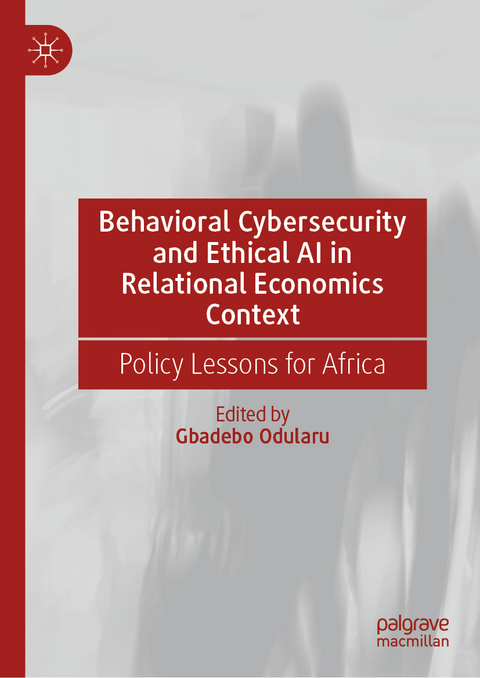
Behavioral Cybersecurity and Ethical AI in Relational Economics Context
Springer International Publishing (Verlag)
978-3-032-01213-5 (ISBN)
- Noch nicht erschienen - erscheint am 25.02.2026
- Versandkostenfrei
- Auch auf Rechnung
- Artikel merken
The book identifies unique AI-driven patterns, cultural nuances, and socioeconomic drivers in African contexts, asking readers to rethink their approach to knowledge-based systems, behavioral frontiers, and cybersecurity. The book adopts an interdisciplinary approach to help readers decode how AI shapes African government cybersecurity choices.
With a unique focus on supporting safer and more resilient cybersecurity behaviors in Africa, the book provides insights into the interconnections between education, finance, entrepreneurship, information science, psychology, public health, and other policy domains, the book proposes workable policy tools to help action the African Union Agenda 2063. Chapters offer constructive approaches to reconfigure the UN's SDGs 2030 themes related to cybersecurity and AI.
Readers will discover opportunities to bolster the capacities of policymaking and research to enable AI-driven technologies, support cultural nuances, and transform socioeconomic circumstances.
Gbadebo Odularu teaches international economics, labor economics, econometrics, macroeconomics theory, African economic development, and economic research methods at Howard University. He is Research Fellow for the Princeton University Pan-African Scientific Research Council (PASRC) and the Global Labor Organization (GLO). Odularu is also President of the Washington, DC-based professional development non-profit, African Finance and Economic Association (AFEA). In 2023, he was an instructor for Econometrics I for Howard University's American Economic Association (AEA) Summer Program. He is the editor or coeditor of Nutrition, Sustainable Agriculture, and Climate Change in Africa (Palgrave Macmillan, 2020), Strategic Policy Options for Bracing Nigeria for the Future of Trade (Palgrave Macmillan, 2020), and Trade Facilitation Capacity Needs (Palgrave Macmillan, 2019).
Chapter 1: AI Cyberattacks Regulatory Differentials and Institutional Justice.- Chapter 2: Ethical AI Strategies to Address Socioeconomic and Healthcare Challenges.- Chapter 3: Shaping Public Health Digital Health Innovations Equity and Accessibility.- Chapter 4: Impact of Computer Aided Diagnosis with the Help of AI After COVID19.- Chapter 5: On Cybersecurity Public Health Security and Bracing Africa for a Peaceful Future.- Chapter 6: Cyberbullying and Psychological Well-Being among Small Businesses Remote Workers.- Chapter 7: Artificial intelligences AIs disruption of employment opportunities.- Chapter 8: How Integrated are Digital Entrepreneurship Womens Inclusion and Behavioral Cybersecurity Reliability in the African Context.- Chapter 9: Digital Literacy Disparities Artificial Intelligence Access and Cybercrime Vulnerabilities.- Chapter 10: Cyber Resiliency and Minority Owned Business Continuity in an Artificial Intelligence Driven Age.- Chapter 11: Digitalization Artificial Intelligence and Cybersecurity Concerns for SMEs.- Chapter 12: Bridging the Digital Gender Divide Enhancing Cybersecurity Resilience through Womens Participation.- Chapter 13: Cyberspace Marketing and Street Trading.- Chapter 14: Assessing the Potential of Aritifical Intelligence in Strengthening Cybersecurity for International Trade Flows.- Chapter 15: Competition Policies Regional Trade and their Intersection with Cybersecurity.- Chapter 16: Large Language Models Entertainment Authenticity Streaming Discoverability and Rightsholders Diversity in a Cyber Fraud Era Beyond the Borders of French-Speaking African and Caribbean Countries.- Chapter 17: Cybersecurity Threats to Digital Financial Inclusion in Africa Can Ethical AI Bridge the Trust Gap.- Chapter 18: Impact of AI on Luxury Real Estate Marketing in Growing Markets.- Chapter 19: Cybercrimes and Digital Banking Economy A Strategic Intervention from Global Best Practices.- Chapter 20: AI Cybersecurity Skill Asymmetries Kafala Sponsorship and African Expatriates Career Mobility in a Qatari Context.- Chapter 21: Law Enforcement Impersonation in Bank related Scams in South Africa Perceived Vulnerability and Mitigating Strategies.- Chapter 22: Cybersecurity Awareness Frameworks in a Developing Economies Context A Systematic Review.- Chapter 23: A Comprehensive Analysis and Cyberbiosecurity Recommendations Based on Survey Data from Uganda and other Countries.- Chapter 24: For Africa Without Africa Contextualizing West African Cyber Security Strategies.- Chapter 25: Cyber Inequity Inherent Biases and the Paradox of AI Services Market.
| Erscheinungsdatum | 29.11.2025 |
|---|---|
| Zusatzinfo | VI, 539 p. 48 illus. |
| Verlagsort | Cham |
| Sprache | englisch |
| Maße | 148 x 210 mm |
| Themenwelt | Wirtschaft ► Volkswirtschaftslehre |
| Schlagworte | AI in African economies • Behavioral cybersecurity and AI in Economics • Behavioral innovation in economics • Gbadebo Odularu • Gbadebo Odularu Palgrave Macmillan • Interdisciplinary methods in economics |
| ISBN-10 | 3-032-01213-9 / 3032012139 |
| ISBN-13 | 978-3-032-01213-5 / 9783032012135 |
| Zustand | Neuware |
| Informationen gemäß Produktsicherheitsverordnung (GPSR) | |
| Haben Sie eine Frage zum Produkt? |
aus dem Bereich