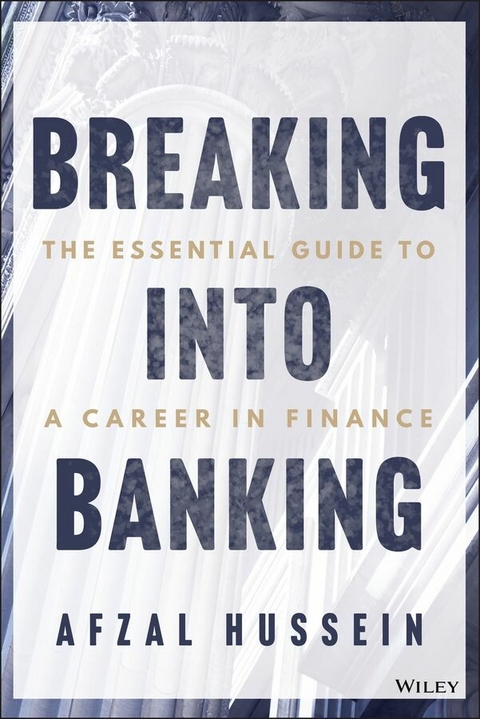
Breaking into Banking (eBook)
287 Seiten
Wiley (Verlag)
978-1-394-30503-2 (ISBN)
Discover how to get your start in the finance and banking industries
In Breaking into Banking: The Essential Guide to a Career in Finance, renowned finance and careers commentator Afzal Hussein delivers a concise and up-to-date roadmap to getting your start in the world of finance and banking. You'll explore the different divisions and areas of the industry-including investment banking, global markets, investment research, asset management, operations, technology, hedge funds, private equity, and venture capital-how they work, and what they do.
You'll also find information about typical career progression routes, working hours, industry culture, compensation expectations, exit opportunities, titles, roles, responsibilities, and more.
Breaking into Banking also provides:
- Actionable advice that improves your chances for success when applying for roles across the industry
- Strategies for effective networking, tackling imposter syndrome, and interview preparation
- Techniques for identifying the best and most suitable career path for you and your circumstances
Perfect for aspiring and young professionals interested in pursuing a career in finance and banking, Breaking into Banking is a must-read, no-nonsense playbook for jumpstarting your career in an industry that is as rewarding as it is complex.
AFZAL HUSSEIN is a former Goldman Sachs finance professional who has helped thousands of people enter and succeed in finance careers all over the world. He's passionate about demystifying the industry and equipping aspiring finance professionals with the tools they need to succeed.
Discover how to get your start in the finance and banking industries In Breaking into Banking: The Essential Guide to a Career in Finance, renowned finance and careers commentator Afzal Hussein delivers a concise and up-to-date roadmap to getting your start in the world of finance and banking. You'll explore the different divisions and areas of the industry including investment banking, global markets, investment research, asset management, operations, technology, hedge funds, private equity, and venture capital how they work, and what they do. You'll also find information about typical career progression routes, working hours, industry culture, compensation expectations, exit opportunities, titles, roles, responsibilities, and more. Breaking into Banking also provides: Actionable advice that improves your chances for success when applying for roles across the industry Strategies for effective networking, tackling imposter syndrome, and interview preparation Techniques for identifying the best and most suitable career path for you and your circumstances Perfect for aspiring and young professionals interested in pursuing a career in finance and banking, Breaking into Banking is a must-read, no-nonsense playbook for jumpstarting your career in an industry that is as rewarding as it is complex.
INTRODUCTION: FROM COUNCIL ESTATE TO GOLDMAN SACHS
Before you dive into this book, I wanted to share how I managed to somehow end up in the front office of one of the most prestigious financial institutions in the world, Goldman Sachs. It's an unconventional story that combines life experiences from my childhood and early years, but one that I hope will inspire you to persist with the drive, determination, and discipline to pursue your goals even if it feels like the odds are stacked against you.
From a young age, I always knew that I wanted to put on a suit and work in the city. I'm not sure why, but I associated it with success and wealth and decided that I wanted to be a businessman, though I never really knew what that meant or how I would go about becoming one. I also never had any real insights or connections into careers in the city since I didn't know anyone who wore a suit to work.
After all, I grew up in a North West London council estate (for anyone unfamiliar with the term, a council estate is a government‐funded housing complex) where the only careers we were exposed to were the youth workers at the local youth clubs, our school teachers, the local librarians, those who worked at the local chippy, betting shops, and newsagents, and those working for Camden Council.
Growing up in a council estate meant being surrounded by young people who were heavily involved in gangs, violence, drug deals, and other crimes and antisocial behaviour. A lot of the young people I grew up around came from extremely disruptive and fragmented homes, were in and out of prison, and had been stabbed by or had stabbed another young person from a different council estate. Youth clubs existed to keep us off the streets and provide a safe space where any young person could participate in recreational activities such as playing PlayStation, pool, football, table tennis, cooking, gym, and more.
My siblings and I were raised by an extremely strong single parent, my mum. We didn't have much, but we had all that we needed. Most importantly, my mum instilled a sense of awareness and direction in us during our formative years. This allowed us to attend the youth clubs and grow up with a lot of freedom and trust, but at the same time understand and appreciate the negative consequences of getting involved in gangs, trying or selling drugs, and mixing with the wrong people. Even so, the youth club was like a second home for us. We went to all the events, activities, trips, and tournaments. We were on good terms with all the young people, irrespective of what they were involved in outside of the youth club. Being particularly good at football, table tennis, and pool helped. But we made sure to keep our distance when it came to doing anything illegal or with potential negative consequences to our lives. Last but not least, we were surrounded by an amazing group of youth workers who always kept an eye out for us and made sure we stayed out of trouble.
From a career perspective, all we knew was that we had to perform well in school and college or sixth form in order to get into a good university, which would then open up a universe of career opportunities for us. And so that's what I did. I was a fairly mischievous kid, but I also got good grades throughout my school years.
After receiving my GCSE results, which were above average but not prodigy‐esque, I had an important decision to make. I could stay at my school's sixth form and do International Baccalaureate (IB) or leave and go to a college and take my A‐levels. I decided to go with the latter, and this is where, for the first time in my academic career, everything went downhill.
FAILURE: THE WAKE‐UP CALL I NEEDED
In essence, the jump from GCSEs to A‐levels caught me off guard. On top of this, I was attending a new college with a lack of focus or direction, and any real sense of why I was there. I knew a few people at the college but I felt like a lone ranger doing my own thing, and I was rudderless. Unfortunately for me, there were no spaces left in Economics which was the one subject I really wanted to learn about. So, I enrolled in AS Maths, Biology, Physics, and Geography. The lack of focus, guidance, and drive meant my mid‐term grades suffered. For the first time, I was taking a massive academic hit. And for a few months, I didn't really care.
At the end of the first year I sat my AS exams and, a few months later, received my results. I ‘achieved’ a D in Maths, an E in Biology, a U in Physics, and a U in Geography. Grades I had never seen before. These results spoke for themselves and were the truest reflection of what happens when you fail to apply yourself. I honestly thought my life was over. I didn't know how I would go home and tell the news to my siblings, let alone my mum. So, I went home that day and caught my mum alone. I told her my results. I felt like a complete failure, and I knew I was better than this. To my surprise, she told me that it wasn't the end of the world, that I should leave the college and redo the year somewhere else. Such simple and straightforward advice. And it worked.
I used to be afraid of failing. I guess we're naturally taught that failure is bad, and succeeding is good. As time has gone on, and my view and perspective on life has matured, I can honestly say that I embrace the concept of failure. After all, every failure serves a purpose and offers a learning opportunity if you're open‐minded enough to see it. My D, E, U, U results were the wake‐up call I needed. I was comfortably complacent. This mega failure on my part was, to this day, one of the biggest blessings in disguise. Had I not failed so badly, only God knows what I'd be doing right now.
GETTING BACK ON TRACK
I knew something needed to change. I knew I was better than this. I knew I had to leave this college and find the drive and ambition that I always carried within me. So, I did what all younger siblings should do when they're in a time of need. I went to my eldest brother, who was very studious, and asked him for his advice.
He previously studied at Westminster City School's sixth form and only had good things to say about the place; he told me it was worth considering redoing my AS‐levels there. I already had quite a few friends from football who were attending the school so I knew I'd fit in, and before I knew it, I had registered and secured my place.
Never did I think that I'd find myself retaking an academic year, but there I was, swallowing my pride and retaking a year with students a whole year younger than me. I felt like a total failure. When I got to Westminster City School, my game plan was simple. Do three AS‐levels, not four, study like my life depended on it, go to class then go home and study, and avoid any and all distractions. At the end of the first year I received my grades, and wasn't surprised to find that I had achieved straight As in Maths, Economics, and Biology. I wasn't surprised because I had applied myself and remembered that performing well in exams is simply a combination of consistent effort and doing (and learning from) lots of past exam papers.
By the time I got into my second year, I had made more friends throughout the sixth form and was slightly ‘less’ focused on my studies compared to my first year. I was still studying hard and even won a scholarship, but I was also hanging around more often after the day was done, playing more football after hours with the guys, going out more, and generally spending more time in the common room instead of having my head in the books 100% of the time. Do I regret it? Not one bit. That sixth‐form experience was amazing, and it allowed me to meet people who have become extremely close friends in my life today.
OFF TO UNIVERSITY
By the end of my final year at Westminster City School my grades got me into Queen Mary University of London (QMUL). QMUL wasn't my first choice, but in hindsight I wouldn't change studying there for the world. Not only because it's where I managed to secure spring weeks, internships, and meet lots of great people, but predominantly because it's where I met my wife. She helped me get into Goldman Sachs, and I helped her get into J.P. Morgan, but that's a story for another time…
During my time at university, I used to dream of securing a spring week because I knew how important it was to simply get my foot in the door. I knew that it would only get harder trying to break into the industry the longer I left it, or the less experience I had on my CV. I also knew that securing a spring week was easier than securing an internship, and securing an internship was easier than securing a graduate scheme. But the icing on the cake, for me, was finding out that you could convert a spring week into a summer internship, and you could convert a summer internship into a full‐time role. Knowing all of this, I decided to be tactical and strategic regarding my approach to breaking into the industry, rather than follow the crowd and only apply for the toughest and fanciest roles out there.
FIRST YEAR: SPRING WEEKS
During my first year at university, I didn't really care which division I was breaking into because my mentality at the time was that beggars can't be choosers and, in my head, I was a beggar. My mentality was to secure anything, at any firm, and then build from there. After all, although QMUL was a great academic institution, and one of the Russell Group...
| Erscheint lt. Verlag | 27.6.2025 |
|---|---|
| Sprache | englisch |
| Themenwelt | Sachbuch/Ratgeber ► Beruf / Finanzen / Recht / Wirtschaft ► Bewerbung / Karriere |
| Wirtschaft ► Betriebswirtschaft / Management | |
| Schlagworte | applying for finance jobs • banking career guide • banking networking tips • Finance career guide • finance networking tips • Goldman Sachs • how do I become an investment banker? • how do I get into finance? • investment banking career guide • jp morgan • morgan stanley |
| ISBN-10 | 1-394-30503-6 / 1394305036 |
| ISBN-13 | 978-1-394-30503-2 / 9781394305032 |
| Informationen gemäß Produktsicherheitsverordnung (GPSR) | |
| Haben Sie eine Frage zum Produkt? |
 EPUB (Adobe DRM)
Kopierschutz: Adobe-DRM
Adobe-DRM ist ein Kopierschutz, der das eBook vor Mißbrauch schützen soll. Dabei wird das eBook bereits beim Download auf Ihre persönliche Adobe-ID autorisiert. Lesen können Sie das eBook dann nur auf den Geräten, welche ebenfalls auf Ihre Adobe-ID registriert sind.
Details zum Adobe-DRM
Dateiformat: EPUB (Electronic Publication)
EPUB ist ein offener Standard für eBooks und eignet sich besonders zur Darstellung von Belletristik und Sachbüchern. Der Fließtext wird dynamisch an die Display- und Schriftgröße angepasst. Auch für mobile Lesegeräte ist EPUB daher gut geeignet.
Systemvoraussetzungen:
PC/Mac: Mit einem PC oder Mac können Sie dieses eBook lesen. Sie benötigen eine
eReader: Dieses eBook kann mit (fast) allen eBook-Readern gelesen werden. Mit dem amazon-Kindle ist es aber nicht kompatibel.
Smartphone/Tablet: Egal ob Apple oder Android, dieses eBook können Sie lesen. Sie benötigen eine
Geräteliste und zusätzliche Hinweise
Buying eBooks from abroad
For tax law reasons we can sell eBooks just within Germany and Switzerland. Regrettably we cannot fulfill eBook-orders from other countries.
aus dem Bereich