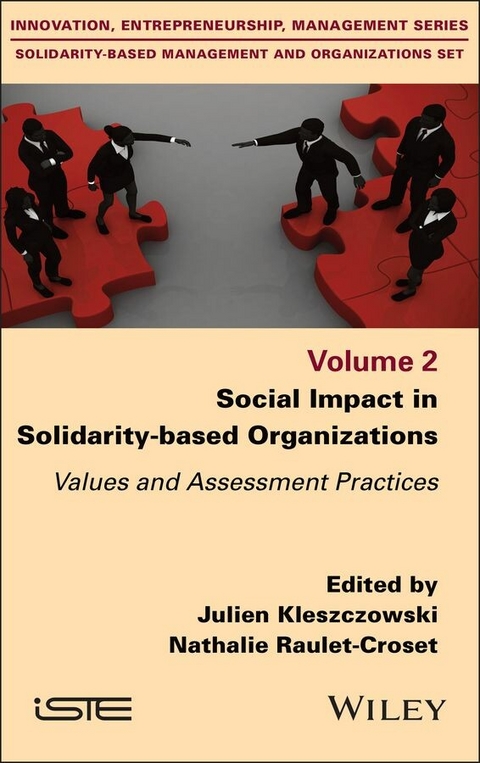
Social Impact in Solidarity-based Organizations (eBook)
282 Seiten
Wiley-Iste (Verlag)
978-1-394-38818-9 (ISBN)
Social Impact in Solidarity-based Organizations is based on a series of original case studies of SIA approaches carried out in a variety of organizations. It takes a nuanced, reflective look at SIA, charting a path between unreserved promotion and wholesale rejection of the very principle of the approach. The book focuses on the debates, uses and limits of SIA practices, placing them in their own contexts, values, challenges and objectives.
Julien Kleszczowski is Senior Lecturer of Management Science at IAE Lille (LUMEN Laboratory), University of Lille, France, where he heads up the master's degree program in Management of SSE Organizations. His thesis focused on social impact assessment of non-profit organizations.
Nathalie Raulet-Croset is Professor at the IAE Paris-Sorbonne (IAE Paris-Sorbonne Lab), Panthéon-Sorbonne University, France, where she heads up the mutations anticipations innovations chair and the executive master's degree program in Management of Non-profit Organizations.
In recent years, social impact assessment (SIA) has become an important issue for organizations in the social and solidarity economy (SSE). SIA refers to the measurement of the effects of these organizations on society, and it is increasingly seen as a performance measurement for this type of organization. Social Impact in Solidarity-based Organizations is based on a series of original case studies of SIA approaches carried out in a variety of organizations. It takes a nuanced, reflective look at SIA, charting a path between unreserved promotion and wholesale rejection of the very principle of the approach. The book focuses on the debates, uses and limits of SIA practices, placing them in their own contexts, values, challenges and objectives.
1
Co-Construction of an Assessment Process by and for Organizations in the Social and Solidarity Economy
1.1. Introduction
In recent years, the numerous articles in scientific literature focusing on social impact assessments (SIA) indicate a growing interest in this subject. Enterprises in the social and solidarity economy (SSE) are grappling with this issue, which is particularly central for them. The assessment processes developed by funders from the for-profit sector (venture philanthropy, socially responsible investment, etc.) present risks for SSE organizations (developed in section 1.2), since these processes are not always suited to their governance and their specificities. Nevertheless, some authors (Bouchard and Rousselière 2022) suggest that assessment has also become a tool for negotiation and empowerment, enabling SSE organizations to prove their worth, build stronger relationships with their stakeholders, engage in initiatives or take decisions.
Seeking to avoid having imposed upon them an assessment process that would not mesh with the realities experienced on the ground, SSE organizations, social and solidarity economy federations and academic actors worked together, in an action research approach, under the auspices of the Interreg project VISES (described in section 1.3), to co-construct an SIA process by and for SSE actors. This chapter’s contribution is therefore twofold. On the one hand, it sets out to demonstrate the value of an action research approach to apprehend this complex subject of the SIA of SSE organizations (developed in section 1.2) through a detailed description of the SIA process to which the action research approach has led. Thus, section 1.3 describes this.
1.2. Contextualization
The SIA has become a dominant issue for enterprises, and has various facets: demonstrating their contribution to sustainable development goals, strengthening their CSR practices, publishing a report on their socially responsible practices, giving visibility to the social impact they generate, etc.
This issue is especially central for SSE organizations which are pursuing above all a social purpose that is reflected in their day-to-day activities and practices. Generating this impact is their raison d’être. Moreover, the expectations in terms of demonstrating this impact are stated very clearly by the new breed of funders from impact investing or venture philanthropy and amplified by supranational institutions (G8, OECD, European Commission). Processes that have to do with impact are also developed by consultants and taught in a number of business schools. Public funding bodies are also starting to take an interest in this and even see it as a tool that could support the development of new types of public–private partnerships, as in the scenario of social impact bonds. The scientific community is also embracing this issue, as evidenced by the growing number of publications on the subject (Rawhouser et al. 2019).
However, proving the social impact generated by an enterprise is highly complex. Firstly, being able to assign, with certainty, an impact to the activities of the enterprise, and thus prove a causal link, requires demanding methodologies. This is what we call the attribution issue. Then, being able to take into account the impacts generated over the long term requires taking a step back. Assessing social impact necessitates stopping and taking our time, which is not always realistic in terms of the day-to-day activities of organizations. Finally, some impacts are difficult to measure, such as social cohesion or feelings of inclusion and usefulness.
To this complexity must be added the risks perceived by the SSE sector (federations and enterprises): the risk of isomorphism that would push SSE organizations to conform to the expectations of the environment, even if that makes no sense for them (DiMaggio and Powell 1983; Bouchard and Rousselière 2022); the risk of bias in the selection of enterprises that are given visibility or funding (only SSE organizations that generate an easily demonstrable or “sexy” impact would be promoted); the risk of a mismatch between the needs of SSE organizations and the methods proposed (Kah and Akenroye 2020). In this context, allowing SSE organizations to take back ownership of this key issue which they are confronting with greater and greater urgency, seems essential. Moving forwards on these SIA issues therefore means, for the SSE, both gaining a better grasp of the injunctions and constructing a way of responding to them that is suited to the issues and imperatives of the actors involved. This is what the VISES project set out to implement. VISES is an action research project which took place from 2016 to 2019 and which sought to highlight the contributions that SSE organizations make to territorial dynamism and to the well-being of their inhabitants.
1.3. The VISES project
The VISES project (Valorisation de l’impact social de l’entrepreneuriat social1 – Valorization of the Social Impact of Social Entrepreneurship) is an action research project conducted over a period of four years (2016–2019) and supported by the European Interreg program. This action research brought together 23 French and Belgian (Walloon and Flemish) partners2, including federations, research centers, funders, public authorities and also 68 SSE structures that experienced the process. The research center to which the authors of this chapter belong, namely the Center for Social Economy3 of HEC Liège, was the academic operator of this project.
In the landscape of social impact assessment, the VISES project stands out from the many scientific works and measurement or assessment tools proposed by consultants, in that it positioned itself from the outset as an action research project. This scientific approach positioned “at the meeting between a desire for change and a research intention” (Lewin 1946) makes it possible, through change and through action, to take knowledge forward and, simultaneously, through the development of knowledge, to take action forward. Action research is “a democratic and participative orientation to knowledge creation. It brings together action and reflection, theory and practice, in the pursuit of practical solutions to issues of pressing concern. Action research is a pragmatic co-creation” (Bradbury 2015).
1.3.1. Description of the VISES project
The objective of the VISES project was to enable SSE actors to take back ownership of the issues relating to SIA and to develop a process that makes sense and is appropriate to the specificities of SSE organizations. To do this, the process was tested with SSE organizations, thus allowing SIAs to be experienced by various SSE organizations. Various types of actors were involved in this large-scale project.
SSE federations provided support to enterprises to implement and experience the SIA process. They thus played an external support role (which will be described in section 1.4). Academic actors fed the partners with scientific knowledge and spearheaded proposals to structure an SIA process. The enterprises testing the approach, i.e. 68 SSE organizations, were thus supported by the SSE federations to assess their social impact on the basis of a co-construction process. Finally, two partner operator structures monitored the project end to end, in order to make the SIA a live issue among their members and advocate it to the public authorities.
Starting out from an analysis of existing initiatives (practical synthesis) and a state of the art on the SIA of SSE organizations (theoretical synthesis), the partners began by co-constructing an initial SIA process suited to the realities of SSE organizations, and then tested it, for two years, with the SSE organizations experiencing the process. During the four years of the project, the federations, the partner structures, the coordinating structures and also the academic actors, met regularly, at “research groups”, during which the federations shared their experiences of SIAs with the SSE organizations, while the assessment process was still under construction. The academic actors fed the debate with the existing academic knowledge and structured the discussions. The federations kept a log for each enterprise to which they were providing support, logging information such as the main characteristics of the assessment, the evaluative question, the problems encountered, how the enterprise had taken ownership of the process, a description of the data collection, the stakeholders involved, etc.
In total, 93 logs were completed and analyzed: 38 logs for step 1, 29 logs for step 2 and 26 logs for step 3. In addition, some support providers who did not complete logs conducted an interview with the researcher (academic actor) at each step to describe the SIA processes and give oral answers to the questions in the log. Thus, in addition to the 93 logs mentioned above, data linked to dozen or so structures (three for step 1, 10 for step 2 and six for step 3) were collected, analyzed and integrated from logs completed in the form of interviews with the researcher. Ultimately, some 40 logs were analyzed at each step.
The absence of a log for some organizations can be explained in a number of ways. To begin with, one partner, due to a lack of financial resources, ended up providing support semi-collectively, with the assistance of the other partners, to eight SSE structures. A specific data analysis was...
| Erscheint lt. Verlag | 24.6.2025 |
|---|---|
| Reihe/Serie | ISTE Invoiced |
| Sprache | englisch |
| Themenwelt | Wirtschaft ► Betriebswirtschaft / Management ► Unternehmensführung / Management |
| Schlagworte | performance measurement • social and solidarity economy (SSE) • social impact assessment (SIA) • social organizations • Solidarity |
| ISBN-10 | 1-394-38818-7 / 1394388187 |
| ISBN-13 | 978-1-394-38818-9 / 9781394388189 |
| Informationen gemäß Produktsicherheitsverordnung (GPSR) | |
| Haben Sie eine Frage zum Produkt? |
 EPUB (Adobe DRM)
Kopierschutz: Adobe-DRM
Adobe-DRM ist ein Kopierschutz, der das eBook vor Mißbrauch schützen soll. Dabei wird das eBook bereits beim Download auf Ihre persönliche Adobe-ID autorisiert. Lesen können Sie das eBook dann nur auf den Geräten, welche ebenfalls auf Ihre Adobe-ID registriert sind.
Details zum Adobe-DRM
Dateiformat: EPUB (Electronic Publication)
EPUB ist ein offener Standard für eBooks und eignet sich besonders zur Darstellung von Belletristik und Sachbüchern. Der Fließtext wird dynamisch an die Display- und Schriftgröße angepasst. Auch für mobile Lesegeräte ist EPUB daher gut geeignet.
Systemvoraussetzungen:
PC/Mac: Mit einem PC oder Mac können Sie dieses eBook lesen. Sie benötigen eine
eReader: Dieses eBook kann mit (fast) allen eBook-Readern gelesen werden. Mit dem amazon-Kindle ist es aber nicht kompatibel.
Smartphone/Tablet: Egal ob Apple oder Android, dieses eBook können Sie lesen. Sie benötigen eine
Geräteliste und zusätzliche Hinweise
Buying eBooks from abroad
For tax law reasons we can sell eBooks just within Germany and Switzerland. Regrettably we cannot fulfill eBook-orders from other countries.
aus dem Bereich