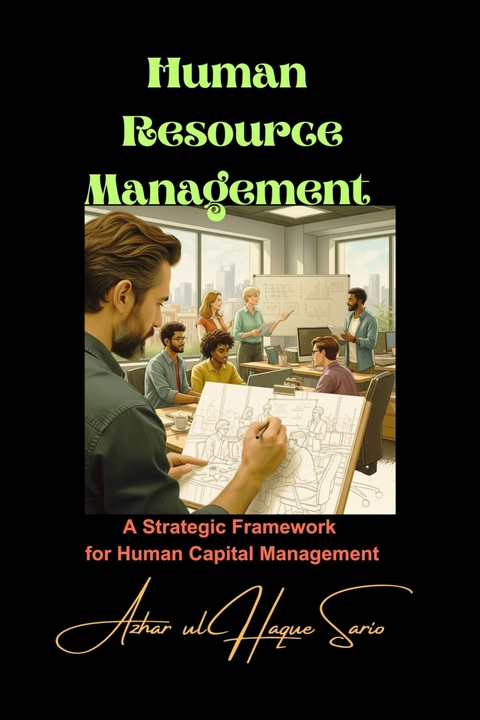
Human Resource Management (eBook)
232 Seiten
Azhar Sario Hungary (Verlag)
978-3-384-63922-6 (ISBN)
It's time to stop managing personnel and start building true human capital.
This book is your complete guide to modern people strategy. We start with the core of any organization: the individual. You will explore personality, motivation, and the psychology of work. Learn how to foster a growth mindset in your people. Understand how to manage stress and promote well-being. Then, we move to the dynamics of groups. Discover the blueprint for creating high-performing teams. You'll learn to manage communication, conflict, and virtual collaboration. The book then lays out the strategic framework for HR. See how the HR function evolved into a vital business partner. We show you how to align every HR action with company goals. The journey continues through the entire employee lifecycle. Master strategic talent acquisition and build a powerful employer brand. Learn the science of selecting the best candidates. We transform performance management from a yearly chore into a continuous, coaching-based conversation. You'll learn to design total rewards systems. This includes fair pay, modern benefits, and meaningful recognition. Finally, we focus on growth, building a true learning organization and architecting career paths that retain your best talent.
So, what makes this book different? Many human resource texts are either dry academic theories or a disconnected list of best practices. They fail to show you how everything fits together. This guide provides a single, cohesive framework that connects the dots from individual psychology to macro-level business strategy. Inspired by the curriculum priorities of world-leading institutions like Harvard, Cambridge, and Oxford, it bridges the critical gap between deep theory and actionable strategy. It doesn't just tell you what to do; it explains the why behind the methods and gives you the tools to implement them effectively. You'll learn to think like a strategic partner, make data-driven decisions with people analytics, and lead with a strong ethical compass. This is more than a textbook-it's a comprehensive playbook designed for ambitious managers, MBA students, and senior HR leaders who are ready to unlock the immense competitive advantage that comes from exceptional human capital management.
Disclaimer: The author is not affiliated with any institution mentioned. This book is an independent publication. All trademarks and registered names are used for identification and commentary purposes only, under the principle of nominative fair use.
Part II: The Employee Lifecycle and Talent Management
Strategic Talent Acquisition and Employer Branding
In the high-stakes theater of finance, where fortunes are forged and futures decided in the blink of an eye, we often worship at the altar of market trends, algorithmic genius, and iron-clad risk models. We celebrate the rainmakers and the quants, the architects of the deal. But behind the curtain, away from the ticker tape and the trading floor, lies a far more profound secret to lasting success. It’s not found in a spreadsheet or a market forecast. It’s found in people.
Building a financial powerhouse isn’t about filling seats; it's about curating a living, breathing ecosystem of talent. It’s an art form, a science, and a strategic imperative. This is the world of Strategic Workforce Planning (SWP) and Job Analysis—not as dusty HR terms, but as the master keys to unlocking an organization's true potential. For anyone dreaming of not just surviving but thriving in finance, understanding this human architecture isn't just important; it's everything.
The Crystal Ball: Seeing Your Future Workforce Today
Imagine you’re the captain of a state-of-the-art ship, navigating the treacherous, ever-changing seas of global finance. Strategic Workforce Planning is your advanced sonar and satellite mapping system, allowing you to see beyond the immediate fog of today's hiring needs. It’s the ability to spot the icebergs of talent shortages and the favorable currents of emerging skills long before they appear on the horizon. This isn't about reacting; it's about anticipating. It’s the difference between patching a leak in a storm and building a vessel designed to glide through it.
The proof isn't just in the philosophy; it's in the profits. Think about this: Gartner found that organizations with this kind of foresight were 2.3 times more likely to blow past their financial targets. This isn’t a coincidence; it's a direct consequence of seeing the future of their people.
So, how do you gaze into this crystal ball?
Reading the Tea Leaves of Your Own Team (Demographic Analysis): You start by looking inward. Who are your people? Is your team of veteran analysts a brilliant repository of wisdom or a "retirement time bomb" waiting to go off? A 2020 PwC report revealed a startling truth: 74% of CEOs lose sleep over the availability of key skills. A simple look at the age and tenure of your team can be the first step to ensuring you don’t become one of them. It’s the essential, often-ignored intelligence that turns a potential crisis into a well-managed transition.
The Art of Predicting Goodbyes (Predictive Turnover Modeling): Why do people leave? It's the million-dollar question—or, more accurately, the multi-million-dollar question. The cost of losing a key player in finance, whose relationships and expertise are the bedrock of client trust, can be astronomical. Tech giants like Google have turned this into a science, using algorithms to predict who might be packing their bags. By understanding the subtle cues—from engagement scores to market rumblings—you can intervene, not with a desperate counteroffer, but with a meaningful conversation that reaffirms their value. It’s about saving not just money, but the very soul and memory of your organization.
Mapping a New World (Identifying Future Skill Gaps): The financial landscape is being redrawn by forces like FinTech, AI, and blockchain. The skills that built empires yesterday won't be enough to sustain them tomorrow. The World Economic Forum's 2023 "Future of Jobs" report reads like a casting call for a new kind of financial expert: data scientists, AI specialists, cybersecurity guardians. SWP is the process of holding up this map of the future against the blueprint of your current team and asking the tough question: "Are we ready?" Without it, you're not just risking falling behind; you're risking becoming obsolete.
The Blueprint for Brilliance: Defining the "Who"
Once your strategic crystal ball has shown you what kind of talent you need, Job Analysis provides the meticulous, high-definition blueprint for who that person is. This isn't about writing a boring list of duties. It’s the soul-searching work of defining excellence for every single role. It’s the difference between asking for "a bricklayer" and providing the detailed architectural plans for building a cathedral. The outputs of this deep dive are the two most critical documents in the entire talent journey:
The Job Description: The "What." This is the role's story. What challenges will they face? What impact will they have? Who will they collaborate with to create value? It’s a clear, honest, and compelling narrative of the position itself.
The Person Specification: The "Who." This is the character sketch of your ideal hero. It goes beyond mere qualifications. It speaks to the resilience needed to weather a market downturn, the curiosity to uncover a hidden investment opportunity, and the collaborative spirit to make the entire team better. A job description might say, "manages investment portfolios." The person specification whispers, "We need a visionary with a fire in their belly, a proven history of navigating emerging markets, and the integrity of a true fiduciary."
The legendary research by Schmidt and Hunter (1998) proved that hiring without this foundation is like playing darts in the dark. You might hit the board occasionally, but you'll never hit the bullseye consistently. In a world where a Leadership IQ study found that nearly half of all new hires fail within 18 months—not from a lack of skill, but from a poor fit—getting this blueprint right isn't just good practice; it's your best defense against catastrophic mis-hires.
Battle-Tested: Stories from the Front Lines
Case Study 1: JPMorgan Chase vs. The FinTech Revolution
Imagine being a titan of finance and suddenly, a swarm of agile, tech-savvy startups are coming for your lunch. This was the reality for JPMorgan Chase. Their strategic foresight (SWP) revealed a terrifying gap: their workforce was built for the old world, not the new one of machine learning and blockchain.
The Strategy: Instead of panicking, they launched a two-pronged attack. They poured hundreds of millions into transforming their own loyal employees into a next-generation workforce. Simultaneously, their recruitment became laser-focused.
The Blueprint: They didn’t just look for "coders." Through rigorous job analysis, they defined roles like "AI Algorithm Engineer," specifying the need for individuals who could speak both the language of Python and the language of portfolios.
The Victory: JPMorgan didn't just survive the disruption; they harnessed it. By anticipating their needs and meticulously defining their new heroes, they accelerated their own evolution, proving an old giant could learn to dance with the newcomers.
Case Study 2: Deutsche Bank's Reinvention
Faced with the monumental task of restructuring, Deutsche Bank had to make tough choices. This wasn't just about cutting costs; it was about pivoting toward a new future, one centered on sustainable finance and core banking.
The Strategy: Their SWP team became mission control, modeling different futures to see how restructuring would ripple through their talent pool. They identified not only who was redundant but, more importantly, who was critical for the new vision.
The Blueprint: As they built their new sustainable finance division, they had to define roles that had never existed before. What does an "ESG Risk Analyst" or a "Green Bond Specialist" actually do? Job analysis gave them the answer, creating blueprints that blended deep financial knowledge with a genuine passion for environmental and social impact.
The Victory: This meticulous human-centered approach allowed Deutsche Bank to navigate a corporate earthquake. It ensured that as the old structure was dismantled, a new, stronger one—staffed with the right people with the right skills—was already rising to take its place, maintaining stability and client trust through the storm.
Your Questions, Answered
1. Question: Isn't "strategic workforce planning" just a fancy new term for what HR has always done? What's the real difference?
Answer: It’s like the difference between being a passenger and being the pilot. Traditional HR planning is often reactive—you're a passenger told that someone has left their seat, and now you need to find a replacement. It's focused on the immediate, empty chair.
Strategic Workforce Planning (SWP) puts you in the pilot's seat. You're looking at the flight plan—the company's five-year business strategy. You're checking the weather report—the rise of AI in trading, shifting regulations. You're looking at your crew manifest and realizing that in three years, you won't need more navigators; you'll need specialized engineers for a new type of engine. So, you start training and recruiting for those engineers now, long before the new engine even arrives. SWP is about shaping the future, not just reacting to the present.
2. Question: Job descriptions and person specifications sound like a lot of corporate paperwork. Why are they so...
| Erscheint lt. Verlag | 23.6.2025 |
|---|---|
| Sprache | englisch |
| Themenwelt | Wirtschaft ► Betriebswirtschaft / Management ► Personalwesen |
| Schlagworte | Employee engagement • Human Capital Management • Human Resource Management • leadership development • Organizational Behavior • Strategic human resources • Talent Management |
| ISBN-10 | 3-384-63922-7 / 3384639227 |
| ISBN-13 | 978-3-384-63922-6 / 9783384639226 |
| Informationen gemäß Produktsicherheitsverordnung (GPSR) | |
| Haben Sie eine Frage zum Produkt? |
 EPUB (Ohne DRM)
Digital Rights Management: ohne DRM
Dieses eBook enthält kein DRM oder Kopierschutz. Eine Weitergabe an Dritte ist jedoch rechtlich nicht zulässig, weil Sie beim Kauf nur die Rechte an der persönlichen Nutzung erwerben.
Dateiformat: EPUB (Electronic Publication)
EPUB ist ein offener Standard für eBooks und eignet sich besonders zur Darstellung von Belletristik und Sachbüchern. Der Fließtext wird dynamisch an die Display- und Schriftgröße angepasst. Auch für mobile Lesegeräte ist EPUB daher gut geeignet.
Systemvoraussetzungen:
PC/Mac: Mit einem PC oder Mac können Sie dieses eBook lesen. Sie benötigen dafür die kostenlose Software Adobe Digital Editions.
eReader: Dieses eBook kann mit (fast) allen eBook-Readern gelesen werden. Mit dem amazon-Kindle ist es aber nicht kompatibel.
Smartphone/Tablet: Egal ob Apple oder Android, dieses eBook können Sie lesen. Sie benötigen dafür eine kostenlose App.
Geräteliste und zusätzliche Hinweise
Buying eBooks from abroad
For tax law reasons we can sell eBooks just within Germany and Switzerland. Regrettably we cannot fulfill eBook-orders from other countries.
aus dem Bereich