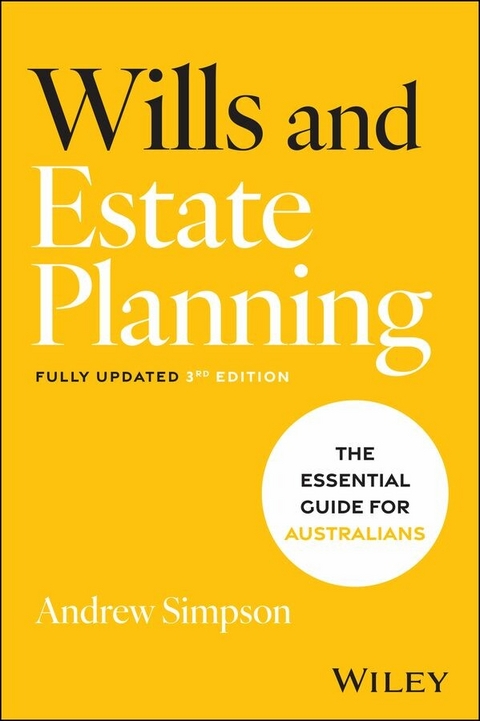
Wills and Estate Planning (eBook)
354 Seiten
Wiley (Verlag)
978-1-394-33771-2 (ISBN)
Have you prepared your legacy? Get peace of mind for you and your loved ones tomorrow by planning your estate today.
Wills and Estate Planning: The Essential Guide for Australians will help you make a plan to leave your wealth to your selected beneficiaries, protect your financial legacy and avoid family disagreements. This plain-English guide makes estate planning easy, providing exactly what you need to know to get started.
You have spent substantial amounts of time and energy building your life as it is now. But have you planned for how your wealth and assets will be distributed after your death? Many people prepare a will only when a life event brings the topic sharply into view-ike the death of a loved one or a personal health issue. But being proactive and planning your estate today can help you avoid significant time pressure and emotional stress.
Wills and estates expert Andrew Simpson shares his extensive knowledge in this clear, jargon-free guide. From planning your retirement to writing a will and distributing your assets, Wills and Estate Planning covers the fundamentals and answers your questions. Inside, you'll find informative case studies, practical examples and easy-to-read explanations.
Designed specifically for readers with little to no experience with wills and estate planning, this book will help you:
- Create a secure, legitimate estate plan: understand your assets, draft your will and protect it from legal challenges
- Navigate complex topics: use trusts to safeguard your assets, your superannuation and your financial legacy
- Avoid costly mistakes and minimise tax burdens for yourself and your family
- Know what to look for when choosing a professional estate planner
With the latest financial and tax guidelines, this is a must-have resource for anyone seeking to confidently pass on their wealth to future generations. Wills and Estate Planning is for anyone who wants a simple, stress-free way to sort their affairs and enjoy peace of mind.
Andrew Simpson is an experienced wills and estates lawyer with over 25 years' experience helping Australians plan and protect their wealth.
Have you prepared your legacy? Get peace of mind for you and your loved ones tomorrow by planning your estate today. Wills and Estate Planning: The Essential Guide for Australians will help you make a plan to leave your wealth to your selected beneficiaries, protect your financial legacy and avoid family disagreements. This plain-English guide makes estate planning easy, providing exactly what you need to know to get started. You have spent substantial amounts of time and energy building your life as it is now. But have you planned for how your wealth and assets will be distributed after your death? Many people prepare a will only when a life event brings the topic sharply into view ike the death of a loved one or a personal health issue. But being proactive and planning your estate today can help you avoid significant time pressure and emotional stress. Wills and estates expert Andrew Simpson shares his extensive knowledge in this clear, jargon-free guide. From planning your retirement to writing a will and distributing your assets, Wills and Estate Planning covers the fundamentals and answers your questions. Inside, you'll find informative case studies, practical examples and easy-to-read explanations. Designed specifically for readers with little to no experience with wills and estate planning, this book will help you: Create a secure, legitimate estate plan: understand your assets, draft your will and protect it from legal challenges Navigate complex topics: use trusts to safeguard your assets, your superannuation and your financial legacy Avoid costly mistakes and minimise tax burdens for yourself and your family Know what to look for when choosing a professional estate planner With the latest financial and tax guidelines, this is a must-have resource for anyone seeking to confidently pass on their wealth to future generations. Wills and Estate Planning is for anyone who wants a simple, stress-free way to sort their affairs and enjoy peace of mind.
Chapter 1
What is estate planning?
Many people despise wealth, but few know how to give it away.
Francois de La Rochefoucauld
While most of us would prefer not to think about it, we all face a number of inescapable truths:
- Whether we like it or not, all of us will die.
- The timing of our death is unknown.
- We can't take anything with us when we die!
We have a simple choice: do we plan for this inevitable event, or do we choose to ignore it and hope that everything will somehow work out?
Estate planning is the process of planning and recording your wishes for the distribution of your wealth after death. This definition appears straightforward. For this reason, it is often assumed that ‘estate planning’ refers only to the preparation of a will. In some cases, it is not this simple. There are aspects of estate planning that go beyond the will. For example, how are family trust assets to be dealt with? What happens to superannuation? How are jointly held assets treated?
In understanding estate planning, the term itself is helpful. It describes the two essential aspects:
- ‘Estate’ — indicates that the process is concerned with a period of time following your death. This aspect is guaranteed: we are all mortal.
- ‘Planning’ — refers to the need to organise your affairs during your lifetime. This aspect is not inevitable. It requires action.
Why is estate planning important?
Wealth creation and wealth preservation tend to be popular pastimes. Most of us aspire to financial security and do what we can to achieve it. The enormous growth in the financial-planning industry in the last 20 years confirms this. However, the distribution of wealth after death has not held the same fascination. This has changed in the last decade or so. The importance of planning the distribution and succession of wealth is now an essential part of personal and financial planning. There are a number of possible reasons for this:
- Overall wealth has increased. This is due partly to the significant increase in superannuation contributions since the introduction of the superannuation guarantee in 1992. It can also be explained by the real estate boom that has occurred in most states of Australia that has seen the median house price in the capital cities increase significantly.
- Australia's social fabric has changed enormously. The traditional family structure is now no longer the norm. Data from the Australian Bureau of Statistics in June 2016 predicted that the number of couple families without children is projected to become the most common family type in Australia between 2023 and 2029. Statistics have also confirmed that in recent decades trends in divorce and remarriage have contributed to changing numbers of one-parent, step and blended families. As a result, more deliberate planning is required to deal with such diversity.
- The use of alternative investment structures such as trusts, companies and self-managed superannuation funds has increased. The Australian Taxation Office estimates that as at 30 June 2022 there were more than 600 000 self-managed superannuation funds in existence in Australia (an increase of 8% since 2017–18) with more than 1.1 million members.
- Australia's population is ageing. Figures provided by the Australian Bureau of Statistics suggest that 15 per cent of the Australian population is currently aged 65 and over. By 2030 this percentage is predicted to be more than 20 per cent. The number of Australians aged 85 and over is expected to quadruple between 1999 and 2051. The life expectancy of Australians is also increasing. This changing demographic has brought with it novel estate-planning issues that tend to be age specific, such as the consequences of a reverse mortgage and the implications of a move into aged care.
These and other related topics are discussed in part VI.
Features of estate planning
Thorough estate planning has a number of characteristics, outlined as follows.
Estate planning must be tailored
As every person and every family is different, an estate plan needs to be tailored to your specific circumstances. Your estate plan will not be the same as your neighbours'. The view that one plan suits all is a dangerous one. A detailed review of your circumstances will identify unique estate-planning issues that will need to be addressed. Examples of these issues may include:
- family members who require special treatment because of a disability, addiction or other health concern
- antiques, family heirlooms or collectables that need to be dealt with specifically
- business interests
- family circumstances, such as a second marriage or children from different relationships
- potential challenges to your will
- the existence of a self-managed superannuation fund or other trust structure.
Estate planning needs to be flexible
Your estate plan needs to be flexible enough to deal with a change to your circumstances and to the circumstances of your beneficiaries. Wherever possible, you should avoid locking future generations into arrangements that may become restrictive and unworkable. Examples of such arrangements include the creation of life interests, and binding directions requiring the indefinite retention of estate assets.
Case study
Constance leaves a will that directs that her family home is not to be sold until all her children have died. Her intention is to ensure that her children have a home to return to should they find themselves in financial difficulty or experience a relationship breakdown. At her death, none of her children want the house retained and would prefer it to be sold and the proceeds divided. The prospect of maintaining the property for the rest of their lives is not one that appeals to any of them.
Estate planning must be understood by you
It is important that you understand your estate plan, and that it can be understood by others, including your executor and family members who survive you. If you do not understand it, there is a very good chance that others will also have difficulty. Unnecessary complexity and ambiguity may serve to defeat your intentions. Remember, when your will is administered, you will not be present to explain what you intended; your intentions must be clear from the terms of the will. For example, if your will contains a specific gift of personal items such as jewellery or artwork, the description of the relevant item needs to be precise. For a further discussion of personal chattels, see chapter 6.
Estate planning must be reviewed regularly
Your estate plan should be regularly reviewed. Estate planning is not a discipline that relies on the ‘set and forget’ principle. A five-yearly review at a minimum is recommended, however there may be circumstances that justify more regular reviews.
Following is a list of circumstances that would justify an estate-planning review and/or a meeting with your adviser to determine whether your estate plan requires amendment:
- marriage, separation or divorce
- entering into or ending a de-facto relationship
- having children (including adopted or foster children)
- the death of a proposed beneficiary
- other major events occurring in your family
- major events affecting your assets, including the disposal of an asset that is referred to in your will
- a change in the need to ensure a gift for spendthrift, intellectually disabled or bankrupt beneficiaries is protected under the will
- a proposed beneficiary qualifying for a means-tested social security pension
- a change to the extent to which your beneficiaries will benefit from other sources, such as jointly held assets, superannuation and life-insurance proceeds, and family trust distributions
- changes to the taxation laws
- the death, ageing or ill health of your proposed executor
- the establishment of a family trust or a new business venture
- the transfer of assets to a business or family trust
- the existence of trust income allocated to a beneficiary that has not been paid to or applied for the benefit of the beneficiary that may require adjustment. For a further explanation of this issue, see chapter 6
- the desire to implement a plan for business succession. Business succession agreements are discussed in chapter 18.
Estate planning is the result of collaboration between professional advisers
Where you have existing professional advisers, thorough estate planning relies on the collaboration and cooperation of all of these advisers. The process is illustrated in figure 1.1.
Figure 1.1: the relationship between clients and advisers
Each person shown in figure 1.1 has specific knowledge and skills that are drawn on during the estate-planning process. These are outlined as follows:
- The client understands his or her personal circumstances, beliefs, values and long-term goals and objectives.
- The financial planner has financial and investment expertise and understands the nature of the client's investment portfolio and risk profile.
- The...
| Erscheint lt. Verlag | 18.6.2025 |
|---|---|
| Sprache | englisch |
| Themenwelt | Sachbuch/Ratgeber ► Beruf / Finanzen / Recht / Wirtschaft ► Geld / Bank / Börse |
| Wirtschaft ► Betriebswirtschaft / Management | |
| Schlagworte | Australian estate law • Australian guide • Australian trusts • Australian wills • beneficiaries • create a will • Death and Taxes • do I need a will • End of Life • Estate Planning • estate planning answers • estate planning examples • estate planning guide • estate planning help • estate planning methods • executor • Family Trust • great wealth transfer • how to write a will • Noel Whittaker • personal finance • retirement planning • superannuation • will kit • write a will |
| ISBN-10 | 1-394-33771-X / 139433771X |
| ISBN-13 | 978-1-394-33771-2 / 9781394337712 |
| Informationen gemäß Produktsicherheitsverordnung (GPSR) | |
| Haben Sie eine Frage zum Produkt? |
 EPUB (Adobe DRM)
Kopierschutz: Adobe-DRM
Adobe-DRM ist ein Kopierschutz, der das eBook vor Mißbrauch schützen soll. Dabei wird das eBook bereits beim Download auf Ihre persönliche Adobe-ID autorisiert. Lesen können Sie das eBook dann nur auf den Geräten, welche ebenfalls auf Ihre Adobe-ID registriert sind.
Details zum Adobe-DRM
Dateiformat: EPUB (Electronic Publication)
EPUB ist ein offener Standard für eBooks und eignet sich besonders zur Darstellung von Belletristik und Sachbüchern. Der Fließtext wird dynamisch an die Display- und Schriftgröße angepasst. Auch für mobile Lesegeräte ist EPUB daher gut geeignet.
Systemvoraussetzungen:
PC/Mac: Mit einem PC oder Mac können Sie dieses eBook lesen. Sie benötigen eine
eReader: Dieses eBook kann mit (fast) allen eBook-Readern gelesen werden. Mit dem amazon-Kindle ist es aber nicht kompatibel.
Smartphone/Tablet: Egal ob Apple oder Android, dieses eBook können Sie lesen. Sie benötigen eine
Geräteliste und zusätzliche Hinweise
Buying eBooks from abroad
For tax law reasons we can sell eBooks just within Germany and Switzerland. Regrettably we cannot fulfill eBook-orders from other countries.
aus dem Bereich