


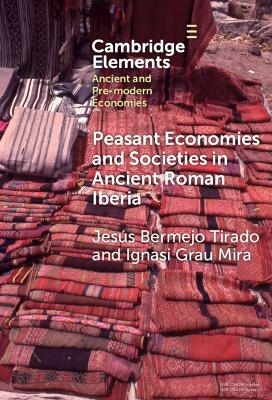
Peasant Economies and Societies in Ancient Roman Iberia
Seiten
2025
Cambridge University Press (Verlag)
978-1-009-61121-3 (ISBN)
Cambridge University Press (Verlag)
978-1-009-61121-3 (ISBN)
This Element revisits the historiographical and archaeological paradigms of Roman rural economies, with a focus on the peasant communities of Roman Iberia. The Element highlights the significance of dispersed settlements, small-scale farms, and sustainable agrarian strategies that defined the peasant landscape.
This Element revisits the historiographical and archaeological paradigms of Roman rural economies, with a particular focus on the peasant communities of Roman Iberia. Traditionally overshadowed by the dominance of the villa schiavistica model, which centers on large-scale slave-operated agricultural estates, recent interdisciplinary research has unveiled the complexity and persistence of peasant economies. By integrating data from archaeological surveys, rescue excavations, and textual analyses, this volume highlights the significance of dispersed settlements, small-scale farms, and sustainable agrarian strategies that defined the peasant landscape. Case studies from diverse sectors of the Iberian Peninsula demonstrate diverse modes of land use, such as intensive cultivation, crop rotation, and manuring, which contrast with the economic assumptions tied to elite-dominated production models. Furthermore, the author explores Roman peasants' socio-economic structures and adaptive strategies, emphasizing their pivotal role in shaping landscapes. This Element advocates for reexamining Roman peasantries as active and complex agents in ancient history.
This Element revisits the historiographical and archaeological paradigms of Roman rural economies, with a particular focus on the peasant communities of Roman Iberia. Traditionally overshadowed by the dominance of the villa schiavistica model, which centers on large-scale slave-operated agricultural estates, recent interdisciplinary research has unveiled the complexity and persistence of peasant economies. By integrating data from archaeological surveys, rescue excavations, and textual analyses, this volume highlights the significance of dispersed settlements, small-scale farms, and sustainable agrarian strategies that defined the peasant landscape. Case studies from diverse sectors of the Iberian Peninsula demonstrate diverse modes of land use, such as intensive cultivation, crop rotation, and manuring, which contrast with the economic assumptions tied to elite-dominated production models. Furthermore, the author explores Roman peasants' socio-economic structures and adaptive strategies, emphasizing their pivotal role in shaping landscapes. This Element advocates for reexamining Roman peasantries as active and complex agents in ancient history.
1. Introduction: defining roman peasant economics; 2. Roman peasant settlements and productive structures; 3. Roman peasant economy as seen through landscapes and agrarian systems; 4. Roman peasant networks and economic hubs; 5. Peasant economies and roman markets; 6. Conclusions and future directions; References.
| Erscheinungsdatum | 30.09.2025 |
|---|---|
| Reihe/Serie | Elements in Ancient and Pre-modern Economies |
| Zusatzinfo | Worked examples or Exercises |
| Verlagsort | Cambridge |
| Sprache | englisch |
| Maße | 152 x 229 mm |
| Gewicht | 276 g |
| Themenwelt | Geisteswissenschaften ► Archäologie |
| Geschichte ► Allgemeine Geschichte ► Vor- und Frühgeschichte | |
| Geschichte ► Teilgebiete der Geschichte ► Wirtschaftsgeschichte | |
| Wirtschaft ► Volkswirtschaftslehre ► Mikroökonomie | |
| ISBN-10 | 1-009-61121-6 / 1009611216 |
| ISBN-13 | 978-1-009-61121-3 / 9781009611213 |
| Zustand | Neuware |
| Informationen gemäß Produktsicherheitsverordnung (GPSR) | |
| Haben Sie eine Frage zum Produkt? |
Mehr entdecken
aus dem Bereich
aus dem Bereich
Konzepte – Methoden – Theorien
Buch | Softcover (2024)
UTB (Verlag)
CHF 55,85
auf den Spuren der frühen Zivilisationen
Buch | Hardcover (2023)
C.H.Beck (Verlag)
CHF 27,95


