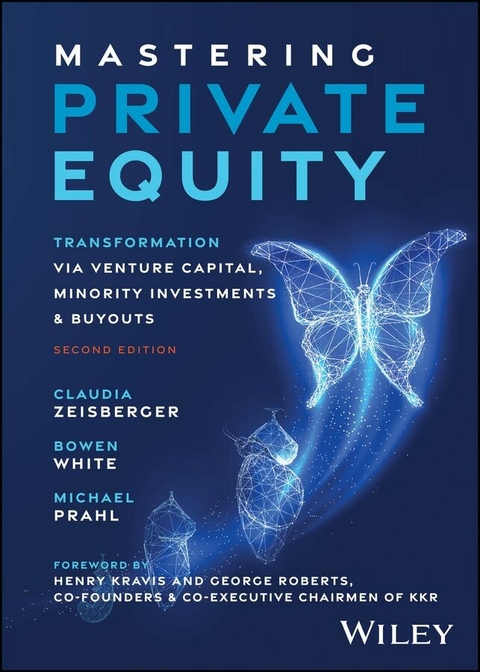
Mastering Private Equity (eBook)
717 Seiten
Wiley (Verlag)
978-1-394-31033-3 (ISBN)
**Mastering Private Equity - Second Edition: Navigating New Horizons in Private Markets**
Mastering Private Equity, the definitive guide to private equity (PE) since 2017, has been fully updated to reflect the current state of the industry, the latest market data, and the innovation reshaping the private capital industry.
Written for a professional audience, the Second Edition of Mastering Private Equity is a valuable and unique reference for investors, finance professionals, students, and business owners looking to engage with PE firms or invest in PE funds.
**What's New**
While preserving its core focus on education, the Second Edition highlights the latest industry developments, including:
- A more measured and resilient Venture Capital space, following steep repricing of risk in 2021 and 3x increase in downrounds in 22-23
- the rapid expansion of Private Debt, catalysed by a high-interest rate environment and the strategy's edge in a traditional fixed income portfolio
- Buy-and-Build Strategies, and PE investor's ability to create category leading businesses and grow platforms via acquisition
- PE Secondaries are de jour, as the market delivered liquidity in an inflationary and low exit environment
- the step-change in responsible and impact investing, from 'interesting' in 2017 to 'essential' in 2025
- the Democratization of Private Capital, introducing high-net-worth individuals to the asset class
Join the authors and two dozen senior industry contributors for a masterclass on the essentials of private equity and the trends driving the industry's sustained growth.
**50,000+ copies of the first edition sold****Mastering Private Equity Second Edition: Navigating New Horizons in Private Markets** Mastering Private Equity, the definitive guide to private equity (PE) since 2017, has been fully updated to reflect the current state of the industry, the latest market data, and the innovation reshaping the private capital industry. Written for a professional audience, the Second Edition of Mastering Private Equity is a valuable and unique reference for investors, finance professionals, students, and business owners looking to engage with PE firms or invest in PE funds. **What's New** While preserving its core focus on education, the Second Edition highlights the latest industry developments, including: A more measured and resilient Venture Capital space, following steep repricing of risk in 2021 and 3x increase in downrounds in 22-23 the rapid expansion of Private Debt, catalysed by a high-interest rate environment and the strategy s edge in a traditional fixed income portfolio Buy-and-Build Strategies, and PE investor s ability to create category leading businesses and grow platforms via acquisition PE Secondaries are de jour, as the market delivered liquidity in an inflationary and low exit environment the step-change in responsible and impact investing, from interesting in 2017 to essential in 2025 the Democratization of Private Capital, introducing high-net-worth individuals to the asset class Join the authors and two dozen senior industry contributors for a masterclass on the essentials of private equity and the trends driving the industry s sustained growth.
FOREWORD
By Henry Kravis and George Roberts, Co‐founders and Co‐Executive Chairmen of KKR
When we founded KKR in 1976, our ambitions were modest.
After leaving Bear Stearns that year, we and Jerry Kohlberg cobbled together US$120,000 and sublet a small office in Manhattan with grey wall‐to‐wall carpeting, used desks and a few pieces of inexpensive artwork. The private equity (PE) industry did not exist, but we thought we could build a successful enterprise by making a handful of what we then called “bootstrap acquisitions.”
Today, thousands of firms worldwide manage trillions of dollars across several asset classes that encompass what is now known as the private markets industry. It employs millions of people and often provides returns far exceeding traditional equity and debt investments. But the PE story is more than a tale of financial growth and performance. It is the story of an ever‐increasing number of people and institutions benefiting from the value created by private capital.
PE expanded from a niche business specializing in leveraged buyouts to an ecosystem of private capital covering many sectors and companies of all sizes and stages of growth. The beneficiaries include the businesses receiving capital and support to achieve their goals, the management teams running them, the employees working for them and investors spanning pension funds, endowments, insurance companies, sovereign wealth funds, family offices and individuals. Through pension funds, over 30 million teachers, firefighters, police officers and other public employees in the US alone count on private market investments to help support their retirements. At KKR, we always begin and end our firmwide meetings by discussing who we work for—the millions of retirees and organizations counting on our investments to secure their financial future.
But what exactly is PE?
PE investing involves acquiring companies and creating long‐term value by transforming good businesses into great ones. Once a company has reached its potential and a PE firm exits the investment, that value creation generates returns for investors who have committed their capital.
The first principle of PE has always been the alignment of interests, specifically between company management, the PE firm and the limited partners—like pension funds—who entrust firms with their capital.
When investing in a company, we ask ourselves: How can we improve it? What do we bring to this investment—besides capital—that will enable us to create value for the company, its employees, its customers and our investors?
Of course, the corporate landscape has evolved significantly since the advent of the private equity industry in the 1970s. The United States towered over other economies for decades after World War II and, by 1965, accounted for 38% of global economic output. By the time we founded KKR, a generation of American business managers had come of age when robust economic growth was taken for granted, and companies lacked meaningful global competition. Management often held little or no financial ownership of their companies. It lacked alignment with shareholders, resulting in less concern for increasing efficiencies and seizing opportunities to increase the value of the business.
That all ended with an oil shock and recession in the early 1970s, which revealed that many US companies needed to become leaner, more competitive and more productive. Corporate reform was in order, and long‐term PE capital was well‐positioned to facilitate it.
From our first deals, we instituted management ownership programs, an uncommon concept in the 1970s. Running a company as an owner, not just as a manager, dramatically changes things. We learned early on that people care much more about a company's performance when personally invested in its success.
Over the decades, we continued adding to our investor toolkit amid the globalization of business, talent and innovation. Our expansion into Europe in the late 1990s and Asia in the 2000s positioned us to invest in the best global opportunities while building the tools and local relationships to help our portfolio companies achieve their own international ambitions.
Since KKR's founding, we have also aimed to provide our companies with “patient capital”—meaning a longer‐term investment horizon—so our partners know we are invested in their long‐term success, not just an immediate return. One question we always like to ask the CEO of a public company is: “OK, this is your company today. But what will it be like five years from now?”
As our own business evolved, we both took a notable quote to heart. General Eric Shinseki, the former US Army Chief of Staff, once said, “If you dislike change, you're going to dislike irrelevance even more.” For KKR, this meant having a willingness to change, innovate and reinvent ourselves.
In the early 2000s, we realized we wanted to be able to say “yes” to more companies seeking a capital partner, regardless of the type of investment required. Many companies don't want to sell but still need capital. That led us to expand beyond traditional PE and enter the credit market in 2004.
This marked a significant evolution in our business. If a company wasn't interested in selling, we could now provide alternative capital solutions without needing to control the asset. This strategic flexibility increased our opportunities, much like a soccer team getting more shots on goal. Since then, our investment scope has broadened to include core PE, growth equity, infrastructure, real estate, insurance and capital markets.
Today, PE represents around a third of KKR's assets under management. This shift didn't happen overnight; it has taken nearly five decades of deliberate and strategic growth, a highly collaborative culture and creativity to respond to the needs of the businesses we invest in.
The growth of the private capital industry would not have been possible without the confidence of the limited partners who entrust their capital with us. We can both recall our elation in 1981 when the Oregon State Treasury Fund became the first public pension fund to invest with us. It was a breakthrough for KKR and a leap of faith for Oregon because pension funds at that time invested almost exclusively in public stocks and bonds. Now, on average, nearly nine in ten US public pension funds have a private equity allocation, accounting for 14% of their portfolio (according to the American Investment Council).
Although large institutions are still the primary investors in private market investments, our universe of investors is growing, especially as more individuals become responsible for their own retirement security. Financial advisors and accredited investors increasingly access investment vehicles focused on private credit, private equity, private real estate and infrastructure. This is another step in our industry's evolution toward serving a more diversified set of stakeholders.
So, too, is expanding ownership in PE investments beyond the management team.
We always knew that transforming a business required aligning with management, who were depended on to engage and motivate employees. But Pete Stavros, a KKR partner who previously ran our US team focusing on industrial investments, had an idea. He wondered: What if we deployed broad‐based ownership programs in which all employees could participate if the company performed well?
While many companies have equity programs, most require that you buy into them. Pete believed we could build stronger businesses by investing in the workforce and taking some of the equity and giving it to the employees (without cost to them or diminishing their compensation or benefits). This was part of cultivating an ownership culture where companies shared information and financial results with employees and gave people a more significant say in running the business. After trying with a few of our investments in the manufacturing space, it's now a norm for our control investments in the US.
These broad‐based ownership programs have dramatically increased growth, profitability and employee engagement, enhancing the performance of our portfolio companies and fueling some of KKR's most successful exits. The data suggest this approach is additive for everyone involved: workers, management and our limited partners. We call this shared success.
Consider the example of CHI Overhead Doors, a garage door manufacturer in rural Arthur, Illinois. When KKR purchased CHI in 2015, just 18 senior executives owned equity in the firm. We then supported the management team in creating an equity program, giving equity to all 800 employees—from factory workers to truck drivers—and launching a robust employee engagement initiative.
With all 800 employees thinking like owners, drivers started devising more fuel‐efficient routes. Floor workers developed faster, safer ways to move materials down the assembly line. The purchasing team discovered better ways to buy.
As worker engagement and enthusiasm rose, they helped create exceptional value at CHI. Between 2015 and 2022, profit margins increased by 67%, while workforce injury rates fell by almost 80%. By aligning the incentives of nearly everyone involved, KKR was able to sell CHI to the steel giant Nucor for ten times the equity value KKR had invested seven years earlier. The sale created a payout of US$360 million for workers, with the newest...
| Erscheint lt. Verlag | 16.6.2025 |
|---|---|
| Vorwort | Henry Kravis, George Roberts |
| Sprache | englisch |
| Themenwelt | Wirtschaft ► Betriebswirtschaft / Management |
| Schlagworte | Buyouts • Corporate Governance • deal pricing private equity • Deal structuring in private markets • Democratisation of private equity • Exits for PE & VC funds Growth Capital • lp portfolio management • Measuring fund performance in PE & VC • Operational Value Creation in PE • pe firms • Private Debt • Private Equity • private equity fund formation • private equity fundraising • private equity risk management • private equity secondaries • responsible investment and ESG in PE • Securing Management teams • target valuation • Transaction documentation in PE • vc firms • Venture Capital |
| ISBN-10 | 1-394-31033-1 / 1394310331 |
| ISBN-13 | 978-1-394-31033-3 / 9781394310333 |
| Informationen gemäß Produktsicherheitsverordnung (GPSR) | |
| Haben Sie eine Frage zum Produkt? |
 EPUB (Adobe DRM)
Kopierschutz: Adobe-DRM
Adobe-DRM ist ein Kopierschutz, der das eBook vor Mißbrauch schützen soll. Dabei wird das eBook bereits beim Download auf Ihre persönliche Adobe-ID autorisiert. Lesen können Sie das eBook dann nur auf den Geräten, welche ebenfalls auf Ihre Adobe-ID registriert sind.
Details zum Adobe-DRM
Dateiformat: EPUB (Electronic Publication)
EPUB ist ein offener Standard für eBooks und eignet sich besonders zur Darstellung von Belletristik und Sachbüchern. Der Fließtext wird dynamisch an die Display- und Schriftgröße angepasst. Auch für mobile Lesegeräte ist EPUB daher gut geeignet.
Systemvoraussetzungen:
PC/Mac: Mit einem PC oder Mac können Sie dieses eBook lesen. Sie benötigen eine
eReader: Dieses eBook kann mit (fast) allen eBook-Readern gelesen werden. Mit dem amazon-Kindle ist es aber nicht kompatibel.
Smartphone/Tablet: Egal ob Apple oder Android, dieses eBook können Sie lesen. Sie benötigen eine
Geräteliste und zusätzliche Hinweise
Buying eBooks from abroad
For tax law reasons we can sell eBooks just within Germany and Switzerland. Regrettably we cannot fulfill eBook-orders from other countries.
aus dem Bereich