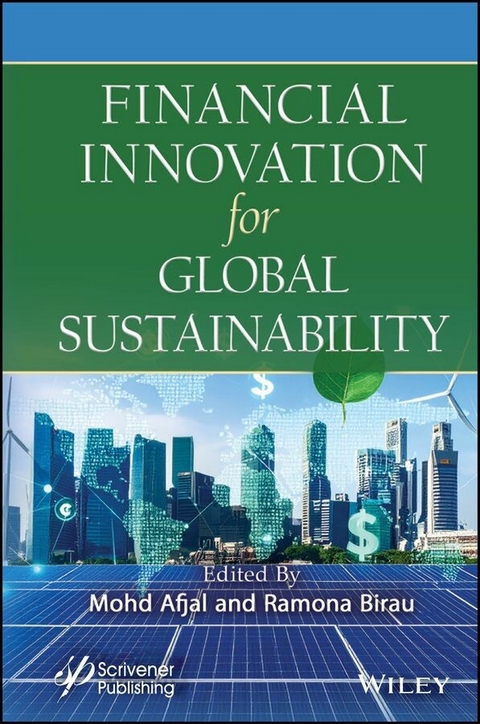
Financial Innovation for Global Sustainability (eBook)
886 Seiten
Wiley-Scrivener (Verlag)
978-1-394-31166-8 (ISBN)

Financial Innovation for Global Sustainability provides essential insight and practical strategies for navigating the evolving landscape of sustainable finance to demonstrate how FinTech can drive environmental sustainability and promote inclusive economic growth.
Financial Innovation for Global Sustainability centers on the integration of financial technology (FinTech) with sustainable development and inclusive economic growth. This volume delves into how FinTech can be leveraged to promote environmental sustainability, enhance financial inclusion, and support equitable economic development. The content will explore various aspects of sustainable finance, including green finance, digital financial services, and the role of innovation in driving sustainability within the financial sector. A multi-disciplinary approach draws insights from finance, economics, technology, and environmental studies and features empirical research, case studies, theoretical analyses, and policy discussions. This book will not only discuss current trends and innovations in sustainable FinTech but critically analyze challenges, regulatory hurdles, and ethical considerations.
In essence, the book will serve as a comprehensive resource on sustainable financial innovation, offering insights into how FinTech can be a catalyst for positive change in the global financial landscape. Sustainable FinTech sits at the intersection of financial innovation, environmental sustainability, and social equity, reflecting a broader shift in how industries and disciplines are evolving to address the complex challenges of the 21st century. Financial Innovation for Global Sustainability situates itself within this critical discourse, offering a comprehensive exploration of how FinTech can be harnessed to lead the charge towards a sustainable and inclusive future.
Mohd Afjal, PhD is an assistant professor in the Business School at the Vellore Institute of Technology with over six years of teaching experience. He has an impressive portfolio of publications with 21 scholarly papers in renowned journals, as well as two book chapters. He also serves as a reviewer for high-impact factor journals in finance and sustainability. His teaching interests encompass financial management, economic analysis, investment management, and financial modelling.
Ramona Birau, PhD is a lecturer for the Faculty of Education Science, Law, and Public Administration at Constantin Brancusi University with over ten years of experience. She has published over 100 research papers in journals and conferences and authored four books. In addition, she is the Editor in Chief of two international journals. Her research interests include financial markets, economics, cybernetics and statistics, quantitative finance, financial econometrics, management, behavioral psychology, economic sociology, and management.
Financial Innovation for Global Sustainability provides essential insight and practical strategies for navigating the evolving landscape of sustainable finance to demonstrate how FinTech can drive environmental sustainability and promote inclusive economic growth. Financial Innovation for Global Sustainability centers on the integration of financial technology (FinTech) with sustainable development and inclusive economic growth. This volume delves into how FinTech can be leveraged to promote environmental sustainability, enhance financial inclusion, and support equitable economic development. The content will explore various aspects of sustainable finance, including green finance, digital financial services, and the role of innovation in driving sustainability within the financial sector. A multi-disciplinary approach draws insights from finance, economics, technology, and environmental studies and features empirical research, case studies, theoretical analyses, and policy discussions. This book will not only discuss current trends and innovations in sustainable FinTech but critically analyze challenges, regulatory hurdles, and ethical considerations. In essence, the book will serve as a comprehensive resource on sustainable financial innovation, offering insights into how FinTech can be a catalyst for positive change in the global financial landscape. Sustainable FinTech sits at the intersection of financial innovation, environmental sustainability, and social equity, reflecting a broader shift in how industries and disciplines are evolving to address the complex challenges of the 21st century. Financial Innovation for Global Sustainability situates itself within this critical discourse, offering a comprehensive exploration of how FinTech can be harnessed to lead the charge towards a sustainable and inclusive future.
1
Connecting the Unconnected—Taking the Financial Services to the Last Mile Through Digital Infrastructure
C.P. Somasundaran1, Mohd. Danish Chishti2, Abdullah Bin Junaid3* and Rakesh Guglani4
1Faculty of Management Science, SRM University, U.P., India
2Faculty of Management Science, Shri Ram Murti Smarak, College of Engineering and Technology, Bareilly, U.P., India
3Department of Management, Institute of Management Technology Dubai, Dubai, Unites Arab Emirates
4Faculty of Management, Asia-Pacific Institute of Management, New Delhi, India
Abstract
Purpose: When the majority of the population remains unconnected with financial services, no economy can attain the goal of sustainable inclusive growth. No success is meaningful unless felt by last ones in a culturally and socially committed humanity. This study examines the country’s financial inclusion efforts undertaken by banking and other Indian financial establishments.
Methodology: This study covers secondary data and case studies to portray the realities of economic inequalities and sociocultural asymmetries across regions. The paper discusses the country’s financial services and banking scenario, followed by the progress, prospects, and challenges in implementing financial inclusion. An attempt has been initiated to examine the impact of financial inclusion and scope of financial services supplied to the population.
Findings: Committees and working groups advocated the widespread adoption of microfinance institutions and an innovative agency banking system as rural banking replacement. Data suggest that cooperatives increasingly support weaker, neglected categories of marginal farmers.
Practical Implications: Despite the progress made in the credit delivery mechanism, preponderance of rural inhabitants still lacks access to formal finance. The glaring agrarian crisis resulting from an increase in farmer suicides and structural constraints in the non-agricultural informal segments, despite their capacity to generate employment opportunities, has led to a severe deficit in the fund flow to these segments.
Keywords: Financial services, sociocultural asymmetries, policy interventions, digitalization, Fintech industry
1.1 Introduction
The stress caused by mounting and spiraling bad loans and advances in the Indian banking structure is of enormous concern for the policymakers, the Government of India, and the Reserve Bank of India as it is undermining the growth of the Indian financial system and impairing the economy as a whole. The Securities Exchange Board of India has projected the Mutual Funds industry to grow by at least two and a half times over the next 5 years. Nevertheless, it is ironic that inclusive growth, or financial inclusion for that matter, remains neglected. The so-called social schemes formulated for the welfare of previously marginally tribal, hilly, and rural regions, socially disadvantaged groups, and women have remained mere policies as a large proportion of them still lacks access to basic amenities of the financial services in India. Many accolades are being promoted through various means of advertising by political circles concerning programs, like the Agriculture and Rural Debt Relief Scheme, 2008, direct benefits transfer, one-time settlement and caste-based banking, and other financial services, especially when the General Elections are approaching, with no party leaving any stone unturned to attract the vote bank. Against this backdrop, it is meaningful to review the course of providing financial services to the last mile to comprehend the robustness of our financial system vividly. Furthermore, it is also important to review the risk management practices to understand the lessons learned by our policymakers and other stakeholders from the mistakes of developed nations, especially the United States of America. As a result, an attempt has been made in this research paper to examine the impact of financial inclusion and the scope of financial services supplied to the most crucial part of the population.
Hence, the objectives framed are as follows:
- To review the financial inclusion process and also to suggest some policy interventions in this regard,
- To analyze the pitfalls and hurdles in extending the fruits of economic growth to the neglected ones, and
- To suggest the best practices for effectively monitoring social welfare schemes with particular reference to financial services.
1.2 Literature Review
The first phase (1950–1967) of our post-independence planning, known for banking consolidation and strengthening of banking regulation, originated by building and nurturing the financial institutions to mobilize household savings and deploy them into production-based activities. Till the mid-1960s, the task of catering to the credit needs of rural India remained with the cooperative credit structures, which were mainly regulated by the respective State Cooperative Societies Acts but needed more professionalization in assessing credit needs and appraisal of the agricultural projects (see Table 1.1). Also, these structures lacked the technology required to maintain accuracy and pace with the system. With technological innovations in Indian agriculture and the onset of the Green Revolution, it was felt that the prevalent cooperative structures would not be able to meet the credit needs of the agricultural sector [1]. The next phase (1967–1990) thus assumed a more pivotal thrust regarding a supply-leading method to the formal credit architecture. As a result, 14 scheduled commercial banks and six other banks were nationalized in 1969 and 1980, respectively. The connected public policies on banking and financial sector progress are based on the robust supposition that there is a need to promote financial intermediation by developing institutions, expanding their geographic coverage, mobilizing savings, and promoting better regional, sectorial, and functional coverage in addition to small-borrower access to formal credit in India. In between, the Regional Rural Banks Act of 1975 was promulgated to develop banking, with a rural feel, at lower transaction costs to cater to the agricultural and rural credit needs of the preponderance of the hitherto neglected populace (see Table 1.1).
Furthermore, the RBI priority sector rules included making it essential for nationalized commercial banks to give 40% of their deposits to the priority sector, with 18% dedicated solely to agricultural purposes. All of these activities contributed to the spread of the banking network across the country’s regions. Rural credit expansion and scope superseded village moneylenders substantially resulting in small gains in aggregate crop yield, rapid increases in fertilizer usage, and investments in physical capital such as pump sets, animal stocks, and tractors.
Table 1.1 Phase/period, key actions/policies, results/outcomes, remarks.
Source: Authors’ own analysis.
| Phase/period | Key actions/policies | Results/outcomes | Remarks |
|---|
| 1950–1967 | Strengthening banking regulation and consolidation | Financial institutions mobilized household savings for production-based activities | Cooperative credit structures struggled with technology and professionalism |
| 1967–1990 | Nationalization of banks (14 in 1969, 6 in 1980) | Expansion of banking network, rural credit improved | Regional Rural Banks Act of 1975 established; priority sector lending rules set |
| 1977–1990 | Nationalized banks required to allocate 40% of deposits to priority sectors (18% to agriculture) | Increased regional and sectorial coverage, expansion in rural credit | Significant reduction in village moneylenders’ influence; improvements in crop yield and asset investments |
| December 1972 to June 1983 | State cooperative banks added 2.12 crore new borrowers’ accounts | 93.1% of new accounts had a credit limit of Rs.0.10 lakh or less | High proportion of small-borrower accounts and credit limits under Rs.0.25 lakh |
| December 1982 to March 1992 | 3.60 crore accounts with credit limits up to Rs.0.25 lakh | 94.5% of total accounts were small borrowers | Post-liberalization, growth in accounts with higher credit limits |
| March 1992 to March 2001 | Increase in borrowers’ accounts with credit limits above Rs.0.25 lakh | Rise in large-borrower accounts; reduced growth in small-borrower accounts | Decline in small-borrower accounts; rural branches decreased significantly |
| March 1995 to March 2006 | Number of rural branches fell from 33,017 to 30,572 | Decrease in rural branch numbers; severe institutional crisis in rural credit | Regional Rural Banks’ branches decreased by 2,445 |
| March 2004 | 3.80 lakh employees in rural and semi-urban zones | Government opportunity to create additional jobs for rural branches | Additional costs for Regional Rural Banks adversely affected viability |
| Post-2004 | Committees established to address credit... |
| Erscheint lt. Verlag | 17.6.2025 |
|---|---|
| Sprache | englisch |
| Themenwelt | Wirtschaft ► Betriebswirtschaft / Management ► Finanzierung |
| Schlagworte | AI in Sustainable Finance • Blockchain for Sustainability • Digital Finance and Inclusion • Environmental Sustainability in Finance • Ethical FinTech • Financial Inclusion and Tech • Financial technology and sustainability • FinTech and SDGs • FinTech for Social Impact • FinTech Policy and Regulation • Future of Sustainable Finance • Green finance • Green Investment and Tech • Sustainable Development in Finance • Sustainable FinTech |
| ISBN-10 | 1-394-31166-4 / 1394311664 |
| ISBN-13 | 978-1-394-31166-8 / 9781394311668 |
| Informationen gemäß Produktsicherheitsverordnung (GPSR) | |
| Haben Sie eine Frage zum Produkt? |
 EPUB (Adobe DRM)
Kopierschutz: Adobe-DRM
Adobe-DRM ist ein Kopierschutz, der das eBook vor Mißbrauch schützen soll. Dabei wird das eBook bereits beim Download auf Ihre persönliche Adobe-ID autorisiert. Lesen können Sie das eBook dann nur auf den Geräten, welche ebenfalls auf Ihre Adobe-ID registriert sind.
Details zum Adobe-DRM
Dateiformat: EPUB (Electronic Publication)
EPUB ist ein offener Standard für eBooks und eignet sich besonders zur Darstellung von Belletristik und Sachbüchern. Der Fließtext wird dynamisch an die Display- und Schriftgröße angepasst. Auch für mobile Lesegeräte ist EPUB daher gut geeignet.
Systemvoraussetzungen:
PC/Mac: Mit einem PC oder Mac können Sie dieses eBook lesen. Sie benötigen eine
eReader: Dieses eBook kann mit (fast) allen eBook-Readern gelesen werden. Mit dem amazon-Kindle ist es aber nicht kompatibel.
Smartphone/Tablet: Egal ob Apple oder Android, dieses eBook können Sie lesen. Sie benötigen eine
Geräteliste und zusätzliche Hinweise
Buying eBooks from abroad
For tax law reasons we can sell eBooks just within Germany and Switzerland. Regrettably we cannot fulfill eBook-orders from other countries.
aus dem Bereich