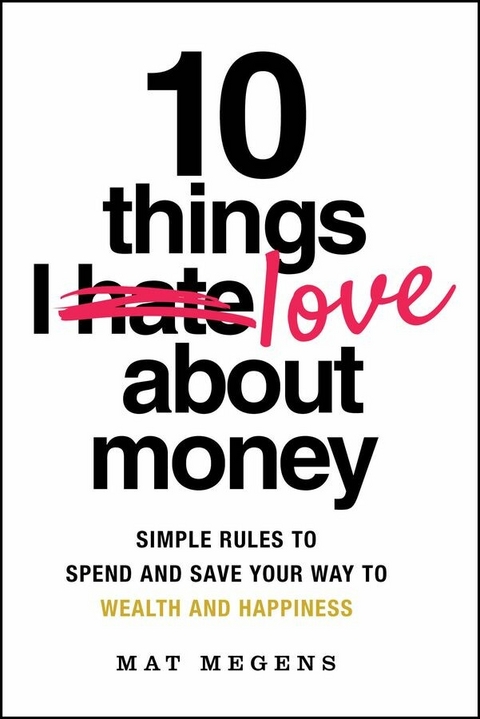
10 Things I Love About Money (eBook)
323 Seiten
Wiley (Verlag)
978-1-394-29976-8 (ISBN)
An accessible playbook for a brighter financial future
In 10 Things I Love About Money: Simple Rules to Spend your Way to Wealth, author Mathew Megens, founder of the money management app HyperJar, delivers an easy-to-follow roadmap to financial independence, security, and freedom that anyone can use. The book is packed with insightful tips you can action immediately, from simple strategies for mindful spending to automating your good habits. You'll also learn about how to get - and stay - out of debt, and how to save money over the long term by taking advantage of discounts, loyalty programmes, and debt refinancing.
Inside the book:
- Advice for understanding how to accumulate wealth based on your personality type
- 10 Rules for Financial Mastery, including how to start with a spending audit and the power of tiny daily habits
- Simple strategies to start investing today without getting ripped off
- Learn how to make saving money as much fun as spending money
The perfect roadmap to financial wellness for students andworking people of any age, 10 Things I Love About Money is the no-nonsense, jargon-free guide to money, spending, debt, and wealth that you've been waiting for.
Mat Megens is the founder and Chief Consumer Architect of HyperJar, an award-winning consumer app designed to help you spend better. He is a former electrical engineer and investment banker, with over 15 years' experience in the financial services sector.
An accessible playbook for a brighter financial future In 10 Things I Love About Money: Simple Rules to Spend your Way to Wealth, author Mathew Megens, founder of the money management app HyperJar, delivers an easy-to-follow roadmap to financial independence, security, and freedom that anyone can use. The book is packed with insightful tips you can action immediately, from simple strategies for mindful spending to automating your good habits. You'll also learn about how to get and stay out of debt, and how to save money over the long term by taking advantage of discounts, loyalty programmes, and debt refinancing. Inside the book: Advice for understanding how to accumulate wealth based on your personality type 10 Rules for Financial Mastery, including how to start with a spending audit and the power of tiny daily habits Simple strategies to start investing today without getting ripped off Learn how to make saving money as much fun as spending money The perfect roadmap to financial wellness for students andworking people of any age, 10 Things I Love About Money is the no-nonsense, jargon-free guide to money, spending, debt, and wealth that you've been waiting for.
INTRODUCTION
This book does not contain a magic formula for wealth. I'm sorry.1
What it does contain is a very simple set of rules and principles for how to understand and manage the messy reality of money. This book builds a foundation of habits that will make everyone, even wealthy people, happier with their lives.
On first glance, it seems very obvious why having money, or the lack of it, is important. We use money to buy things that we need, or in order to buy things that we want. But dig a little bit deeper and it becomes clear that there is much more to it than that:
- How financially successful we perceive ourselves to be can often be a major driver of self-esteem, either directly, or in terms of how we think others view us and our place in the world.
- How much money we have squirrelled away for the future to cover retirement or unexpected problems, has a major impact on how we feel about life today.2
- Feeling uncomfortable with understanding the complexity of finance and money can be overwhelming and stressful – and it can be a continuous form of low-level torture that never goes away.
- Worrying about other people, family and loved ones, and if they will have enough now and in the future, can extend your levels of stress from personal to your social networks, creating a multiplier effect.
- Being in debt, for many people a semi-permanent state, can be one of the most stressful aspects of modern life.
- There are plenty of people, with plenty of money, who still have plenty of issues and anxieties surrounding their finances.
To put it simply, money worries can have a massive impact on mental health, no matter who you are, or what your actual financial situation is. Some (not remotely fun) facts about the United Kingdom for context:
- 39% of UK adults don't feel confident managing their money.3
- 34% of UK adults reported feeling anxious about their financial situation in the past month and 10% feel hopeless about their financial situation.4
- 46% of people in problem debt also have mental health problems.5
So, the statistics on mental health problems and money are pretty stark. I can't imagine that this is much of a surprise to anyone reading this, but the magnitude of the problem is quite something isn't it? I'm not a betting person6 but if I was, I would gamble a few quid on pretty much any person, even those who wouldn't ever consider themselves having any mental health issues, having a low-level constant stream of anxiety relating to their money.7
What is it about money that seems to always bring with it big dollops of stress? I think I may finally know the answer to this question in so far as it relates to myself, and hopefully this book is here to try and see if these rules can help you.
I'm going to pause for a second and draw an analogy with physical health and fitness here.8 There are thousands of books on health, diet, fitness and how to live to 100.9 There are endless fads and experts, the next new thing in terms of working out or dieting and entire TV channels dedicated to selling you fancy new gadgets, but, when it all comes down to it, they can all be boiled down to about four principles which will get you 90% of the way there:
- Eat decent food, and eat fewer calories than you burn.
- Get some exercise – some walking, some stretching and some weights will do.
- Get enough sleep and try not to be too stressed.
- Don't do incredibly stupid things which will kill you, like smoking (at all) or drinking (way too much).
That's it. I've just saved you hundreds of hours of time and thousands of hours of worry. Just do the four things above and don't delay.10
On first blush, finance seems even more complex and overwhelming. Not only are there just as many crazy books, fads and people with advice, there are also big scary banks, lots of technical jargon combined with numbers and maths which can make the difficulty of getting to grips with money almost impossible.
Well, the good news is that it's not. Understanding how to get financially fit is even simpler than getting physically fit and really boils down to one single overarching principle:
Learn to spend well.
There is only so much you can do about, and think about, how much you earn. Get or change your job. Educate yourself over many years. Marry a footballer. Win the lottery. Find out that dear departed Uncle Bob was actually a millionaire and left you some money in his will. Don't get me wrong, finding ways to get money is really important, but there are only so many ways that you can actively change your income.
What you can do, every day, is spend what money you have better, or indeed don't spend it at all. Understanding what your financial resources are (for good or bad) but more importantly making sure you deploy them effectively and in equilibrium is the secret to reaching a state of financial zen. What you'll also learn is how much of a difference doing this well will make to your finances and your mental well-being.
So how do you learn to spend well? I've set out 10 rules for how do this across two sections: ‘What’ and ‘How’:
- What comprises five rules around what we need to be aware of. This is our foundation.
- How are five concrete rules to help us tackle the What.11
- To give you a sense of where we are going, I'm going to summarise the 10 rules here.12
WHAT
- Rule 1 – Focus on your daily spend. Ignore the noise.
When it comes down to it, it's actually very simple: focus on your spending. Everything you earn you are ultimately going to spend somewhere. If you read the financial pages or look at most stuff online there is a huge amount of stuff on savings and investments which is really complex, you can ignore almost all of this. Why don't people talk about spending well? Because no-one, apart from you, makes any money from it.13
- Rule 2 – Understand yourself.
We are all different, and the reasons why we spend what we do are all different. Work out what kind of spender you are, try and change, or learn how to manage your particular challenges.
- Rule 3 – Understand others.
Almost no-one wants you to spend well, everyone wants you to spend your money: your family, your friends and social circle, banks, lenders, shops, social media, the government. By understanding the ‘enemy’ you can learn how to come to terms with all of the forces which consciously or unconsciously conspire to make you spend poorly.
- Rule 4 – Small things matter.
Even small amounts of good spending behaviour can add up to very big changes in financial outcomes. The most basic daily improvements in spending can change your life.
- Rule 5 – Master debt. Don't let it master you.
There are different kinds of debt, both good and bad14 – work out which is which and do everything in your power to avoid or repay the bad kind.
HOW
- Rule 6 – Audit your spending history.
Work out exactly what you spend, where and why. Work out what your stable equilibrium spending level is so you can stick to it in a way that is permanent, sustainable and eliminates mental clutter. This is the first and most important step. Even if you stop here good things will happen.
- Rule 7 – Build healthy spending habits that work for you.
Given who you are, and what you spend, what are the habits that you can adopt which work for you?
- Rule 8 – How to shop.
Spend less by finding deals. It's not as hard as you think, and it's fun.
- Rule 9 – Make mastering money fun.
Being in control of your money isn't a chore, it's fun. Remember that, as well as the pleasure of being in control, everything you don't spend now can be spent on something else in the future.
- Build a positive connection with money. This is less about how wealthy you are, and more about how aware you are and how good you feel about yourself on a daily basis. That's a function of small habits and self-awareness.
- Rule 10 – Begin investing daily.
Investing isn't complex, it's easy. It's also easy to do it regularly (in small amounts if required). When you have sorted out your spending, try and put a little bit of money aside for the future. You will feel great about it.
- Bonus Rule 11 – Help your children (or young people in your life) become money maestros.
For a lot of people, anxiety about money is not just personal, it's a family thing. Spend some time getting your children financially fit and healthy, and you will feel less stressed about it yourself.15
That's it. The book sets each of these rules out in their own lovely chapters.
This book won't reveal any secrets of the universe, but if you follow its advice, most of which will seem like common sense, I hope it can change your life for the better. I have tried to make the rules simple in order to encourage you to start attempting to spend life well as soon as possible. Why is this so important now?
It...
| Erscheint lt. Verlag | 16.6.2025 |
|---|---|
| Sprache | englisch |
| Themenwelt | Sachbuch/Ratgeber ► Beruf / Finanzen / Recht / Wirtschaft ► Geld / Bank / Börse |
| Wirtschaft ► Betriebswirtschaft / Management | |
| Schlagworte | debt management guide • Debt repayment strategies • easy investing • investing for beginners • money management book • personal finance book • personal finance guide • personal finance management • retirement investing • retirement planning • visual budgeting |
| ISBN-10 | 1-394-29976-1 / 1394299761 |
| ISBN-13 | 978-1-394-29976-8 / 9781394299768 |
| Informationen gemäß Produktsicherheitsverordnung (GPSR) | |
| Haben Sie eine Frage zum Produkt? |
 EPUB (Adobe DRM)
Kopierschutz: Adobe-DRM
Adobe-DRM ist ein Kopierschutz, der das eBook vor Mißbrauch schützen soll. Dabei wird das eBook bereits beim Download auf Ihre persönliche Adobe-ID autorisiert. Lesen können Sie das eBook dann nur auf den Geräten, welche ebenfalls auf Ihre Adobe-ID registriert sind.
Details zum Adobe-DRM
Dateiformat: EPUB (Electronic Publication)
EPUB ist ein offener Standard für eBooks und eignet sich besonders zur Darstellung von Belletristik und Sachbüchern. Der Fließtext wird dynamisch an die Display- und Schriftgröße angepasst. Auch für mobile Lesegeräte ist EPUB daher gut geeignet.
Systemvoraussetzungen:
PC/Mac: Mit einem PC oder Mac können Sie dieses eBook lesen. Sie benötigen eine
eReader: Dieses eBook kann mit (fast) allen eBook-Readern gelesen werden. Mit dem amazon-Kindle ist es aber nicht kompatibel.
Smartphone/Tablet: Egal ob Apple oder Android, dieses eBook können Sie lesen. Sie benötigen eine
Geräteliste und zusätzliche Hinweise
Buying eBooks from abroad
For tax law reasons we can sell eBooks just within Germany and Switzerland. Regrettably we cannot fulfill eBook-orders from other countries.
aus dem Bereich