


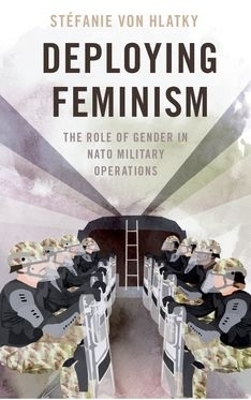
Deploying Feminism
The Role of Gender in NATO Military Operations
Seiten
2026
Oxford University Press Inc (Verlag)
978-0-19-783449-7 (ISBN)
Oxford University Press Inc (Verlag)
978-0-19-783449-7 (ISBN)
A detailed account, based on fieldwork and interviews, of how Women, Peace and Security norms are militarized and put at the service of operational effectiveness.
International organizations and governments want to increase women's participation in military operations and peacebuilding. Gender equality is increasingly seen as the antidote to conflict, a key factor in achieving stability. While feminist activism inspired the emergence of these norms on gender and conflict, they were institutionalized through the Women, Peace and Security (WPS) agenda, with the military at the forefront of those changes.
In Deploying Feminism, Stéfanie von Hlatky tells the story of how the military has been delegated authority to advance gender equality as part of their activities, while simultaneously tackling increasingly complex threats. Drawing upon fieldwork and interviews, she illustrates how NATO, the world's foremost alliance, has even embedded these ideas in the planning and execution of its missions. For troops deployed on NATO missions, this often means seeking out women in their operating area to improve intelligence gathering activities. While this helps the mission, does it help women and conflict-affected communities? Because of the military's focus on operational effectiveness above all else, von Hlatky argues that there is a distortion of WPS norms, as gender equality concerns fade into the background.
Looking at NATO's ongoing operations in Iraq, Kosovo, and the Baltics, Deploying Feminism details the process by which Women, Peace and Security norms are militarized and put at the service of operational effectiveness. Further, it shows why an adjustment is necessary for gender equality to become a true planning priority.
International organizations and governments want to increase women's participation in military operations and peacebuilding. Gender equality is increasingly seen as the antidote to conflict, a key factor in achieving stability. While feminist activism inspired the emergence of these norms on gender and conflict, they were institutionalized through the Women, Peace and Security (WPS) agenda, with the military at the forefront of those changes.
In Deploying Feminism, Stéfanie von Hlatky tells the story of how the military has been delegated authority to advance gender equality as part of their activities, while simultaneously tackling increasingly complex threats. Drawing upon fieldwork and interviews, she illustrates how NATO, the world's foremost alliance, has even embedded these ideas in the planning and execution of its missions. For troops deployed on NATO missions, this often means seeking out women in their operating area to improve intelligence gathering activities. While this helps the mission, does it help women and conflict-affected communities? Because of the military's focus on operational effectiveness above all else, von Hlatky argues that there is a distortion of WPS norms, as gender equality concerns fade into the background.
Looking at NATO's ongoing operations in Iraq, Kosovo, and the Baltics, Deploying Feminism details the process by which Women, Peace and Security norms are militarized and put at the service of operational effectiveness. Further, it shows why an adjustment is necessary for gender equality to become a true planning priority.
Stéfanie von Hlatky is the Canada Research Chair in Gender, Security and the Armed Forces and Full Professor of Political Studies at Queen's University. She is a leading expert on NATO and military affairs, the founder of Women in International Security-Canada, and the Honorary Colonel of the Princess of Wales' Own Regiment. Dr. von Hlatky is the author of American Allies in Times of War: The Great Asymmetry (Oxford, 2013).
Preface
Acronyms
Tables and Figures
Chapter 1: Introduction
Chapter 2: Gender Wars and Gender in War
Chapter 3: Deploying Feminism in NATO Operations
Chapter 4: Securing the Environment in Kosovo
Chapter 5: Deterring in the Baltics
Chapter 6: Advising and Assisting in Iraq
Chapter 7: Conclusion
Appendix
Bibliography
Index
| Erscheinungsdatum | 17.10.2025 |
|---|---|
| Reihe/Serie | Bridging the Gap |
| Zusatzinfo | 3 b/w line drawings; 4 tables |
| Verlagsort | New York |
| Sprache | englisch |
| Maße | 157 x 226 mm |
| Gewicht | 318 g |
| Themenwelt | Sozialwissenschaften ► Politik / Verwaltung ► Europäische / Internationale Politik |
| Sozialwissenschaften ► Politik / Verwaltung ► Politische Theorie | |
| Sozialwissenschaften ► Politik / Verwaltung ► Staat / Verwaltung | |
| Sozialwissenschaften ► Soziologie ► Gender Studies | |
| Wirtschaft ► Betriebswirtschaft / Management ► Unternehmensführung / Management | |
| ISBN-10 | 0-19-783449-3 / 0197834493 |
| ISBN-13 | 978-0-19-783449-7 / 9780197834497 |
| Zustand | Neuware |
| Informationen gemäß Produktsicherheitsverordnung (GPSR) | |
| Haben Sie eine Frage zum Produkt? |
Mehr entdecken
aus dem Bereich



aus dem Bereich
Amerikas Strategie der Vorherrschaft und der Kampf um Eurasien
Buch | Softcover (2024)
NOMEN Verlag
CHF 27,95
kurze Geschichte einer langen Beziehung
Buch | Hardcover (2025)
Suhrkamp (Verlag)
CHF 36,40
erfolgreiche Interessenvertretung durch Prozesskompetenz im komplexen …
Buch | Hardcover (2023)
Wiley-VCH (Verlag)
CHF 58,75


